



 Chat with AI
Exam 9: Nuclear Chemistry

Exam 1: Matter, Energy, and Measurement143 Questions
Exam 2: Atoms134 Questions
Exam 3: Chemical Bonds142 Questions
Exam 4: Chemical Reactions138 Questions
Exam 5: Gases, Liquids, and Solids104 Questions
Exam 6: Solutions and Colloids157 Questions
Exam 7: Reaction Rates and Chemical Equilibrium104 Questions
Exam 8: Acids and Bases198 Questions
Exam 9: Nuclear Chemistry152 Questions
Exam 10: Organic Chemistry71 Questions
Exam 11: Alkanes142 Questions
Exam 12: Alkenes, Alkynes, and Aromatic Compounds184 Questions
Exam 13: Alcohols, Ethers, and Thiols118 Questions
Exam 14: Chirality: the Handedness of Molecules92 Questions
Exam 15: Amines89 Questions
Exam 16: Aldehydes and Ketones102 Questions
Exam 17: Carboxylic Acids115 Questions
Exam 18: Carboxylic Anhydrides, Esters, and Amides117 Questions
Exam 19: Carbohydrates103 Questions
Exam 20: Lipids132 Questions
Exam 21: Proteins128 Questions
Exam 22: Enzymes62 Questions
Exam 23: Chemical Communications: Neurotransmitters and Hormones89 Questions
Exam 24: Nucleotides, Nucleic Acids, and Heredity121 Questions
Exam 25: Gene Expression and Protein Synthesis129 Questions
Exam 26: Bioenergetics: How the Body Converts Food to Energy133 Questions
Exam 27: Specific Catabolic Pathways: Carbohydrate, Lipid, and Protein Metabolism104 Questions
Exam 28: Biosynthetic Pathways67 Questions
Exam 29: Nutrition73 Questions
Exam 30: Immunochemistry132 Questions
Exam 31: Body Fluids72 Questions
Select questions type


Which of the following affects the half-life of a radioactive sample?
(Multiple Choice)
4.8/5  (79)
(79) Strontium-90 is a dangerous isotope because strontium is chemically similar to calcium and is easily incorporated into bones. Sr-90 has a half-life of 28.1 years. If a person ingests 100 mg of Sr-90, identify the amount that is left in the person's body after 56.2 years.
(Multiple Choice)
4.8/5 (70)
(70) When alpha, beta, and gamma radiations interact with matter, _____ are knocked out, forming positively charged ions.
(Multiple Choice)
4.8/5 (88)
(88) Identify the element formed when  decays by electron capture.
 (Multiple Choice)
4.8/5 (67)
(67) Which of the following particles is emitted during alpha decay?
(Multiple Choice)
4.7/5 (77)
(77) Which of the following forms of radiation consists of negatively charged particles?
(Multiple Choice)
4.8/5 (81)
(81)  .
A radioactive isotope in a 9.0-mL vial has an intensity of 300 mCi. How much of the liquid should be injected into a patient to deliver a dose of 50 mCi?
(Multiple Choice)
4.9/5 (86)
(86) Examine the following graph for a particular isotope. 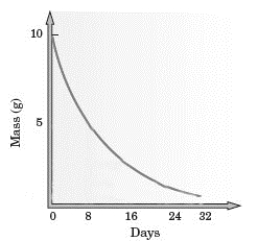 A change in which of the following conditions would change the shape of this curve?
 (Multiple Choice)
4.7/5 (88)
(88) Which of the following conversion factors relates the rem to the sievert?
(Multiple Choice)
5.0/5 (73)
(73) Which of the following Greek letters is used to represent frequency?
(Multiple Choice)
4.9/5 (81)
(81) Which of the following radioisotopes, an α emitter used in the treatment of prostate cancer, is delivered using a monoclonal antibody?
(Multiple Choice)
4.8/5 (73)
(73) Which of the following processes is observed when uranium-235 is bombarded with a neutron?
(Multiple Choice)
4.9/5 (75)
(75) Which of the following radioisotopes is used in PET scans?
(Multiple Choice)
4.8/5 (80)
(80) A single whole-body exposure to what dose of radiation will almost invariably lead to a person's death in a relatively short time?
(Multiple Choice)
4.7/5 (80)
(80) Which of the following elements is not likely to be produced by nuclear fission?
(Multiple Choice)
4.8/5 (85)
(85) Examine the following figure. 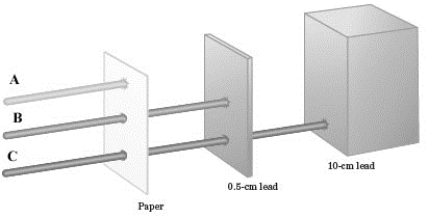 Which line represents an alpha particle?
 (Multiple Choice)
4.8/5 (79)
(79) 
Filters
- Essay(0)
- Multiple Choice(0)
- Short Answer(0)
- True False(0)
- Matching(0)