



 Chat with AI
Exam 14: Tax Consequences of Home Ownership

Exam 1: An Introduction to Tax113 Questions
Exam 2: Tax Compliance, the IRS, and Tax Authorities112 Questions
Exam 3: Tax Planning Strategies and Related Limitations115 Questions
Exam 4: Individual Income Tax Overview, Dependents, and Filing Status125 Questions
Exam 5: Gross Income and Exclusions130 Questions
Exam 6: Individual Deductions98 Questions
Exam 7: Investments74 Questions
Exam 8: Individual Income Tax Computation and Tax Credits156 Questions
Exam 9: Business Income, Deductions, and Accounting Methods99 Questions
Exam 10: Property Acquisition and Cost Recovery109 Questions
Exam 11: Property Dispositions110 Questions
Exam 12: Compensation101 Questions
Exam 13: Retirement Savings and Deferred Compensation115 Questions
Exam 14: Tax Consequences of Home Ownership119 Questions
Select questions type


Renting a residence may have nontax advantages over owning a home.
(True/False)
4.9/5  (81)
(81) Amelia is looking to refinance her home loan of $200,000. She has the option of (1) paying no discount points on the loan and paying interest at 7 percent or (2) paying two discount points on the loan and paying interest of 6 percent on the loan. Both options require Amelia to make interest-only payments for the first five years of the loan and pay back the loan over the 25 years after that (it is a 30-year loan). Amelia itemizes deductions irrespective of any interest expense she may pay. Amelia's marginal ordinary income tax rate is 32 percent. What is Amelia's break-even point in years (for simplicity, ignore time value of money concerns)?
(Essay)
4.8/5 (88)
(88) Which of the following statements regarding the exclusion of gain on the sale of a principal residence is correct?
(Multiple Choice)
4.9/5 (78)
(78) Larry owned and lived in a home for five years before marrying Darlene. Larry and Darlene lived in the home for one year before selling it at a $600,000 gain. Larry was the sole owner of the residence until it was sold. How much of the gain may Larry and Darlene exclude?
(Multiple Choice)
4.8/5 (81)
(81) Nelson Whiting (single) purchased a home in Denver, Colorado for $300,000. He moved into the home on July 1 of year 1. He lived in the home as his primary residence until December 1, year 2 when he sold the home for $450,000. Nelson sold the home because he needed to move because he was changing jobs and his new job was located several hundred miles away. What amount of gain must Nelson recognize on the home sale in year 2?
(Essay)
4.8/5 (82)
(82) Which of the following statements regarding limitations on the deductibility of home office expenses of self-employed taxpayers is correct?
(Multiple Choice)
4.8/5 (73)
(73) Joshua and Mary Sullivan purchased a new home on October 1 of year 1 for $400,000. At the time of the purchase, it was estimated that the real property tax rate for the year would be 1 percent of the property's value. Because the taxing jurisdiction collects taxes on a July 1 year-end, it was estimated that the Sullivans would be required to pay $3,000 in property taxes for the property tax year relating to October through June of year 2 ($400,000 × 1% × 9/12). The seller would be required to pay the $1,000 for July through September of year 1. Along with their monthly payment of principal and interest, the Sullivans paid $333 a month to the mortgage company to cover the property taxes. The mortgage company placed the money in escrow and used the escrow funds to pay the $3,000 property tax bill in July of year 2. The Sullivans' itemized deductions exceed the standard deduction before considering property taxes. What amount are the Sullivans allowed to deduct for property taxes relating to the property in year 1 (ending July 1, year 1) and year 2 (ending July 1, year 2)?
(Essay)
4.8/5 (83)
(83) Taxpayers with high AGI are not allowed to deduct home mortgage interest expense.
(True/False)
4.9/5 (82)
(82) Joshua and Mary Sullivan purchased a new home on October 1 of year 1 for $400,000. At the time of the purchase, it was estimated that the real property tax rate for the year would be 1 percent of the property's value. Because the taxing jurisdiction collects taxes on a July 1 year-end, it was estimated that the Sullivans would be required to pay $3,000 in property taxes for the property tax year relating to October through June of year 2 ($400,000 × 1% × 9/12). The seller would be required to pay the $1,000 for July through September of year 1. Along with their monthly payment of principal and interest, the Sullivans paid $333 a month to the mortgage company to cover the property taxes. The mortgage company placed the money in escrow and used the escrow funds to pay the $3,000 property tax bill in July of year 2. The Sullivans' itemized deductions exceed the standard deduction before considering property taxes. What amount are the Sullivans allowed to deduct for property taxes relating to the property in year 1 (ending July 1, year 1) and year 2 (ending July 1, year 2)?
(Not Answered)
This question doesn't have any answer yet
Rayleen owns a condominium near Orlando, Florida. This year, she incurs the following expenses in connection with her condo:
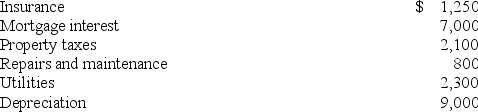 During the year, Rayleen rented the condo for 130 days and she received $25,000 of rental receipts. She did not use the condo at all for personal purposes during the year. Rayleen is considered to be an active participant in the property. Rayleen's AGI from all sources other than the rental property is $130,000. Rayleen does not have passive income from any other sources. What is Rayleen's AGI?
 (Not Answered)
This question doesn't have any answer yet
Which of the following statements regarding the tax deductibility of points related to a home mortgage is correct?
(Multiple Choice)
4.9/5 (81)
(81) When determining the number of days a taxpayer has rented out a home during the year, any day when the home is available for rent but not actually rented out counts as a day of personal use.
(True/False)
4.8/5 (77)
(77) Leticia purchased a home on July 1, 2017 for $200,000. She paid $180,000 down and financed the remaining $20,000. On January 1, 2019 when the outstanding balance of her mortgage was $15,000 and her home was valued at $300,000, Leticia refinanced her home for $200,000. With the $200,000 loan, she paid off the remaining $15,000 balance of her original mortgage, she used $35,000 to substantially improve her home and she used the remaining $150,000 for purposes unrelated to her home. During 2021, Leticia made interest-only payments of $15,000 on the loan. What amount of the $15,000 interest expense is Leticia allowed to deduct in year 2021?
(Essay)
4.9/5 (75)
(75) A taxpayer can qualify for the home sale exclusion even if she has moved out of the home and is renting the home to another at the time of the sale.
(True/False)
4.7/5 (69)
(69) Jorge owns a home that he rents for 360 days and uses for personal purposes for five days. Jorge is not required to allocate expenses associated with the home between rental and personal use.
(True/False)
4.9/5 (67)
(67) Several years ago, Chara acquired a home that she vacationed in part of the time and she rented part of the time. During the current year Chara:
-Personally stayed in the home for 14 days,
-Rented it at full fair market value to her parents for eight days,
-Rented it to her sister for five days at half price,
-Rented it to her friend at a discounted rate for three days,
-Rented it to another friend at fair market value for six days,
-Rented the home to third parties for 42 days at the market rate,
-Did repair and maintenance work for three days to keep the home ready for renters, and
-Marketed the property and made it available for rent for 120 days during the year even though it was not rented during this time.
How many days of personal use and how many days of rental use did Chara experience on the property during the year?
(Essay)
5.0/5 (82)
(82) Patrick purchased a home on January 1, year 2018 for $600,000 by making a down payment of $100,000 and financing the remaining $500,000 with a 30-year loan, secured by the residence, at 6 percent. During 2018, Patrick made interest-only payments on the loan of $30,000. On July 1, 2018, when his home was worth $600,000 Patrick borrowed an additional $75,000 secured by the home at an interest rate of 8 percent. During 2018, he made interest-only payments on this loan in the amount of $3,000. What amount of the $33,000 interest expense Patrick paid during 2018 may he deduct as an itemized deduction if he used the $75,000 from the July 1 loan to purchase a car?
(Multiple Choice)
4.9/5 (79)
(79) Which of the following statements regarding the break-even point for paying discount points in order to get a lower interest rate on the loan is correct?
(Multiple Choice)
4.9/5 (84)
(84) Lebron Taylor purchased a home on July 1, 2018 for $500,000. Lebron paid for the entire purchase price with cash. On January 1, 2019, Lebron needed additional cash for purposes unrelated to his home so he took out a loan secured by the residence for $150,000. During 2019, he made interest only payments of $4,500 on the loan. What amount of the $4,500 interest expense can Lebron deduct in 2019?
(Essay)
4.9/5 (88)
(88) Heidi (single) purchased a home on January 1, 2008 for $400,000. She lived in the home as her primary residence until January 1, 2016 when she began using the home as a vacation home. She used the home as a vacation home until January 1, 2017 (she used a different home as her primary residence from January 1, 2016 to January 1, 2017). On January 1, 2017, Heidi moved back into the home and used it as her primary residence until January 1, 2018 when she sold the home for $700,000. What amount of the $300,000 gain Heidi realized on the sale must she recognize for tax purposes in 2018?
(Essay)
4.9/5 (80)
(80) 
Filters
- Essay(0)
- Multiple Choice(0)
- Short Answer(0)
- True False(0)
- Matching(0)