



 Chat with AI
Exam 14: Tax Consequences of Home Ownership

Exam 1: An Introduction to Tax113 Questions
Exam 2: Tax Compliance, the IRS, and Tax Authorities112 Questions
Exam 3: Tax Planning Strategies and Related Limitations115 Questions
Exam 4: Individual Income Tax Overview, Dependents, and Filing Status125 Questions
Exam 5: Gross Income and Exclusions130 Questions
Exam 6: Individual Deductions98 Questions
Exam 7: Investments74 Questions
Exam 8: Individual Income Tax Computation and Tax Credits156 Questions
Exam 9: Business Income, Deductions, and Accounting Methods99 Questions
Exam 10: Property Acquisition and Cost Recovery109 Questions
Exam 11: Property Dispositions110 Questions
Exam 12: Compensation101 Questions
Exam 13: Retirement Savings and Deferred Compensation115 Questions
Exam 14: Tax Consequences of Home Ownership119 Questions
Select questions type


Which of the following statements regarding home-related transactions is correct?
(Multiple Choice)
4.9/5  (86)
(86) Ashton owns a condominium near San Diego, California. This year, he incurs the following expenses in connection with his condo:
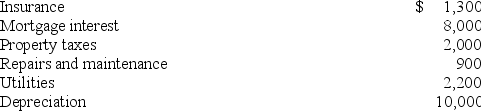 During the year, Ashton rented the condo for 120 days and he received $24,000 of rental receipts. He did not use the condo at all for personal purposes during the year. Ashton is considered to be an active participant in the property. Ashton's AGI from all sources other than the rental property is $120,000. Ashton does not have passive income from any other sources. What is Ashton's AGI?
 (Essay)
4.7/5 (97)
(97) Harvey rents his second home. During the year, Harvey reported a net loss of $35,000 from the rental. If Harvey is an active participant in the rental and his AGI is $80,000, how much of the loss can he deduct against ordinary income for the year?
(Multiple Choice)
4.8/5 (79)
(79) Harriet owns a second home that she rents to others. During the year, she used the second home for 10 personal days and for 200 rental days. Which of the following statements regarding the manner in which she should account for her income and/or expenses associated with the home is False?
(Multiple Choice)
4.8/5 (80)
(80) Dawn (single) purchased her home on July 1, 2008. On July 1, 2017 Dawn moved out of the home. She rented out the home until July 1, 2018 when she sold the home and realized a $230,000 gain (assume none of the gain was attributable to depreciation). What amount of the gain is Dawn allowed to exclude from her 2018 gross income?
(Multiple Choice)
4.8/5 (81)
(81) Darren (single) purchased a home on January 1, 2014 for $400,000. Darren lived in the home as his primary residence until January 1, 2016 when he began using the home as a vacation home. He used the home as a vacation home until January 1 2017 (he used a different home as his primary residence from January 1, 2016 to January 1, 2017). On January 1, 2017, Darren moved back into the home and used it as his primary residence until January 1, 2018 when he sold the home for $500,000. What amount of the $100,000 gain Darren realized on the sale must he recognize for tax purposes in 2018?
(Essay)
4.9/5 (66)
(66) Katy owns a second home. During the year, she used the home for 20 personal use days and 50 rental days. Katy allocates expenses associated with the home between rental use and personal use. Katy did not incur any expenses to obtain tenants. Which of the following statements is correct regarding the tax treatment of Katy's income and expenses from the home?
(Multiple Choice)
4.8/5 (76)
(76) Jasper is looking to purchase a new home for $250,000. He is paying $50,000 as a down payment on the home and financing the remaining $200,000 with a loan secured by the home. He has the option of (1) paying no discount points on the loan and paying interest at 6.5 percent or (2) paying one discount point on the loan and paying interest of 5.5 percent on the loan. Both options require Jasper to make interest-only payments for the first five years of the loan and to pay the loan principal over the 25 years after that (it is a 30-year loan). Jasper itemizes deductions irrespective of any interest expense he may pay. Jasper's marginal ordinary income tax rate is 32 percent. What is Jasper's break-even point in years (for simplicity, ignore time value of money concerns)?
(Essay)
4.9/5 (72)
(72) Don owns a condominium near Orlando, California. This year, he incurs the following expenses in connection with his condo:
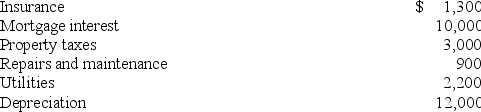 During the year, Don rented the condo for 70 days and he received $17,400 of rental receipts. He did not use the condo at all for personal purposes during the year. Don is considered to be an active participant in the property. Don's AGI from all sources other than the rental property is $140,000. Don does not have passive income from any other sources. What is Don's AGI?
 (Essay)
4.7/5 (78)
(78) Andrew Whiting (single) purchased a home in Boise, Idaho for $300,000. He moved into the home on July 1 of year 1. He lived in the home as his primary residence until November 1, year 2 when he sold the home for $470,000. Andrew sold the home because he was changing jobs and his new job was in a different state. What amount of gain must Andrew recognize on the home sale in year 2?
(Essay)
4.9/5 (96)
(96) The longer a taxpayer plans on living in a home without refinancing the taxpayer's mortgage on the home, the more likely it is that paying points to receive a reduced interest rate on the loan makes economic sense.
(True/False)
4.8/5 (62)
(62) Which of the following statements regarding the home mortgage interest expense deduction is False for a single taxpayer?
(Multiple Choice)
5.0/5 (77)
(77) Patricia purchased a home on January 1, 2017 for $1,200,000 by making a down payment of $100,000 and financing the remaining $1,100,000 with a 30-year loan, secured by the residence, at 6 percent. During year 2017 and 2018, Patricia made interest-only payments on the loan of $66,000. What amount of the $66,000 interest expense Patricia paid during 2018 may she deduct as an itemized deduction? (Assume not married filing separately.)
(Multiple Choice)
4.7/5 (77)
(77) A taxpayer who rents out a home for at least one day and does not use a home for personal purposes for at least 15 days during the year is ineligible to deduct any home mortgage interest expense on a loan secured by the home.
(True/False)
4.8/5 (70)
(70) Kenneth lived in his home for the entire year except for when he rented his home (near a very nice ski resort) to a married couple for 14 days in December. The couple paid Kenneth $14,000 in rent for the two weeks. Kenneth incurred $1,000 in direct expenses relating to the home for the 14 days. Which of the following statements accurately describes the manner in which Kenneth should report his rental receipts and expenses for tax purposes?
(Multiple Choice)
5.0/5 (73)
(73) Amanda purchased a home for $1,000,000 in 2016. She paid $200,000 cash and borrowed the remaining $800,000. This is Amanda's only residence. Assume that in year 2021 when the home had appreciated to $1,500,000 and the remaining mortgage was $600,000, interest rates declined and Amanda refinanced her home. She borrowed $1,000,000 at the time of the refinancing, paid off the first mortgage, and used the remainder for purposes unrelated to the home. What is her total amount of her amount of acquisition indebtedness for purposes of determining the deduction for home mortgage interest? (Assume not married filing separately.)
(Multiple Choice)
4.7/5 (96)
(96) Kristen rented out her home for 10 days during the year for $5,000. She used the home for personal purposes for the other 355 days. She allocated the following home expenses to the rental use of the home:
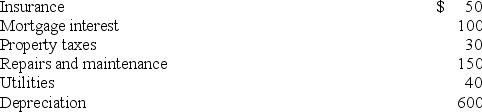 Kristen's AGI is $120,000 before considering the effect of the rental activity. What is Kristen's AGI after considering the tax effect of the rental use of her home?
 (Not Answered)
This question doesn't have any answer yet
Which of the following statements regarding a taxpayer's principal residence is True for purposes of determining whether the taxpayer is eligible to exclude gain realized on the sale of the residence?
(Multiple Choice)
4.8/5 (73)
(73) Taxpayers with home offices who use the actual expense method for computing home office expenses must allocate indirect expenses of the home between personal use and home office use. Only expenses allocated to the home office use are deductible.
(True/False)
4.7/5 (85)
(85) Jessica purchased a home on January 1, 2018 for $500,000 by making a down payment of $200,000 and financing the remaining $300,000 with a 30-year loan, secured by the residence, at 6 percent. During 2018 and 2019, Jessica made interest-only payments on this loan of $18,000 (each year). On July 1, 2018, when her home was worth $500,000 Jessica borrowed an additional $125,000 secured by the home at an interest rate of 8 percent. During 2018, she made interest-only payments on the second loan in the amount of $5,000. During 2019, she made interest only on the second loan in the amount of $10,000. What is the maximum amount of the $28,000 interest expense Jessica paid during 2019 may she deduct as an itemized deduction if she used the proceeds of the second loan to finish the basement in her home and landscape her yard? (Assume not married filing separately.)
(Multiple Choice)
4.9/5 (84)
(84) 
Filters
- Essay(0)
- Multiple Choice(0)
- Short Answer(0)
- True False(0)
- Matching(0)