



 Chat with AI
Exam 14: Tax Consequences of Home Ownership

Exam 1: An Introduction to Tax113 Questions
Exam 2: Tax Compliance, the IRS, and Tax Authorities112 Questions
Exam 3: Tax Planning Strategies and Related Limitations115 Questions
Exam 4: Individual Income Tax Overview, Dependents, and Filing Status125 Questions
Exam 5: Gross Income and Exclusions130 Questions
Exam 6: Individual Deductions98 Questions
Exam 7: Investments74 Questions
Exam 8: Individual Income Tax Computation and Tax Credits156 Questions
Exam 9: Business Income, Deductions, and Accounting Methods99 Questions
Exam 10: Property Acquisition and Cost Recovery109 Questions
Exam 11: Property Dispositions110 Questions
Exam 12: Compensation101 Questions
Exam 13: Retirement Savings and Deferred Compensation115 Questions
Exam 14: Tax Consequences of Home Ownership119 Questions
Select questions type


When a taxpayer rents a residence for part of the year, the residence is not eligible as a qualified residence for the home mortgage interest expense deduction unless the taxpayer's:

Free
(Multiple Choice)
4.9/5  (82)
(82) Correct Answer: Verified
D
A taxpayer may be required to include in gross income gain the taxpayer realizes when she sells her principal residence.
Free
(True/False)
4.8/5 (74)
(74) Correct Answer:Verified
VerifiedTrue
Taxpayers who use a vacation home for both personal and rental use generally must allocate expenses associated with the home to the personal use and to the rental use.
Free
(True/False)
4.9/5 (85)
(85) Correct Answer:Verified
VerifiedTrue
Which of the following statements regarding the home office expense deduction is correct?
(Multiple Choice)
4.9/5 (79)
(79) In order to be eligible to exclude gain on the sale of a principal residence, the taxpayer must meet which of the following test(s)?
(Multiple Choice)
4.9/5 (98)
(98) Which of the following statements regarding deductions for real property taxes is incorrect?
(Multiple Choice)
4.9/5 (77)
(77) Ashton owns a condominium near San Diego, California. This year, he incurs the following expenses in connection with his condo:
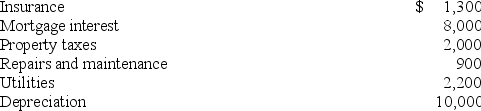 During the year, Ashton rented the condo for 120 days and he received $24,000 of rental receipts. He did not use the condo at all for personal purposes during the year. Ashton is considered to be an active participant in the property. Ashton's AGI from all sources other than the rental property is $120,000. Ashton does not have passive income from any other sources. What is Ashton's AGI?
 (Not Answered)
This question doesn't have any answer yet
Which of the following statements regarding personal and/or rental use of a home is False?
(Multiple Choice)
4.9/5 (82)
(82) Jason and Alicia Johnston purchased a home in Austin, Texas for $500,000. They moved into the home on September 1, year 0. They lived in the home as their primary residence until July 1 of year 5 when they sold the home for $800,000. What amount of the $300,000 gain are they allowed to exclude? (Assume not married filing separately.)
(Not Answered)
This question doesn't have any answer yet
Careen owns a condominium near Newport Beach in California. This year, she incurs the following expenses in connection with her condo:
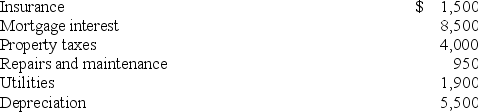 During the year, Careen rented the condo for 90 days, receiving $20,000 of gross income. She personally used the condo for 50 days. Assuming Careen uses the IRS method of allocating expenses to rental use of the property. What is Careen's net rental income for the year?
 (Essay)
4.8/5 (81)
(81) On April 1, year 1, Mary borrowed $200,000 to refinance the original mortgage on her principal residence. Mary paid 3 points to reduce her interest rate from 6 percent to 5 percent. The loan is for a 30-year period. How much can Mary deduct in year 1 for her points paid?
(Multiple Choice)
4.9/5 (84)
(84) Tyson owns a condominium near Laguna Beach, California. This year, he incurs the following expenses in connection with his condo:
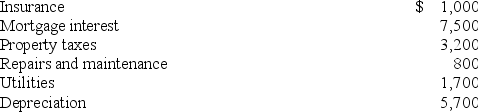 During the year, Tyson rented the condo for 100 days, receiving $25,000 of gross income. He personally used the condo for 60 days. Assuming Tyson uses the Tax Court method of allocating expenses to rental use of the property. What is Tyson's net rental income for the year (assume this is not a leap year)?
 (Essay)
4.8/5 (84)
(84) To be allowed to exclude gain on the sale of a principal residence, the taxpayer selling the home must be using the home as a principal residence at the time of the sale.
(True/False)
4.8/5 (73)
(73) Jennifer owns a home that she rents for 364 days and uses for personal purposes for one day. Jennifer is required to allocate expenses associated with the home between rental and personal use.
(True/False)
4.9/5 (63)
(63) What is the maximum amount of gain on the sale of principal residence a married couple may exclude from gross income?
(Multiple Choice)
4.7/5 (73)
(73) The tax law places a fixed dollar limit on the amount of home mortgage interest a taxpayer may deduct in a particular year.
(True/False)
4.8/5 (82)
(82) Under the tax law, a taxpayer's itemized deduction for home mortgage interest in any one particular year is limited to $10,000.
(True/False)
5.0/5 (85)
(85) On February 1, 2018 Stephen (who is single) sold his principal residence (home 1) at a $100,000 gain. He was able to exclude the entire gain on his 2018 tax return. Stephen purchased and moved into home 2 on the same day. Assuming Stephen lives in home 2 as his principal residence until he sells it, which of the following statements is True?
(Multiple Choice)
4.9/5 (82)
(82) A taxpayer is not allowed to deduct home mortgage interest on debt unless the debt was incurred to acquire or construct the home.
(True/False)
4.9/5 (79)
(79) In year 1, Abby purchased a new home for $200,000 by making a down payment of $150,000 and financing the remaining $50,000 with a loan, secured by the residence, at 6 percent. As of January 1, year 4 the outstanding balance on the loan was $40,000. On January 1, year 4, when her home was worth $300,000, Abby refinanced the home by taking out a $120,000 mortgage at 5 percent. With the loan proceeds, she paid off the $40,000 balance of the existing mortgage and used the remaining $80,000 for purposes unrelated to the home. During year 4, she made interest-only payments on the new loan of $6,000. What amount of the $6,000 interest expense on the new loan can Abby deduct in year 4 on the new mortgage as home related interest expense?
(Multiple Choice)
4.9/5 (81)
(81) 
Filters
- Essay(0)
- Multiple Choice(0)
- Short Answer(0)
- True False(0)
- Matching(0)