



 Chat with AI
Exam 13: Gravitation

Exam 2: Motion Along a Straight Line55 Questions
Exam 3: Motion in Two or Three Dimensions59 Questions
Exam 4: Newtons Laws of Motion50 Questions
Exam 5: Applying Newtons Laws139 Questions
Exam 6: Work and Kinetic Energy109 Questions
Exam 7: Potential Energy and Energy Conservation50 Questions
Exam 8: Momentum, Impulse, and Collisions99 Questions
Exam 9: Rotation of Rigid Bodies26 Questions
Exam 10: Dynamics of Rotational Motion49 Questions
Exam 11: Equilibrium and Elasticity50 Questions
Exam 12: Fluid Mechanics54 Questions
Exam 13: Gravitation52 Questions
Exam 14: Periodic Motion109 Questions
Exam 15: Mechanical Waves50 Questions
Exam 16: Sound and Hearing121 Questions
Exam 17: Temperature and Heat60 Questions
Exam 18: Thermal Properties of Matter41 Questions
Exam 19: The First Law of Thermodynamics55 Questions
Exam 20: The Second Law of Thermodynamics52 Questions
Exam 21: Electric Charge and Electric Field54 Questions
Exam 22: Gausss Law54 Questions
Exam 23: Electric Potential88 Questions
Exam 24: Capacitance and Dielectrics70 Questions
Exam 25: Current, Resistance, and Electromotive Force44 Questions
Exam 26: Direct-Current Circuits51 Questions
Exam 27: Magnetic Field and Magnetic Forces105 Questions
Exam 28: Sources of Magnetic Field82 Questions
Exam 29: Electromagnetic Induction51 Questions
Exam 30: Inductance88 Questions
Exam 31: Alternating Current51 Questions
Exam 32: Electromagnetic Waves Optics53 Questions
Exam 33: The Nature and Propagation of Light31 Questions
Exam 34: Geometric Optics89 Questions
Exam 35: Interference59 Questions
Select questions type


First law of thermodynamics: An ideal gas is allowed to expand slowly at constant temperature to twice its original volume. During the expansion, the gas absorbs 200 kJ of heat.
(a) What is the change in the internal (thermal) energy of the gas during the expansion?
(b) How much work does the gas do during the expansion?
(Essay)
4.8/5  (76)
(76) Molar heat capacities: 3.0 moles of an ideal gas with a molar heat capacity at constant volume of 4.9 cal/(mol∙K) and a molar heat capacity at constant pressure of 6.9 cal/(mol ∙ K) starts at 300 K and is heated at constant pressure to 320 K, then cooled at constant volume to its original temperature. How much heat flows into the gas during this two-step process?
(Multiple Choice)
4.8/5 (84)
(84) First law of thermodynamics: A container of ideal gas has a movable frictionless piston. This container is placed in a very large water bath and slowly compressed so that the temperature of the gas remains constant and equal to the temperature of the water. Which of the following statements about this gas are true for this process? (There may be more than one correct choice.)
(Multiple Choice)
4.9/5 (70)
(70) Molar heat capacities: An adiabatic compression is performed on an ideal gas. The final pressure is equal to 0.560 times the initial pressure and the final volume equals 1.50 times the initial volume. What is the adiabatic constant for the gas?
(Multiple Choice)
4.9/5 (76)
(76) Type of thermodynamic processes: The figure shows a pV diagram for 0.95 mol of gas that undergoes the process 1 → 2. The gas then undergoes an isochoric heating from point 2 until the pressure is restored to the value it had at point 1. What is the final temperature of the gas? The ideal gas constant is R = 8.314 J/mol ∙ K = 0.0821 L ∙ atm/mol ∙ K. 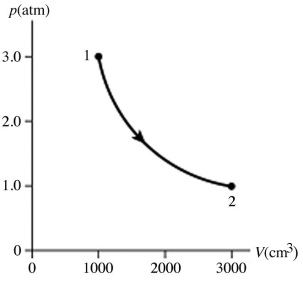
(Multiple Choice)
4.8/5 (93)
(93) Molar heat capacities: An expansion process on an ideal diatomic gas has a linear path between the initial and final states on a pV diagram. The initial pressure is  the initial volume is
 and the initial temperature is
 The ideal gas constant is R = 8.314 J/mol ∙ K. The final pressure is
 and the final temperature is
 The work done by the gas is closest to
the initial volume is and the initial temperature is The ideal gas constant is R = 8.314 J/mol ∙ K. The final pressure is and the final temperature is The work done by the gas is closest to (Multiple Choice)
5.0/5 (88)
(88) First law of thermodynamics: A cylinder contains 23 moles of an ideal gas at a temperature of 300 K. The gas is compressed at constant pressure until the final volume equals 0.43 times the initial volume. The molar heat capacity at constant volume of the gas is 24.0 J/mol · K and the ideal gas constant is R = 8.314 J/mol ∙ K. The heat absorbed by the gas is closest to
(Multiple Choice)
4.9/5 (79)
(79) First law of thermodynamics: During an isothermal process, 5.0 J of heat is removed from an ideal gas. What is the change in internal (thermal) energy of the gas?
(Multiple Choice)
4.8/5 (83)
(83) First law of thermodynamics: In an isochoric process, the internal (thermal) energy of an ideal gas decreases by 50 J. How much heat is exchanged with the gas during this process?
(Multiple Choice)
4.7/5 (90)
(90) First law of thermodynamics: A cylinder contains 1.2 moles of ideal gas, initially at a temperature of 116°C. The cylinder is provided with a frictionless piston, which maintains a constant pressure of  on the gas. The gas is cooled until its temperature has decreased to
 For the gas
 and the ideal gas constant
 (a) Find the work done by (or on) the gas during this process. Is the work done by or on the gas?
(b) What is the change in the internal (thermal) energy of the gas during this process?
(c) How much heat is transferred to (or from) the gas during this process? Does this heat flow into or out of the gas?
on the gas. The gas is cooled until its temperature has decreased to For the gas and the ideal gas constant (a) Find the work done by (or on) the gas during this process. Is the work done by or on the gas?
(b) What is the change in the internal (thermal) energy of the gas during this process?
(c) How much heat is transferred to (or from) the gas during this process? Does this heat flow into or out of the gas? (Essay)
4.9/5 (88)
(88) The figure shows the pV diagram for a certain thermodynamic process. In this process, 1500 J of heat flows into a system, and at the same time the system expands against a constant external pressure of  If the volume of the system increases from
 to
 calculate the change in internal (thermal) energy of the system. If the internal (thermal) energy change is nonzero, be sure to indicate whether this energy change is positive or negative.
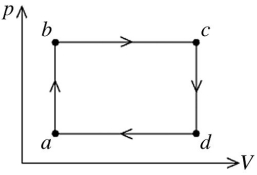
If the volume of the system increases from to calculate the change in internal (thermal) energy of the system. If the internal (thermal) energy change is nonzero, be sure to indicate whether this energy change is positive or negative. (Short Answer)
5.0/5 (88)
(88) Work: An ideal gas in a balloon is kept in thermal equilibrium with its constant-temperature surroundings. How much work is done by the gas if the outside pressure is slowly reduced, allowing the balloon to expand to 6.0 times its original size? The balloon initially has a pressure of  and a volume of
 The ideal gas constant is R = 8.314 J/mol ∙ K.
and a volume of The ideal gas constant is R = 8.314 J/mol ∙ K. (Multiple Choice)
4.9/5 (70)
(70) 
Filters
- Essay(0)
- Multiple Choice(0)
- Short Answer(0)
- True False(0)
- Matching(0)