



 Chat with AI
Exam 23: State and Local Taxes

Exam 1: An Introduction to Tax134 Questions
Exam 2: Tax Compliance, the Irs, and Tax Authorities109 Questions
Exam 3: Tax Planning Strategies and Related Limitations137 Questions
Exam 4: Individual Income Tax Overview, Dependents, and Filing Status130 Questions
Exam 5: Gross Income and Exclusions152 Questions
Exam 6: Individual Deductions117 Questions
Exam 7: Investments93 Questions
Exam 8: Individual Income Tax Computation and Tax Credits179 Questions
Exam 9: Business Income, Deductions, and Accounting Methods129 Questions
Exam 10: Property Acquisition and Cost Recovery131 Questions
Exam 11: Property Dispositions132 Questions
Exam 12: Compensation122 Questions
Exam 13: Retirement Savings and Deferred Compensation157 Questions
Exam 14: Tax Consequences of Home Ownership126 Questions
Exam 15: Entities Overview87 Questions
Exam 16: Corporate Operations126 Questions
Exam 17: Accounting for Income Taxes125 Questions
Exam 18: Corporate Taxation: Nonliquidating Distributions122 Questions
Exam 19: Corporate Formation, Reorganization, and Liquidation121 Questions
Exam 20: Forming and Operating Partnerships131 Questions
Exam 21: Dispositions of Partnership Interests and Partnership Distributions118 Questions
Exam 22: S Corporations157 Questions
Exam 23: State and Local Taxes139 Questions
Exam 24: The Us Taxation of Multinational Transactions105 Questions
Exam 25: Transfer Taxes and Wealth Planning145 Questions
Select questions type


Which of the following is incorrect regarding nondomiciliary businesses?
(Multiple Choice)
4.9/5  (91)
(91) Roxy operates a dress shop in Arlington, Virginia. Roxy also ships dresses nationwide upon request. Roxy's Virginia sales are $1,000,000 and out-of-state sales are $200,000. Assuming that Virginia's sales tax rate is 5 percent, what is Roxy's Virginia sales and use tax collection obligation?
(Multiple Choice)
4.8/5 (79)
(79) Super Sadie, Incorporated, manufactures sandals and distributes them across the southwestern United States. Assume that Super Sadie has sales tax nexus in Arizona, California, Colorado, New Mexico, and Texas. Super Sadie has sales as follows:
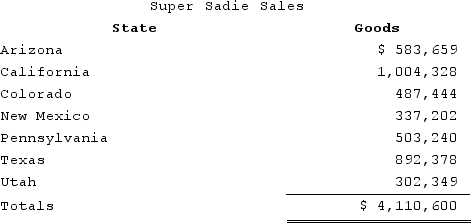 Assume the following sales tax rates: Arizona (6 percent), California (8 percent), Colorado (7 percent), New Mexico (6.5 percent), Pennsylvania (7.25 percent), Texas (8 percent), and Utah (5 percent). What is Super Sadie's total sales and use tax liability? (Round your interim calculations to the nearest whole number.)
 (Essay)
4.9/5 (80)
(80) Tennis Pro is headquartered in Virginia. Assume it has a Kentucky state income tax base of $220,000. Of this amount, $40,000 was nonbusiness income. Assume that Tennis Pro's Kentucky sales, payroll, and property apportionment factor are 12, 5, and 3 percent, respectively. Assume that Kentucky uses a single-factor sales formula apportionment method. The nonbusiness income allocated to Kentucky was $1,000. Assuming Kentucky's corporate tax rate is 6 percent, what is Tennis Pro's Kentucky stateincome tax liability?
(Essay)
4.8/5 (86)
(86) PWD Incorporated is an Illinois corporation. It properly included, deducted, or excluded the following items on its federal tax return in the current year: 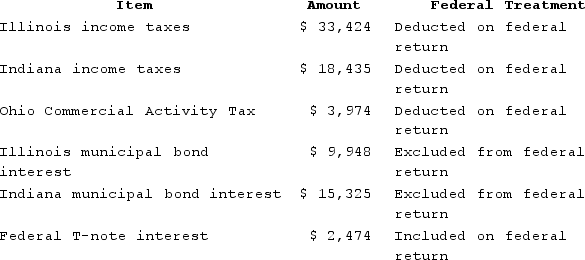 PWD's federal taxable income was $113,000. If Illinois only requires Illinois taxes to be added back, calculate PWD's Illinois state tax base.
 (Multiple Choice)
4.8/5 (80)
(80) Lefty provides demolition services in several southern states. Lefty has property as follows: 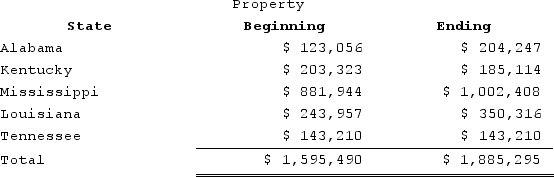 Lefty is a Mississippi corporation. Lefty also rents property in Mississippi and Tennessee with annual rents of $62,000 and $27,000, respectively. What is Lefty's Mississippi property numerator? (Round your answer to the nearest whole number.)
 (Multiple Choice)
4.9/5 (76)
(76) Carolina's Hats has the following sales, payroll, and property factors: 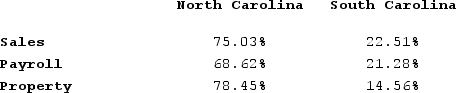 What is Carolina's Hats North and South Carolina apportionment factors if North Carolina uses an equally weighted three-factor formula and South Carolina uses a double-weighted sales factor formula? (Round your answers to two decimal places.)
 (Multiple Choice)
4.7/5 (84)
(84) In Complete Auto Transit the U.S. Supreme Court determined eight criteria for determining whether a state can tax a nondomiciliary company.
(True/False)
4.9/5 (75)
(75) Mahre, Incorporated, a New York corporation, runs ski tours in a several states. Mahre also has a New York retail store and an Internet store, which ships to out-of-state customers. Assume sales transactions in all states, except New York, are under 200 and that all states have adopted Wayfair legislation. The ski tours operate in Maine, New Hampshire, and Vermont, where Mahre has employees and owns and uses tangible personal property. Mahre has real property only in New York. Mahre has the following sales: 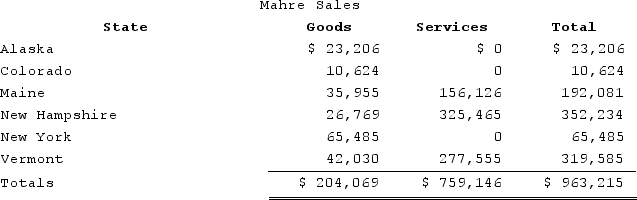 Assume the following sales tax rates: Alaska (0 percent), Colorado (7.75 percent), Maine (8.5 percent), New Hampshire (0 percent), New York (8 percent), and Vermont (5 percent). How much sales and use tax must Mahre collect and remit?
 (Multiple Choice)
4.9/5 (94)
(94) Mighty Manny, Incorporated manufactures and services deli machinery and distributes it across the United States. Mighty Manny is incorporated and headquartered in New Jersey. It has sales tax nexus in Connecticut, New Jersey, New York, Pennsylvania, Rhode Island, and South Carolina. Mighty Manny has sales as follows:
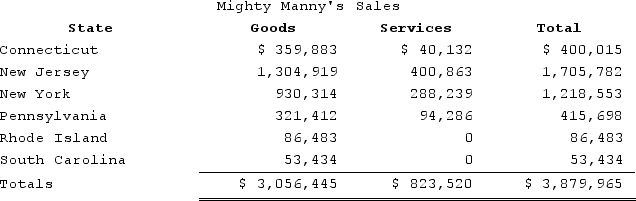 Assume the following sales tax rates: Connecticut (6.75 percent), New Jersey (7.5 percent), New York (8.5 percent), Pennsylvania (6.5 percent), Rhode Island (7.25 percent), and South Carolina (5.5 percent). Assume that only Connecticut taxes Mighty Manny's services. What is Mighty Manny's total sales and use tax liability? (Round your answer to the nearest whole number.)
 (Essay)
4.8/5 (86)
(86) Which of the following is not a general rule for calculating the property factor?
(Multiple Choice)
5.0/5 (82)
(82) Most states have shifted away from an equally weighted three-factor to a heavily weighted sales apportionment formula.
(True/False)
4.8/5 (96)
(96) The throwback rule requires a company, for apportionment purposes, to include all sales of inventory sold into a state without income tax nexus rather than from the state from where the inventory was shipped.
(True/False)
4.9/5 (84)
(84) All states employ some combination of sales and use tax, income or franchise tax, or property tax to fund their government operations.
(True/False)
4.9/5 (74)
(74) Public Law 86-272 protects certain business activities from creating income tax nexus.
(True/False)
4.8/5 (72)
(72) Which of the following is not a primary revenue source for most states?
(Multiple Choice)
4.7/5 (73)
(73) Gordon operates the Tennis Pro Shop in Blacksburg, Virginia. Tennis Pro sells, manufactures, and customizes tennis racquets for serious amateurs. Tennis Pro's business has expanded significantly over the last few years. Currently, it has sales personnel in 9 states (Virginia, North Carolina, South Carolina, Georgia, Tennessee, Kentucky, Ohio, Maryland, and New Jersey)and the District of Columbia. All sales activity in all of these states is limited to solicitation. Orders are taken by the sales team and forwarded to Blacksburg for approval. All orders are sent by common carrier to customers. Tennis Pro owns retail and warehouse space in Virginia and has another warehouse in Kentucky. Where does Tennis Pro have income tax nexus?
(Essay)
4.9/5 (79)
(79) Business income includes all income earned in the ordinary course of business.
(True/False)
4.8/5 (86)
(86) 
Filters
- Essay(0)
- Multiple Choice(0)
- Short Answer(0)
- True False(0)
- Matching(0)