



 Chat with AI
Exam 23: State and Local Taxes

Exam 1: An Introduction to Tax134 Questions
Exam 2: Tax Compliance, the Irs, and Tax Authorities109 Questions
Exam 3: Tax Planning Strategies and Related Limitations137 Questions
Exam 4: Individual Income Tax Overview, Dependents, and Filing Status130 Questions
Exam 5: Gross Income and Exclusions152 Questions
Exam 6: Individual Deductions117 Questions
Exam 7: Investments93 Questions
Exam 8: Individual Income Tax Computation and Tax Credits179 Questions
Exam 9: Business Income, Deductions, and Accounting Methods129 Questions
Exam 10: Property Acquisition and Cost Recovery131 Questions
Exam 11: Property Dispositions132 Questions
Exam 12: Compensation122 Questions
Exam 13: Retirement Savings and Deferred Compensation157 Questions
Exam 14: Tax Consequences of Home Ownership126 Questions
Exam 15: Entities Overview87 Questions
Exam 16: Corporate Operations126 Questions
Exam 17: Accounting for Income Taxes125 Questions
Exam 18: Corporate Taxation: Nonliquidating Distributions122 Questions
Exam 19: Corporate Formation, Reorganization, and Liquidation121 Questions
Exam 20: Forming and Operating Partnerships131 Questions
Exam 21: Dispositions of Partnership Interests and Partnership Distributions118 Questions
Exam 22: S Corporations157 Questions
Exam 23: State and Local Taxes139 Questions
Exam 24: The Us Taxation of Multinational Transactions105 Questions
Exam 25: Transfer Taxes and Wealth Planning145 Questions
Select questions type


Businesses must pay income tax in their state of commercial domicile.
(True/False)
4.7/5  (69)
(69) A unitary-return group includes only companies included in the federal consolidated tax return filing.
(True/False)
4.8/5 (77)
(77) Nondomiciliary businesses are subject to tax everywhere they do business.
(True/False)
4.8/5 (81)
(81) A state's apportionment formula divides nonbusiness income among the states where income tax nexus exists.
(True/False)
4.7/5 (70)
(70) In recent years, states are weighting the sales factor because it is easier to calculate.
(True/False)
5.0/5 (81)
(81) Which of the following sales is likely subject to sales and use tax in a state that assesses a sales and use tax?
(Multiple Choice)
4.8/5 (87)
(87) Hoosier Incorporated is an Indiana corporation. It properly included, deducted, or excluded the following items on its federal tax return in the current year: 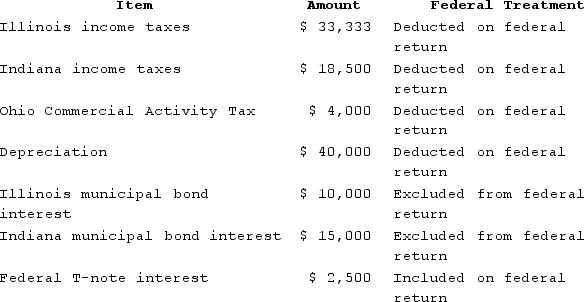 State depreciation expense was $50,000. Hoosier's federal taxable income was $150,300. Calculate Hoosier's Indiana state tax base.
 (Multiple Choice)
4.9/5 (77)
(77) Purchases of inventory for resale are typically exempt from sales and use taxes.
(True/False)
4.8/5 (77)
(77) Gordon operates the Tennis Pro Shop in Blacksburg, Virginia. Tennis Pro has payroll as follows:
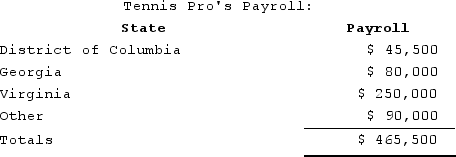 The other total includes $10,000 of salary of a Virginia employee that works part time in another state. What is Tennis Pro's Virginia payroll numerator and payroll factor? (Round the payroll factor to two places.)
 (Essay)
4.8/5 (89)
(89) Mighty Manny, Incorporated manufactures and services deli machinery and distributes it across the United States. Mighty Manny is incorporated and headquartered in New Jersey. It has product sales in all 50 states. New Jersey is the only state in which Mighty Manny exceeds the Wayfair sales thresholds. Mighty Manny's service employees work in Connecticut, New Jersey, New York, Pennsylvania, and Rhode Island. Mighty Manny also has an executive training seminar each year in South Carolina. Determine the states in which Mighty Manny has sales tax nexus.
(Essay)
4.9/5 (72)
(72) Most services are sourced to the state where the services were performed.
(True/False)
4.9/5 (92)
(92) Handsome Rob provides transportation services in several western states. Rob has payroll as follows: 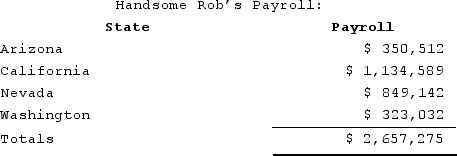 Rob is a California corporation and the following is true:
Rob has income tax nexus in Arizona, California, Nevada, and Washington. The Washington drivers spend 25 percent of their time driving through Oregon. California payroll includes $200,000 of payroll for services provided in Nevada by California-based drivers. What is Rob's California payroll numerator?
Rob is a California corporation and the following is true:
Rob has income tax nexus in Arizona, California, Nevada, and Washington. The Washington drivers spend 25 percent of their time driving through Oregon. California payroll includes $200,000 of payroll for services provided in Nevada by California-based drivers. What is Rob's California payroll numerator? (Multiple Choice)
4.7/5 (73)
(73) Roxy operates a dress shop in Arlington, Virginia. Lisa, a Maryland resident, comes in for a measurement and purchases a $2,400 dress that is shipped to her Maryland residence using a common carrier. Roxy's total Maryland sales are $31,200 on 15 transactions. Assuming that Virginia's sales tax rate is 5 percent and that Maryland's sales tax rate is 7 percent, what is Roxy's sales and use tax collection obligation?
(Multiple Choice)
5.0/5 (88)
(88) Which of the following isn't a requirement of Public Law 86-272?
(Multiple Choice)
4.7/5 (71)
(71) Businesses subject to income tax in more than one jurisdiction have the right to apportionment.
(True/False)
4.9/5 (92)
(92) The annual value of rented property is not included in the property factor.
(True/False)
4.8/5 (87)
(87) The Wrigley case held that the sale of intangibles is protected by Public Law 86-272.
(True/False)
4.8/5 (83)
(83) Giving samples and promotional materials without charge is a protected solicitation activity.
(True/False)
5.0/5 (78)
(78) A state's apportionment formula usually is applied using some variation of sales, payroll, and property factors.
(True/False)
4.9/5 (84)
(84) Businesses engaged in interstate commerce are subject to income tax in every state in which they operate.
(True/False)
4.9/5 (71)
(71) 
Filters
- Essay(0)
- Multiple Choice(0)
- Short Answer(0)
- True False(0)
- Matching(0)