



 Chat with AI
Exam 46: Animal Reproduction

Exam 1: Introduction: Themes in the Study of Life64 Questions
Exam 2: The Chemical Context of Life83 Questions
Exam 3: Water and Life70 Questions
Exam 4: Carbon and the Molecular Diversity of Life71 Questions
Exam 5: The Structure and Function of Large Biological Molecules109 Questions
Exam 6: A Tour of the Cell80 Questions
Exam 7: Membrane Structure and Function80 Questions
Exam 8: An Introduction to Metabolism80 Questions
Exam 9: Cellular Respiration and Fermentation107 Questions
Exam 10: Photosynthesis81 Questions
Exam 11: Cell Communication69 Questions
Exam 12: The Cell Cycle79 Questions
Exam 13: Meiosis and Sexual Life Cycles70 Questions
Exam 14: Mendel and the Gene Idea73 Questions
Exam 15: The Chromosomal Basis of Inheritance61 Questions
Exam 16: The Molecular Basis of Inheritance57 Questions
Exam 17: From Gene to Protein83 Questions
Exam 18: Regulation of Gene Expression99 Questions
Exam 19: Viruses47 Questions
Exam 20: Biotechnology72 Questions
Exam 21: Genomes and Their Evolution42 Questions
Exam 22: Descent with Modification: A Darwinian View of Life55 Questions
Exam 23: The Evolution of Populations78 Questions
Exam 24: The Origin of Species63 Questions
Exam 25: The History of Life on Earth75 Questions
Exam 26: Phylogeny and the Tree of Life73 Questions
Exam 27: Bacteria and Archaea78 Questions
Exam 28: Protists76 Questions
Exam 29: Plant Diversity I: How Plants Colonized Land74 Questions
Exam 30: Plant Diversity II: The Evolution of Seed Plants102 Questions
Exam 31: Fungi89 Questions
Exam 32: An Overview of Animal Diversity74 Questions
Exam 33: An Introduction to Invertebrates93 Questions
Exam 34: The Origin and Evolution of Vertebrates109 Questions
Exam 35: Plant Structure, Growth, and Development67 Questions
Exam 36: Resource Acquisition and Transport in Vascular Plants82 Questions
Exam 37: Soil and Plant Nutrition83 Questions
Exam 38: Angiosperm Reproduction and Biotechnology86 Questions
Exam 39: Plant Responses to Internal and External Signals108 Questions
Exam 40: Basic Principles of Animal Form and Function77 Questions
Exam 41: Animal Nutrition64 Questions
Exam 42: Circulation and Gas Exchange90 Questions
Exam 43: The Immune System100 Questions
Exam 44: Osmoregulation and Excretion69 Questions
Exam 45: Hormones and the Endocrine System72 Questions
Exam 46: Animal Reproduction94 Questions
Exam 47: Animal Development92 Questions
Exam 48: Neurons, Synapses, and Signaling73 Questions
Exam 49: Nervous Systems65 Questions
Exam 50: Sensory and Motor Mechanisms82 Questions
Exam 51: Animal Behavior69 Questions
Exam 52: An Introduction to Ecology and the Biosphere73 Questions
Exam 53: Population Ecology79 Questions
Exam 54: Community Ecology77 Questions
Exam 55: Ecosystems and Restoration Ecology81 Questions
Exam 56: Conservation Biology and Global Change67 Questions
Select questions type


Animals with reproduction dependent on internal fertilization need not have
(Multiple Choice)
4.7/5  (77)
(77) The hypothalamic hormone that triggers the secretion of FSH is
(Multiple Choice)
5.0/5 (84)
(84) Genetic mutations in asexually reproducing organisms lead to more evolutionary change than do genetic mutations in sexually reproducing ones because
(Multiple Choice)
4.8/5 (85)
(85)  -In the above figure, which letter points to the scrotum?
Most flatworms, including parasitic liver flukes, are hermaphrodites that form zygotes as the result of
(Multiple Choice)
4.8/5 (78)
(78) A contraceptive pill that continuously inhibits the release of GnRH from the hypothalamus will
(Multiple Choice)
4.9/5 (76)
(76) Refer to the following figure, which diagrams the reproductive anatomy of the human female, to answer the following questions.
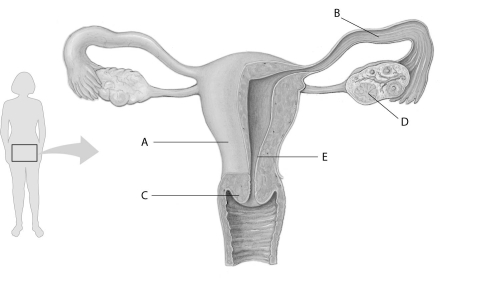 -In the above figure, which letter points to the corpus luteum?
 (Multiple Choice)
4.9/5 (72)
(72) At the end of a nonpregnant ovarian cycle, the breakdown and discharge of the soft uterine tissues is called
(Multiple Choice)
4.8/5 (71)
(71) In correct chronological order, the three phases of the human ovarian cycle are
(Multiple Choice)
4.9/5 (80)
(80) Prior to ovulation, the primary steroid hormone secreted by the growing follicle is
(Multiple Choice)
4.9/5 (79)
(79) Organisms with a reproductive pattern that produces shelled amniotic eggs generally
(Multiple Choice)
4.9/5 (69)
(69) 
Filters
- Essay(0)
- Multiple Choice(0)
- Short Answer(0)
- True False(0)
- Matching(0)