



 Chat with AI
Exam 42: Circulation and Gas Exchange

Exam 1: Introduction: Themes in the Study of Life64 Questions
Exam 2: The Chemical Context of Life83 Questions
Exam 3: Water and Life70 Questions
Exam 4: Carbon and the Molecular Diversity of Life71 Questions
Exam 5: The Structure and Function of Large Biological Molecules109 Questions
Exam 6: A Tour of the Cell80 Questions
Exam 7: Membrane Structure and Function80 Questions
Exam 8: An Introduction to Metabolism80 Questions
Exam 9: Cellular Respiration and Fermentation107 Questions
Exam 10: Photosynthesis81 Questions
Exam 11: Cell Communication69 Questions
Exam 12: The Cell Cycle79 Questions
Exam 13: Meiosis and Sexual Life Cycles70 Questions
Exam 14: Mendel and the Gene Idea73 Questions
Exam 15: The Chromosomal Basis of Inheritance61 Questions
Exam 16: The Molecular Basis of Inheritance57 Questions
Exam 17: From Gene to Protein83 Questions
Exam 18: Regulation of Gene Expression99 Questions
Exam 19: Viruses47 Questions
Exam 20: Biotechnology72 Questions
Exam 21: Genomes and Their Evolution42 Questions
Exam 22: Descent with Modification: A Darwinian View of Life55 Questions
Exam 23: The Evolution of Populations78 Questions
Exam 24: The Origin of Species63 Questions
Exam 25: The History of Life on Earth75 Questions
Exam 26: Phylogeny and the Tree of Life73 Questions
Exam 27: Bacteria and Archaea78 Questions
Exam 28: Protists76 Questions
Exam 29: Plant Diversity I: How Plants Colonized Land74 Questions
Exam 30: Plant Diversity II: The Evolution of Seed Plants102 Questions
Exam 31: Fungi89 Questions
Exam 32: An Overview of Animal Diversity74 Questions
Exam 33: An Introduction to Invertebrates93 Questions
Exam 34: The Origin and Evolution of Vertebrates109 Questions
Exam 35: Plant Structure, Growth, and Development67 Questions
Exam 36: Resource Acquisition and Transport in Vascular Plants82 Questions
Exam 37: Soil and Plant Nutrition83 Questions
Exam 38: Angiosperm Reproduction and Biotechnology86 Questions
Exam 39: Plant Responses to Internal and External Signals108 Questions
Exam 40: Basic Principles of Animal Form and Function77 Questions
Exam 41: Animal Nutrition64 Questions
Exam 42: Circulation and Gas Exchange90 Questions
Exam 43: The Immune System100 Questions
Exam 44: Osmoregulation and Excretion69 Questions
Exam 45: Hormones and the Endocrine System72 Questions
Exam 46: Animal Reproduction94 Questions
Exam 47: Animal Development92 Questions
Exam 48: Neurons, Synapses, and Signaling73 Questions
Exam 49: Nervous Systems65 Questions
Exam 50: Sensory and Motor Mechanisms82 Questions
Exam 51: Animal Behavior69 Questions
Exam 52: An Introduction to Ecology and the Biosphere73 Questions
Exam 53: Population Ecology79 Questions
Exam 54: Community Ecology77 Questions
Exam 55: Ecosystems and Restoration Ecology81 Questions
Exam 56: Conservation Biology and Global Change67 Questions
Select questions type


If, during protein starvation, the osmotic pressure on the venous side of capillary beds drops below the hydrostatic pressure, then
(Multiple Choice)
4.8/5  (94)
(94) After several weeks of exercise, a human athlete's resting heart rate is typically lower than before because
(Multiple Choice)
5.0/5 (84)
(84) A stroke volume in the heart of 70 mL/cycle, with a pulse of 72 cycles per minute, results in a cardiac output of
(Multiple Choice)
4.9/5 (83)
(83) When the air in a testing chamber is specially mixed so that its oxygen content is 10% and its overall air pressure is 400 mm Hg, then PO₂ is
(Multiple Choice)
4.9/5 (85)
(85) Which of the following develops the greatest pressure on the blood in the mammalian aorta?
(Multiple Choice)
4.9/5 (81)
(81) Air rushes into the lungs of humans during inhalation because
(Multiple Choice)
5.0/5 (88)
(88) An "internal reservoir" of oxygen in rested muscle is found in oxygen molecules bound to
(Multiple Choice)
5.0/5 (84)
(84) The Bohr shift on the oxygen-hemoglobin dissociation curve is produced by changes in
(Multiple Choice)
4.9/5 (79)
(79) Which of the following is the correct sequence of blood flow in reptiles and mammals?
(Multiple Choice)
4.9/5 (75)
(75) A patient with a blood pressure of 120/75, a pulse rate of 40 beats/minute, a stroke volume of 70 mL/beat, and a respiratory rate of 25 breaths/minute will have a cardiac output of
(Multiple Choice)
4.7/5 (83)
(83) The velocity of blood flow is the lowest in capillaries because
(Multiple Choice)
4.9/5 (77)
(77) Which of the following pairs of mammalian blood vessels has blood that is the least similar in its gas content?
(Multiple Choice)
4.7/5 (73)
(73) Blood entering a capillary bed of an unusual vertebrate was measured for the pressures exerted by various factors, as shown in Figure 42.1.
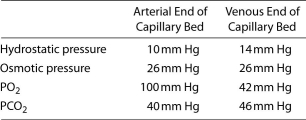 Figure 42.1
-For this unusual capillary bed,
Figure 42.1
-For this unusual capillary bed, (Multiple Choice)
4.7/5 (74)
(74) The circulatory system of bony fishes, rays, and sharks is similar to
(Multiple Choice)
4.9/5 (92)
(92) Fluid is filtered out of the bloodstream into the surrounding interstitial fluid at the arteriole end of systemic capillaries because
(Multiple Choice)
4.8/5 (78)
(78) Which of the following respiratory systems is not closely associated with a blood supply?
(Multiple Choice)
5.0/5 (62)
(62) The set of blood vessels with the slowest velocity of blood flow is
(Multiple Choice)
4.9/5 (82)
(82) An anthropologist discovers the fossilized heart of an extinct animal. The evidence indicates that the organism's heart was large, well-formed, and had four chambers, with no connection between the right and left sides. A reasonable conclusion supported by these observations is that the
(Multiple Choice)
4.8/5 (73)
(73) 
Filters
- Essay(0)
- Multiple Choice(0)
- Short Answer(0)
- True False(0)
- Matching(0)