



 Chat with AI
Exam 27: Bacteria and Archaea

Exam 1: Introduction: Themes in the Study of Life64 Questions
Exam 2: The Chemical Context of Life83 Questions
Exam 3: Water and Life70 Questions
Exam 4: Carbon and the Molecular Diversity of Life71 Questions
Exam 5: The Structure and Function of Large Biological Molecules109 Questions
Exam 6: A Tour of the Cell80 Questions
Exam 7: Membrane Structure and Function80 Questions
Exam 8: An Introduction to Metabolism80 Questions
Exam 9: Cellular Respiration and Fermentation107 Questions
Exam 10: Photosynthesis81 Questions
Exam 11: Cell Communication69 Questions
Exam 12: The Cell Cycle79 Questions
Exam 13: Meiosis and Sexual Life Cycles70 Questions
Exam 14: Mendel and the Gene Idea73 Questions
Exam 15: The Chromosomal Basis of Inheritance61 Questions
Exam 16: The Molecular Basis of Inheritance57 Questions
Exam 17: From Gene to Protein83 Questions
Exam 18: Regulation of Gene Expression99 Questions
Exam 19: Viruses47 Questions
Exam 20: Biotechnology72 Questions
Exam 21: Genomes and Their Evolution42 Questions
Exam 22: Descent with Modification: A Darwinian View of Life55 Questions
Exam 23: The Evolution of Populations78 Questions
Exam 24: The Origin of Species63 Questions
Exam 25: The History of Life on Earth75 Questions
Exam 26: Phylogeny and the Tree of Life73 Questions
Exam 27: Bacteria and Archaea78 Questions
Exam 28: Protists76 Questions
Exam 29: Plant Diversity I: How Plants Colonized Land74 Questions
Exam 30: Plant Diversity II: The Evolution of Seed Plants102 Questions
Exam 31: Fungi89 Questions
Exam 32: An Overview of Animal Diversity74 Questions
Exam 33: An Introduction to Invertebrates93 Questions
Exam 34: The Origin and Evolution of Vertebrates109 Questions
Exam 35: Plant Structure, Growth, and Development67 Questions
Exam 36: Resource Acquisition and Transport in Vascular Plants82 Questions
Exam 37: Soil and Plant Nutrition83 Questions
Exam 38: Angiosperm Reproduction and Biotechnology86 Questions
Exam 39: Plant Responses to Internal and External Signals108 Questions
Exam 40: Basic Principles of Animal Form and Function77 Questions
Exam 41: Animal Nutrition64 Questions
Exam 42: Circulation and Gas Exchange90 Questions
Exam 43: The Immune System100 Questions
Exam 44: Osmoregulation and Excretion69 Questions
Exam 45: Hormones and the Endocrine System72 Questions
Exam 46: Animal Reproduction94 Questions
Exam 47: Animal Development92 Questions
Exam 48: Neurons, Synapses, and Signaling73 Questions
Exam 49: Nervous Systems65 Questions
Exam 50: Sensory and Motor Mechanisms82 Questions
Exam 51: Animal Behavior69 Questions
Exam 52: An Introduction to Ecology and the Biosphere73 Questions
Exam 53: Population Ecology79 Questions
Exam 54: Community Ecology77 Questions
Exam 55: Ecosystems and Restoration Ecology81 Questions
Exam 56: Conservation Biology and Global Change67 Questions
Select questions type


Hershey and Chase performed an elegant experiment that convinced most biologists that DNA, rather than protein, was the genetic material. This experiment subjected bacteria to the same gene transfer mechanism as occurs in
(Multiple Choice)
4.9/5  (77)
(77) The following table depicts characteristics of five prokaryotic species (A-E). Use the information in the table to answer the following questions.
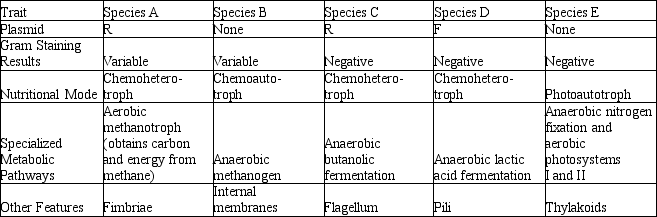 -Which species is most self-sustaining in terms of obtaining nutrition in environments containing little fixed nitrogen or carbon?
 (Multiple Choice)
4.9/5 (83)
(83) The following questions refer to Figure 27.1.
In this eight-year experiment, 12 populations of E. coli, each begun from a single cell, were grown in low-glucose conditions for 20,000 generations. Each culture was introduced to fresh growth medium every 24 hours. Occasionally, samples were removed from the populations, and their fitness in low-glucose conditions was tested against that of members sampled from the ancestral (common ancestor) E. coli population.
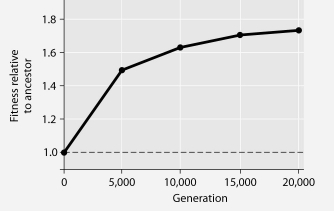 Figure 27.1
-If the experimental population of E. coli lacks an F factor or F plasmid, and if bacteriophages are excluded from the bacterial cultures, then which of these is (are)means by which beneficial mutations might be transmitted horizontally to other E. coli cells?
Figure 27.1
-If the experimental population of E. coli lacks an F factor or F plasmid, and if bacteriophages are excluded from the bacterial cultures, then which of these is (are)means by which beneficial mutations might be transmitted horizontally to other E. coli cells? (Multiple Choice)
4.9/5 (66)
(66) Prokaryotic ribosomes differ from those present in eukaryotic cytosol. Because of this, which of the following is correct?
(Multiple Choice)
4.8/5 (76)
(76) Which statement about the genomes of prokaryotes is correct?
(Multiple Choice)
4.9/5 (80)
(80) Mycoplasmas are bacteria that lack cell walls. On the basis of this structural feature, which statement concerning mycoplasmas should be true?
(Multiple Choice)
4.9/5 (78)
(78) The following table depicts characteristics of five prokaryotic species (A-E). Use the information in the table to answer the following questions.
-Which two species should have much more phospholipid, in the form of bilayers, in their cytoplasms than most other bacteria?
-Which two species should have much more phospholipid, in the form of bilayers, in their cytoplasms than most other bacteria? (Multiple Choice)
4.9/5 (77)
(77) Which of the following involves metabolic cooperation among prokaryotic cells?
(Multiple Choice)
4.8/5 (71)
(71) Genetic variation in bacterial populations cannot result from
(Multiple Choice)
4.9/5 (73)
(73) The termite gut protist, Mixotricha paradoxa, has at least two kinds of bacteria attached to its outer surface. One kind is a spirochete that propels its host through the termite gut. A second type of bacteria synthesizes ATP, some of which is used by the spirochetes. The locomotion provided by the spirochetes introduces the ATP-producing bacteria to new food sources. Which term(s)is (are)applicable to the relationship between the two kinds of bacteria?
1)mutualism
2)parasitism
3)symbiosis
4)metabolic cooperation
(Multiple Choice)
4.9/5 (82)
(82) If a bacterium regenerates from an endospore that did not possess any of the plasmids that were contained in its original parent cell, the regenerated bacterium will probably also
(Multiple Choice)
4.8/5 (97)
(97) The following questions refer to Figure 27.1.
In this eight-year experiment, 12 populations of E. coli, each begun from a single cell, were grown in low-glucose conditions for 20,000 generations. Each culture was introduced to fresh growth medium every 24 hours. Occasionally, samples were removed from the populations, and their fitness in low-glucose conditions was tested against that of members sampled from the ancestral (common ancestor) E. coli population.
Figure 27.1
-E. coli cells typically make most of their ATP by metabolizing glucose. Under the conditions of this experiment, what should be true of E. coli's generation time (especially early in the course of the experiment, but less so later on)?
Figure 27.1
-E. coli cells typically make most of their ATP by metabolizing glucose. Under the conditions of this experiment, what should be true of E. coli's generation time (especially early in the course of the experiment, but less so later on)? (Multiple Choice)
4.8/5 (84)
(84) Broad-spectrum antibiotics inhibit the growth of most intestinal bacteria. Consequently, assuming that nothing is done to counter the reduction of intestinal bacteria, a hospital patient who is receiving broad-spectrum antibiotics is most likely to become
(Multiple Choice)
4.8/5 (67)
(67) A fish that has been salt-cured subsequently develops a reddish color. You suspect that the fish has been contaminated by the extreme halophile, Halobacterium. Which of these features of cells removed from the surface of the fish, if confirmed, would support your suspicion?
1)the presence of the same photosynthetic pigments found in cyanobacteria
2)cell walls that lack peptidoglycan
3)cells that are isotonic to conditions on the surface of the fish
4)cells containing bacteriorhodopsin
5)the presence of very large numbers of ion pumps in its plasma membrane
(Multiple Choice)
4.9/5 (85)
(85) Match the numbered terms to the description that follows. Choose all appropriate terms.
1)autotroph
2)heterotroph
3)phototroph
4)chemotroph
A prokaryote that obtains both energy and carbon as it decomposes dead organisms
(Multiple Choice)
4.9/5 (97)
(97) Which two structures play direct roles in permitting bacteria to adhere to each other, or to other surfaces?
1)capsules
2)endospores
3)fimbriae
4)plasmids
5)flagella
(Multiple Choice)
5.0/5 (75)
(75) Figure 27.2 depicts changes to the amount of DNA present in a recipient cell that is engaged in conjugation with an Hfr cell. Hfr cell DNA begins entering the recipient cell at Time A. Assume that reciprocal crossing over occurs (in other words, a fragment of the recipient's chromosome is exchanged for a homologous fragment from the Hfr cell's DNA). Use Figure 27.2 to answer the following questions.
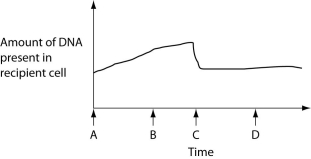 Figure 27.2
-How is the recipient cell different at Time D than it was at Time A?
Figure 27.2
-How is the recipient cell different at Time D than it was at Time A? (Multiple Choice)
4.9/5 (87)
(87) 
Filters
- Essay(0)
- Multiple Choice(0)
- Short Answer(0)
- True False(0)
- Matching(0)