



 Chat with AI
Exam 27: Bacteria and Archaea

Exam 1: Introduction: Themes in the Study of Life64 Questions
Exam 2: The Chemical Context of Life83 Questions
Exam 3: Water and Life70 Questions
Exam 4: Carbon and the Molecular Diversity of Life71 Questions
Exam 5: The Structure and Function of Large Biological Molecules109 Questions
Exam 6: A Tour of the Cell80 Questions
Exam 7: Membrane Structure and Function80 Questions
Exam 8: An Introduction to Metabolism80 Questions
Exam 9: Cellular Respiration and Fermentation107 Questions
Exam 10: Photosynthesis81 Questions
Exam 11: Cell Communication69 Questions
Exam 12: The Cell Cycle79 Questions
Exam 13: Meiosis and Sexual Life Cycles70 Questions
Exam 14: Mendel and the Gene Idea73 Questions
Exam 15: The Chromosomal Basis of Inheritance61 Questions
Exam 16: The Molecular Basis of Inheritance57 Questions
Exam 17: From Gene to Protein83 Questions
Exam 18: Regulation of Gene Expression99 Questions
Exam 19: Viruses47 Questions
Exam 20: Biotechnology72 Questions
Exam 21: Genomes and Their Evolution42 Questions
Exam 22: Descent with Modification: A Darwinian View of Life55 Questions
Exam 23: The Evolution of Populations78 Questions
Exam 24: The Origin of Species63 Questions
Exam 25: The History of Life on Earth75 Questions
Exam 26: Phylogeny and the Tree of Life73 Questions
Exam 27: Bacteria and Archaea78 Questions
Exam 28: Protists76 Questions
Exam 29: Plant Diversity I: How Plants Colonized Land74 Questions
Exam 30: Plant Diversity II: The Evolution of Seed Plants102 Questions
Exam 31: Fungi89 Questions
Exam 32: An Overview of Animal Diversity74 Questions
Exam 33: An Introduction to Invertebrates93 Questions
Exam 34: The Origin and Evolution of Vertebrates109 Questions
Exam 35: Plant Structure, Growth, and Development67 Questions
Exam 36: Resource Acquisition and Transport in Vascular Plants82 Questions
Exam 37: Soil and Plant Nutrition83 Questions
Exam 38: Angiosperm Reproduction and Biotechnology86 Questions
Exam 39: Plant Responses to Internal and External Signals108 Questions
Exam 40: Basic Principles of Animal Form and Function77 Questions
Exam 41: Animal Nutrition64 Questions
Exam 42: Circulation and Gas Exchange90 Questions
Exam 43: The Immune System100 Questions
Exam 44: Osmoregulation and Excretion69 Questions
Exam 45: Hormones and the Endocrine System72 Questions
Exam 46: Animal Reproduction94 Questions
Exam 47: Animal Development92 Questions
Exam 48: Neurons, Synapses, and Signaling73 Questions
Exam 49: Nervous Systems65 Questions
Exam 50: Sensory and Motor Mechanisms82 Questions
Exam 51: Animal Behavior69 Questions
Exam 52: An Introduction to Ecology and the Biosphere73 Questions
Exam 53: Population Ecology79 Questions
Exam 54: Community Ecology77 Questions
Exam 55: Ecosystems and Restoration Ecology81 Questions
Exam 56: Conservation Biology and Global Change67 Questions
Select questions type


Figure 27.2 depicts changes to the amount of DNA present in a recipient cell that is engaged in conjugation with an Hfr cell. Hfr cell DNA begins entering the recipient cell at Time A. Assume that reciprocal crossing over occurs (in other words, a fragment of the recipient's chromosome is exchanged for a homologous fragment from the Hfr cell's DNA). Use Figure 27.2 to answer the following questions.
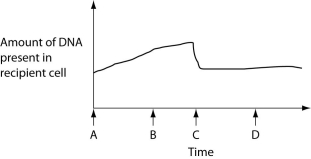 Figure 27.2
-Which two processes are responsible for the shape of the curve at Time B?
1)transduction
2)entry of single-stranded Hfr DNA
3)rolling circle replication of single-stranded Hfr DNA
4)activation of DNA pumps in plasma membrane
Figure 27.2
-Which two processes are responsible for the shape of the curve at Time B?
1)transduction
2)entry of single-stranded Hfr DNA
3)rolling circle replication of single-stranded Hfr DNA
4)activation of DNA pumps in plasma membrane (Multiple Choice)
4.8/5  (77)
(77) Use the information in the following paragraph to answer the next few questions.
A hypothetical bacterium swims among human intestinal contents until it finds a suitable location on the intestinal lining. It adheres to the intestinal lining using a feature that also protects it from phagocytes, bacteriophages, and dehydration. Fecal matter from a human in whose intestine this bacterium lives can spread the bacterium, even after being mixed with water and boiled. The bacterium is not susceptible to the penicillin family of antibiotics. It contains no plasmids and relatively little peptidoglycan.
-This bacterium derives nutrition by digesting human intestinal contents (in other words, food). Thus, this bacterium should be an
(Multiple Choice)
4.8/5 (73)
(73) Prokaryotes' essential genetic information is located in the
(Multiple Choice)
4.9/5 (76)
(76) The following table depicts characteristics of five prokaryotic species (A-E). Use the information in the table to answer the following questions.
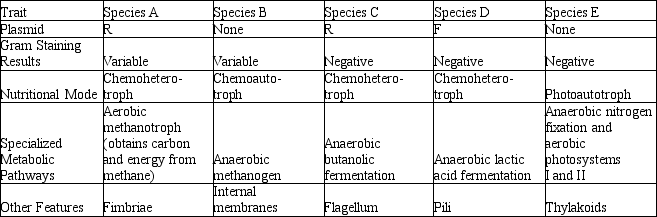 -Which species is probably an important contributor to the base of aquatic food chains as a primary producer?
 (Multiple Choice)
4.8/5 (83)
(83) The following table depicts characteristics of five prokaryotic species (A-E). Use the information in the table to answer the following questions.
-How many of these species probably have a cell wall that partly consists of an outer membrane of lipopolysaccharide?
-How many of these species probably have a cell wall that partly consists of an outer membrane of lipopolysaccharide? (Multiple Choice)
4.9/5 (84)
(84) Mitochondria are thought to be the descendants of certain alpha proteobacteria. They are, however, no longer able to lead independent lives because most genes originally present on their chromosome have moved to the nuclear genome. Which phenomenon accounts for the movement of these genes?
(Multiple Choice)
5.0/5 (78)
(78) Match the numbered terms to the description that follows. Choose all appropriate terms.
1)autotroph
2)heterotroph
3)phototroph
4)chemotroph
An organism that relies on photons to excite electrons within its membranes
(Multiple Choice)
4.8/5 (82)
(82) The following table depicts characteristics of five prokaryotic species (A-E). Use the information in the table to answer the following questions.
-Gram-variable prokaryotes are, sometimes, those without any peptidoglycan. Which two species are most likely to be archaeans?
-Gram-variable prokaryotes are, sometimes, those without any peptidoglycan. Which two species are most likely to be archaeans? (Multiple Choice)
4.8/5 (81)
(81) In general, what is the primary ecological role of prokaryotes?
(Multiple Choice)
4.9/5 (75)
(75) Use the information in the following paragraph to answer the next few questions.
A hypothetical bacterium swims among human intestinal contents until it finds a suitable location on the intestinal lining. It adheres to the intestinal lining using a feature that also protects it from phagocytes, bacteriophages, and dehydration. Fecal matter from a human in whose intestine this bacterium lives can spread the bacterium, even after being mixed with water and boiled. The bacterium is not susceptible to the penicillin family of antibiotics. It contains no plasmids and relatively little peptidoglycan.
-Adherence to the intestinal lining by this bacterium is due to its possession of
(Multiple Choice)
4.9/5 (81)
(81) In a hypothetical situation, the genes for sex pilus construction and for tetracycline resistance are located together on the same plasmid within a particular bacterium. If this bacterium readily performs conjugation involving a copy of this plasmid, then the result should be
(Multiple Choice)
4.9/5 (76)
(76) Use the information in the following paragraph to answer the next few questions.
A hypothetical bacterium swims among human intestinal contents until it finds a suitable location on the intestinal lining. It adheres to the intestinal lining using a feature that also protects it from phagocytes, bacteriophages, and dehydration. Fecal matter from a human in whose intestine this bacterium lives can spread the bacterium, even after being mixed with water and boiled. The bacterium is not susceptible to the penicillin family of antibiotics. It contains no plasmids and relatively little peptidoglycan.
-What should be true of the cell wall of this bacterium?
(Multiple Choice)
4.8/5 (88)
(88) Consider the thermoacidophile, Sulfolobus acidocaldarius. Which of the following graphs most accurately depicts the expected temperature and pH profiles of its enzymes? (Note: The horizontal axes of these graphs are double, with pH above and temperature below.)

(Multiple Choice)
4.8/5 (76)
(76) Use the information in the following paragraph to answer the next few questions.
A hypothetical bacterium swims among human intestinal contents until it finds a suitable location on the intestinal lining. It adheres to the intestinal lining using a feature that also protects it from phagocytes, bacteriophages, and dehydration. Fecal matter from a human in whose intestine this bacterium lives can spread the bacterium, even after being mixed with water and boiled. The bacterium is not susceptible to the penicillin family of antibiotics. It contains no plasmids and relatively little peptidoglycan.
-This bacterium derives nutrition by digesting human intestinal contents (in other words, food). Humans lacking this bacterium have no measurable reproductive advantage or disadvantage relative to humans who harbor this bacterium. Consequently, the bacterium can be properly described as which of the following?
1)symbiont
2)endosymbiont
3)mutualist
4)commensal
(Multiple Choice)
5.0/5 (82)
(82) Use the information in the following paragraph to answer the next few questions.
A hypothetical bacterium swims among human intestinal contents until it finds a suitable location on the intestinal lining. It adheres to the intestinal lining using a feature that also protects it from phagocytes, bacteriophages, and dehydration. Fecal matter from a human in whose intestine this bacterium lives can spread the bacterium, even after being mixed with water and boiled. The bacterium is not susceptible to the penicillin family of antibiotics. It contains no plasmids and relatively little peptidoglycan.
-Some of the proteins that allow this bacterium to swim are related (in an evolutionary sense)to proteins that
(Multiple Choice)
4.9/5 (88)
(88) The following table depicts characteristics of five prokaryotic species (A-E). Use the information in the table to answer the following questions.
-Which species is most likely to be found both in sewage treatment plants and in the guts of cattle?
-Which species is most likely to be found both in sewage treatment plants and in the guts of cattle? (Multiple Choice)
4.8/5 (80)
(80) Bacteria perform each of the following ecological roles. Which role typically does not involve a symbiosis?
(Multiple Choice)
4.9/5 (77)
(77) Match the numbered terms to the description that follows. Choose all appropriate terms.
1)autotroph
2)heterotroph
3)phototroph
4)chemotroph
An organism that obtains both carbon and energy by ingesting prey
(Multiple Choice)
4.8/5 (82)
(82) 
Filters
- Essay(0)
- Multiple Choice(0)
- Short Answer(0)
- True False(0)
- Matching(0)