



 Chat with AI
Exam 18: Regulation of Gene Expression

Exam 1: Introduction: Themes in the Study of Life64 Questions
Exam 2: The Chemical Context of Life83 Questions
Exam 3: Water and Life70 Questions
Exam 4: Carbon and the Molecular Diversity of Life71 Questions
Exam 5: The Structure and Function of Large Biological Molecules109 Questions
Exam 6: A Tour of the Cell80 Questions
Exam 7: Membrane Structure and Function80 Questions
Exam 8: An Introduction to Metabolism80 Questions
Exam 9: Cellular Respiration and Fermentation107 Questions
Exam 10: Photosynthesis81 Questions
Exam 11: Cell Communication69 Questions
Exam 12: The Cell Cycle79 Questions
Exam 13: Meiosis and Sexual Life Cycles70 Questions
Exam 14: Mendel and the Gene Idea73 Questions
Exam 15: The Chromosomal Basis of Inheritance61 Questions
Exam 16: The Molecular Basis of Inheritance57 Questions
Exam 17: From Gene to Protein83 Questions
Exam 18: Regulation of Gene Expression99 Questions
Exam 19: Viruses47 Questions
Exam 20: Biotechnology72 Questions
Exam 21: Genomes and Their Evolution42 Questions
Exam 22: Descent with Modification: A Darwinian View of Life55 Questions
Exam 23: The Evolution of Populations78 Questions
Exam 24: The Origin of Species63 Questions
Exam 25: The History of Life on Earth75 Questions
Exam 26: Phylogeny and the Tree of Life73 Questions
Exam 27: Bacteria and Archaea78 Questions
Exam 28: Protists76 Questions
Exam 29: Plant Diversity I: How Plants Colonized Land74 Questions
Exam 30: Plant Diversity II: The Evolution of Seed Plants102 Questions
Exam 31: Fungi89 Questions
Exam 32: An Overview of Animal Diversity74 Questions
Exam 33: An Introduction to Invertebrates93 Questions
Exam 34: The Origin and Evolution of Vertebrates109 Questions
Exam 35: Plant Structure, Growth, and Development67 Questions
Exam 36: Resource Acquisition and Transport in Vascular Plants82 Questions
Exam 37: Soil and Plant Nutrition83 Questions
Exam 38: Angiosperm Reproduction and Biotechnology86 Questions
Exam 39: Plant Responses to Internal and External Signals108 Questions
Exam 40: Basic Principles of Animal Form and Function77 Questions
Exam 41: Animal Nutrition64 Questions
Exam 42: Circulation and Gas Exchange90 Questions
Exam 43: The Immune System100 Questions
Exam 44: Osmoregulation and Excretion69 Questions
Exam 45: Hormones and the Endocrine System72 Questions
Exam 46: Animal Reproduction94 Questions
Exam 47: Animal Development92 Questions
Exam 48: Neurons, Synapses, and Signaling73 Questions
Exam 49: Nervous Systems65 Questions
Exam 50: Sensory and Motor Mechanisms82 Questions
Exam 51: Animal Behavior69 Questions
Exam 52: An Introduction to Ecology and the Biosphere73 Questions
Exam 53: Population Ecology79 Questions
Exam 54: Community Ecology77 Questions
Exam 55: Ecosystems and Restoration Ecology81 Questions
Exam 56: Conservation Biology and Global Change67 Questions
Select questions type


Transcription factors in eukaryotes usually have DNA binding domains as well as other domains that are also specific for binding. In general, which of the following would you expect many of them to be able to bind?
(Multiple Choice)
4.7/5  (67)
(67) A researcher found a method she could use to manipulate and quantify phosphorylation and methylation in embryonic cells in culture.
-In one set of experiments she succeeded in decreasing methylation of histone tails. Which of the following results would she most likely see?
(Multiple Choice)
4.8/5 (78)
(78) Most repressor proteins are allosteric. Which of the following binds with the repressor to alter its conformation?
(Multiple Choice)
4.7/5 (89)
(89) Absence of bicoid mRNA from a Drosophila egg leads to the absence of anterior larval body parts and mirror-image duplication of posterior parts. This is evidence that the product of the bicoid gene
(Multiple Choice)
4.8/5 (85)
(85) Which of the following is a protein produced by a regulatory gene?
(Multiple Choice)
4.9/5 (84)
(84) Use the following information to answer the following questions.
In Drosophila after ~100 minutes postfertilization, the embryo looks like the following diagram, with all nuclei having moved to the periphery and, subsequently, four of the nuclei being sequestered at the posterior end.
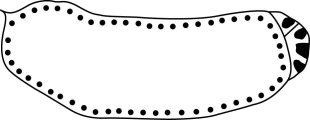 Drosophila embryo after about 2 hours.
-The four sequestered cells at one end are most probably destined to become
Drosophila embryo after about 2 hours.
-The four sequestered cells at one end are most probably destined to become (Multiple Choice)
4.9/5 (90)
(90) Use the following information to answer the following questions.
In Drosophila after ~100 minutes postfertilization, the embryo looks like the following diagram, with all nuclei having moved to the periphery and, subsequently, four of the nuclei being sequestered at the posterior end.
Drosophila embryo after about 2 hours.
-The next step after the embryo is formed would be
Drosophila embryo after about 2 hours.
-The next step after the embryo is formed would be (Multiple Choice)
4.8/5 (76)
(76) The role of a metabolite that controls a repressible operon is to
(Multiple Choice)
4.9/5 (85)
(85) If you were to observe the activity of methylated DNA, you would expect it to
(Multiple Choice)
4.7/5 (79)
(79) Genomic imprinting, DNA methylation, and histone acetylation are all examples of
(Multiple Choice)
4.8/5 (87)
(87) In positive control of several sugar-metabolism-related operons, the catabolite activator protein (CAP)binds to DNA to stimulate transcription. What causes an increase in CAP?
(Multiple Choice)
4.9/5 (76)
(76) What do gap genes, pair-rule genes, segment polarity genes, and homeotic genes all have in common?
(Multiple Choice)
4.8/5 (80)
(80) For a repressible operon to be transcribed, which of the following must occur?
(Multiple Choice)
4.8/5 (71)
(71) Within a cell, the amount of protein made using a given mRNA molecule depends partly on
(Multiple Choice)
4.9/5 (86)
(86) Which of the following is characteristic of the product of the p53 gene?
(Multiple Choice)
5.0/5 (80)
(80) 
Filters
- Essay(0)
- Multiple Choice(0)
- Short Answer(0)
- True False(0)
- Matching(0)