



 Chat with AI
Exam 18: Regulation of Gene Expression

Exam 1: Introduction: Themes in the Study of Life64 Questions
Exam 2: The Chemical Context of Life83 Questions
Exam 3: Water and Life70 Questions
Exam 4: Carbon and the Molecular Diversity of Life71 Questions
Exam 5: The Structure and Function of Large Biological Molecules109 Questions
Exam 6: A Tour of the Cell80 Questions
Exam 7: Membrane Structure and Function80 Questions
Exam 8: An Introduction to Metabolism80 Questions
Exam 9: Cellular Respiration and Fermentation107 Questions
Exam 10: Photosynthesis81 Questions
Exam 11: Cell Communication69 Questions
Exam 12: The Cell Cycle79 Questions
Exam 13: Meiosis and Sexual Life Cycles70 Questions
Exam 14: Mendel and the Gene Idea73 Questions
Exam 15: The Chromosomal Basis of Inheritance61 Questions
Exam 16: The Molecular Basis of Inheritance57 Questions
Exam 17: From Gene to Protein83 Questions
Exam 18: Regulation of Gene Expression99 Questions
Exam 19: Viruses47 Questions
Exam 20: Biotechnology72 Questions
Exam 21: Genomes and Their Evolution42 Questions
Exam 22: Descent with Modification: A Darwinian View of Life55 Questions
Exam 23: The Evolution of Populations78 Questions
Exam 24: The Origin of Species63 Questions
Exam 25: The History of Life on Earth75 Questions
Exam 26: Phylogeny and the Tree of Life73 Questions
Exam 27: Bacteria and Archaea78 Questions
Exam 28: Protists76 Questions
Exam 29: Plant Diversity I: How Plants Colonized Land74 Questions
Exam 30: Plant Diversity II: The Evolution of Seed Plants102 Questions
Exam 31: Fungi89 Questions
Exam 32: An Overview of Animal Diversity74 Questions
Exam 33: An Introduction to Invertebrates93 Questions
Exam 34: The Origin and Evolution of Vertebrates109 Questions
Exam 35: Plant Structure, Growth, and Development67 Questions
Exam 36: Resource Acquisition and Transport in Vascular Plants82 Questions
Exam 37: Soil and Plant Nutrition83 Questions
Exam 38: Angiosperm Reproduction and Biotechnology86 Questions
Exam 39: Plant Responses to Internal and External Signals108 Questions
Exam 40: Basic Principles of Animal Form and Function77 Questions
Exam 41: Animal Nutrition64 Questions
Exam 42: Circulation and Gas Exchange90 Questions
Exam 43: The Immune System100 Questions
Exam 44: Osmoregulation and Excretion69 Questions
Exam 45: Hormones and the Endocrine System72 Questions
Exam 46: Animal Reproduction94 Questions
Exam 47: Animal Development92 Questions
Exam 48: Neurons, Synapses, and Signaling73 Questions
Exam 49: Nervous Systems65 Questions
Exam 50: Sensory and Motor Mechanisms82 Questions
Exam 51: Animal Behavior69 Questions
Exam 52: An Introduction to Ecology and the Biosphere73 Questions
Exam 53: Population Ecology79 Questions
Exam 54: Community Ecology77 Questions
Exam 55: Ecosystems and Restoration Ecology81 Questions
Exam 56: Conservation Biology and Global Change67 Questions
Select questions type


The product of the bicoid gene in Drosophila provides essential information about
(Multiple Choice)
4.8/5  (88)
(88) Which of the following, when taken up by the cell, binds to the repressor so that the repressor no longer binds to the operator?
(Multiple Choice)
4.8/5 (77)
(77) Which of the following genes map out the basic subdivisions along the anterior-posterior axis of the Drosophila embryo?
(Multiple Choice)
4.7/5 (78)
(78) Your brother has just purchased a new plastic model airplane. He places all the parts on the table in approximately the positions in which they will be located when the model is complete. His actions are analogous to which process in development?
(Multiple Choice)
4.9/5 (69)
(69) A researcher has arrived at a method to prevent gene expression from Drosophila embryonic genes. The following questions assume that he is using this method.
-The researcher continues to study the reactions of the embryo to these new proteins and you hypothesize that he is most likely to see which of the following (while embryonic genes are still not being expressed)?
(Multiple Choice)
5.0/5 (80)
(80) A few decades ago, Knudsen and colleagues proposed a theory that, for a normal cell to become a cancer cell, a minimum of two genetic changes had to occur in that cell. Knudsen was studying retinoblastoma, a childhood cancer of the eye.
-In colorectal cancer, several genes must be mutated in order to make a cell a cancer cell, supporting Knudsen's hypothesis. Which of the following kinds of genes would you expect to be mutated?
(Multiple Choice)
4.8/5 (86)
(86) Epstein Bar Virus (EBV) causes most of us to have an episode of sore throat and swollen glands during early childhood. If we first become exposed to the virus during our teen years, however, EBV causes the syndrome we know as mononucleosis. However, in special circumstances, the same virus can be carcinogenic.
-In areas of the world in which malaria is endemic, notably in sub-Saharan Africa, EBV can cause Burkitt's lymphoma in children, which is usually associated with large tumors of the jaw. Which of the following is consistent with these findings?
(Multiple Choice)
4.9/5 (76)
(76) A geneticist introduces a transgene into yeast cells and isolates five independent cell lines in which the transgene has integrated into the yeast genome. In four of the lines, the transgene is expressed strongly, but in the fifth there is no expression at all.
-Which of the following is a likely explanation for the lack of transgene expression in the fifth cell line?
(Multiple Choice)
5.0/5 (71)
(71) A researcher has arrived at a method to prevent gene expression from Drosophila embryonic genes. The following questions assume that he is using this method.
-The researcher in question measures the amount of new polypeptide production in embryos from 2-8 hours following fertilization and the results show a steady and significant rise in polypeptide concentration over that time. The researcher concludes that
(Multiple Choice)
4.8/5 (74)
(74) There is a mutation in the repressor that results in a molecule known as a super-repressor because it represses the lac operon permanently. Which of these would characterize such a mutant?
(Multiple Choice)
4.9/5 (77)
(77) Which of the following is an example of post-transcriptional control of gene expression?
(Multiple Choice)
4.9/5 (89)
(89) A researcher introduces double-stranded RNA into a culture of mammalian cells, and can identify its location or that of its smaller subsections experimentally, using a fluorescent probe.
-Some time later, she finds that the introduced strand separates into single-stranded RNAs, one of which is degraded. What does this enable the remaining strand to do?
(Multiple Choice)
4.8/5 (76)
(76) Transcription of the structural genes in an inducible operon
(Multiple Choice)
4.8/5 (78)
(78) Use the following information to answer the following questions.
In Drosophila after ~100 minutes postfertilization, the embryo looks like the following diagram, with all nuclei having moved to the periphery and, subsequently, four of the nuclei being sequestered at the posterior end.
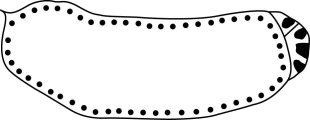 Drosophila embryo after about 2 hours.
-The developmental stages described for Drosophila illustrate
Drosophila embryo after about 2 hours.
-The developmental stages described for Drosophila illustrate (Multiple Choice)
4.8/5 (82)
(82) Which of the following mechanisms is (are)used to coordinate the expression of multiple, related genes in eukaryotic cells?
(Multiple Choice)
4.8/5 (73)
(73) Suppose an experimenter becomes proficient with a technique that allows her to move DNA sequences within a prokaryotic genome.
-If she moves the promoter for the lac operon to the region between the beta galactosidase gene and the permease gene, which of the following would be likely?
(Multiple Choice)
4.8/5 (82)
(82) In response to chemical signals, prokaryotes can do which of the following?
(Multiple Choice)
5.0/5 (83)
(83) A few decades ago, Knudsen and colleagues proposed a theory that, for a normal cell to become a cancer cell, a minimum of two genetic changes had to occur in that cell. Knudsen was studying retinoblastoma, a childhood cancer of the eye.
-One of the human leukemias, called CML (chronic myelogenous leukemia), is associated with a chromosomal translocation between chromosomes 9 and 22 in somatic cells of bone marrow. Which of the following allows CML to provide further evidence of this multistep nature of cancer?
(Multiple Choice)
4.8/5 (87)
(87) One hereditary disease in humans, called xeroderma pigmentosum (XP), makes homozygous individuals exceptionally susceptible to UV-induced mutation damage in the cells of exposed tissue, especially skin. Without extraordinary avoidance of sunlight exposure, patients soon succumb to numerous skin cancers.
-Which of the following best describes this phenomenon?
(Multiple Choice)
5.0/5 (81)
(81) 
Filters
- Essay(0)
- Multiple Choice(0)
- Short Answer(0)
- True False(0)
- Matching(0)