



 Chat with AI
Exam 14: Mendel and the Gene Idea

Exam 1: Introduction: Themes in the Study of Life64 Questions
Exam 2: The Chemical Context of Life83 Questions
Exam 3: Water and Life70 Questions
Exam 4: Carbon and the Molecular Diversity of Life71 Questions
Exam 5: The Structure and Function of Large Biological Molecules109 Questions
Exam 6: A Tour of the Cell80 Questions
Exam 7: Membrane Structure and Function80 Questions
Exam 8: An Introduction to Metabolism80 Questions
Exam 9: Cellular Respiration and Fermentation107 Questions
Exam 10: Photosynthesis81 Questions
Exam 11: Cell Communication69 Questions
Exam 12: The Cell Cycle79 Questions
Exam 13: Meiosis and Sexual Life Cycles70 Questions
Exam 14: Mendel and the Gene Idea73 Questions
Exam 15: The Chromosomal Basis of Inheritance61 Questions
Exam 16: The Molecular Basis of Inheritance57 Questions
Exam 17: From Gene to Protein83 Questions
Exam 18: Regulation of Gene Expression99 Questions
Exam 19: Viruses47 Questions
Exam 20: Biotechnology72 Questions
Exam 21: Genomes and Their Evolution42 Questions
Exam 22: Descent with Modification: A Darwinian View of Life55 Questions
Exam 23: The Evolution of Populations78 Questions
Exam 24: The Origin of Species63 Questions
Exam 25: The History of Life on Earth75 Questions
Exam 26: Phylogeny and the Tree of Life73 Questions
Exam 27: Bacteria and Archaea78 Questions
Exam 28: Protists76 Questions
Exam 29: Plant Diversity I: How Plants Colonized Land74 Questions
Exam 30: Plant Diversity II: The Evolution of Seed Plants102 Questions
Exam 31: Fungi89 Questions
Exam 32: An Overview of Animal Diversity74 Questions
Exam 33: An Introduction to Invertebrates93 Questions
Exam 34: The Origin and Evolution of Vertebrates109 Questions
Exam 35: Plant Structure, Growth, and Development67 Questions
Exam 36: Resource Acquisition and Transport in Vascular Plants82 Questions
Exam 37: Soil and Plant Nutrition83 Questions
Exam 38: Angiosperm Reproduction and Biotechnology86 Questions
Exam 39: Plant Responses to Internal and External Signals108 Questions
Exam 40: Basic Principles of Animal Form and Function77 Questions
Exam 41: Animal Nutrition64 Questions
Exam 42: Circulation and Gas Exchange90 Questions
Exam 43: The Immune System100 Questions
Exam 44: Osmoregulation and Excretion69 Questions
Exam 45: Hormones and the Endocrine System72 Questions
Exam 46: Animal Reproduction94 Questions
Exam 47: Animal Development92 Questions
Exam 48: Neurons, Synapses, and Signaling73 Questions
Exam 49: Nervous Systems65 Questions
Exam 50: Sensory and Motor Mechanisms82 Questions
Exam 51: Animal Behavior69 Questions
Exam 52: An Introduction to Ecology and the Biosphere73 Questions
Exam 53: Population Ecology79 Questions
Exam 54: Community Ecology77 Questions
Exam 55: Ecosystems and Restoration Ecology81 Questions
Exam 56: Conservation Biology and Global Change67 Questions
Select questions type


Refer to the following information to answer the questions below.
Humanoids on the newly explored planet Brin (in a hypothetical galaxy in ~50 years from the present) have a gene structure similar to our own, but many very different plants and animals.
-One species of a small birdlike animal has an extremely variable tail length, which is a highly polymorphic trait. Geneticists have come to realize that there are eight separate genes for tail length per haploid genome, with each gene having two alleles. One allele for each gene (a, b, and so on)increases the length by 1 cm, whereas the other allele (a₂, b₂, and so on)increases it by 0.5 cm. One bird was analyzed and found to have the following genotype:
A₁a₁b₂b₂c₁c₂d₁d₂e₂e₂f₁f₂g₁g₁h₁h₂
What is the length of its tail?
(Multiple Choice)
4.8/5  (76)
(76) Refer to the following information to answer the questions below.
Gene S controls the sharpness of spines in a type of cactus. Cactuses with the dominant allele, S, have sharp spines, whereas homozygous recessive ss cactuses have dull spines. At the same time, a second gene, N, determines whether or not cactuses have spines. Homozygous recessive nn cactuses have no spines at all.
-A cross between a true-breeding sharp-spined cactus and a spineless cactus would produce
(Multiple Choice)
4.8/5 (73)
(73) Refer to the following information to answer the questions below.
Humanoids on the newly explored planet Brin (in a hypothetical galaxy in ~50 years from the present) have a gene structure similar to our own, but many very different plants and animals.
-One species of green plant, with frondlike leaves, a spine-coated stem, and purple cup-shaped flowers, is found to be self-pollinating. Which of the following is true of this species?
(Multiple Choice)
4.8/5 (83)
(83) Which of the following is the best statement of the use of the addition rule of probability?
(Multiple Choice)
4.7/5 (76)
(76) Mendel was able to draw his ideas of segregation and independent assortment because of the influence of which of the following?
(Multiple Choice)
4.8/5 (79)
(79) When crossing an organism that is homozygous recessive for a single trait with a heterozygote, what is the chance of producing an offspring with the homozygous recessive phenotype?
(Multiple Choice)
4.9/5 (79)
(79) Given the parents AABBCc × AabbCc, assume simple dominance for each trait and independent assortment. What proportion of the progeny will be expected to phenotypically resemble the first parent?
(Multiple Choice)
4.7/5 (66)
(66) Use Figure 14.1 and the following description to answer the questions below.
In a particular plant, leaf color is controlled by gene locus D. Plants with at least one allele D have dark green leaves, and plants with the homozygous recessive dd genotype have light green leaves. A true-breeding dark-leaved plant is crossed with a light-leaved one, and the F₁ offspring is allowed to self-pollinate. The predicted outcome of the F₂ is diagrammed in the Punnett square shown in Figure 14.1, where 1, 2, 3, and 4 represent the genotypes corresponding to each box within the square.
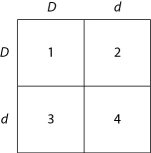 Figure 14.1
-Which of the boxes correspond to plants with a heterozygous genotype?
Figure 14.1
-Which of the boxes correspond to plants with a heterozygous genotype? (Multiple Choice)
4.9/5 (73)
(73) A sexually reproducing animal has two unlinked genes, one for head shape (H)and one for tail length (T). Its genotype is HhTt. Which of the following genotypes is possible in a gamete from this organism?
(Multiple Choice)
4.7/5 (70)
(70) The frequency of heterozygosity for the sickle-cell anemia allele is unusually high, presumably because this reduces the frequency of malaria. Such a relationship is related to which of the following?
(Multiple Choice)
4.8/5 (77)
(77) What was the most significant conclusion that Gregor Mendel drew from his experiments with pea plants?
(Multiple Choice)
4.7/5 (80)
(80) If the environmental parameters, such as temperature, humidity, atmosphere, sunlight, and so on, are mostly Earthlike, which of the following do you expect of its types of leaves, stems, and flowers?
(Multiple Choice)
4.8/5 (70)
(70) Use the following information to answer the questions below.
Drosophila (fruit flies) usually have long wings (+) but mutations in two different genes can result in bent wings (bt) or vestigial wings (vg).
-If flies that are heterozygous for both the bent wing gene and the vestigial wing gene are mated, what is the probability of offspring with bent wings only?
(Multiple Choice)
4.9/5 (82)
(82) The following questions refer to the pedigree chart in Figure 14.2 for a family, some of whose members exhibit the dominant trait, W. Affected individuals are indicated by a dark square or circle.
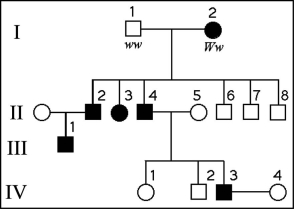 Figure 14.2
-What is the likelihood that the progeny of IV-3 and IV-4 will have the trait?
Figure 14.2
-What is the likelihood that the progeny of IV-3 and IV-4 will have the trait? (Multiple Choice)
4.9/5 (75)
(75) The following questions refer to the pedigree chart in Figure 14.2 for a family, some of whose members exhibit the dominant trait, W. Affected individuals are indicated by a dark square or circle.
Figure 14.2
-What is the probability that individual III-1 is Ww?
Figure 14.2
-What is the probability that individual III-1 is Ww? (Multiple Choice)
4.8/5 (77)
(77) Use Figure 14.1 and the following description to answer the questions below.
In a particular plant, leaf color is controlled by gene locus D. Plants with at least one allele D have dark green leaves, and plants with the homozygous recessive dd genotype have light green leaves. A true-breeding dark-leaved plant is crossed with a light-leaved one, and the F₁ offspring is allowed to self-pollinate. The predicted outcome of the F₂ is diagrammed in the Punnett square shown in Figure 14.1, where 1, 2, 3, and 4 represent the genotypes corresponding to each box within the square.
Figure 14.1
-Which of the boxes marked 1-4 correspond to plants with dark leaves?
Figure 14.1
-Which of the boxes marked 1-4 correspond to plants with dark leaves? (Multiple Choice)
4.9/5 (83)
(83) Use the following pedigree (Figure 14.3) for a family in which dark-shaded symbols represent individuals with one of the two major types of colon cancer. Numbers under the symbols are the individual's age at the time of diagnosis.
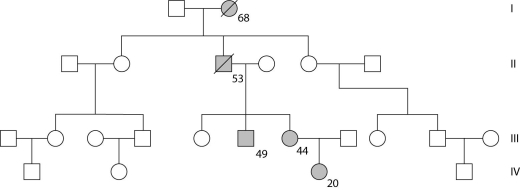 Figure 14.3
-In each generation of this family after generation I, the age at diagnosis is significantly lower than would be found in nonfamilial (sporadic)cases of this cancer (~ 63 years). What is the most likely reason?
Figure 14.3
-In each generation of this family after generation I, the age at diagnosis is significantly lower than would be found in nonfamilial (sporadic)cases of this cancer (~ 63 years). What is the most likely reason? (Multiple Choice)
4.8/5 (79)
(79) How many unique gametes could be produced through independent assortment by an individual with the genotype AaBbCCDdEE?
(Multiple Choice)
4.8/5 (81)
(81) An ideal procedure for fetal testing in humans would have which of the following features?
(Multiple Choice)
4.7/5 (69)
(69) Phenylketonuria (PKU)is a recessive human disorder in which an individual cannot appropriately metabolize a particular amino acid. The amino acid is not otherwise produced by humans. Therefore, the most efficient and effective treatment is which of the following?
(Multiple Choice)
4.8/5 (67)
(67) 
Filters
- Essay(0)
- Multiple Choice(0)
- Short Answer(0)
- True False(0)
- Matching(0)