



 Chat with AI
Exam 14: Mendel and the Gene Idea

Exam 1: Introduction: Themes in the Study of Life64 Questions
Exam 2: The Chemical Context of Life83 Questions
Exam 3: Water and Life70 Questions
Exam 4: Carbon and the Molecular Diversity of Life71 Questions
Exam 5: The Structure and Function of Large Biological Molecules109 Questions
Exam 6: A Tour of the Cell80 Questions
Exam 7: Membrane Structure and Function80 Questions
Exam 8: An Introduction to Metabolism80 Questions
Exam 9: Cellular Respiration and Fermentation107 Questions
Exam 10: Photosynthesis81 Questions
Exam 11: Cell Communication69 Questions
Exam 12: The Cell Cycle79 Questions
Exam 13: Meiosis and Sexual Life Cycles70 Questions
Exam 14: Mendel and the Gene Idea73 Questions
Exam 15: The Chromosomal Basis of Inheritance61 Questions
Exam 16: The Molecular Basis of Inheritance57 Questions
Exam 17: From Gene to Protein83 Questions
Exam 18: Regulation of Gene Expression99 Questions
Exam 19: Viruses47 Questions
Exam 20: Biotechnology72 Questions
Exam 21: Genomes and Their Evolution42 Questions
Exam 22: Descent with Modification: A Darwinian View of Life55 Questions
Exam 23: The Evolution of Populations78 Questions
Exam 24: The Origin of Species63 Questions
Exam 25: The History of Life on Earth75 Questions
Exam 26: Phylogeny and the Tree of Life73 Questions
Exam 27: Bacteria and Archaea78 Questions
Exam 28: Protists76 Questions
Exam 29: Plant Diversity I: How Plants Colonized Land74 Questions
Exam 30: Plant Diversity II: The Evolution of Seed Plants102 Questions
Exam 31: Fungi89 Questions
Exam 32: An Overview of Animal Diversity74 Questions
Exam 33: An Introduction to Invertebrates93 Questions
Exam 34: The Origin and Evolution of Vertebrates109 Questions
Exam 35: Plant Structure, Growth, and Development67 Questions
Exam 36: Resource Acquisition and Transport in Vascular Plants82 Questions
Exam 37: Soil and Plant Nutrition83 Questions
Exam 38: Angiosperm Reproduction and Biotechnology86 Questions
Exam 39: Plant Responses to Internal and External Signals108 Questions
Exam 40: Basic Principles of Animal Form and Function77 Questions
Exam 41: Animal Nutrition64 Questions
Exam 42: Circulation and Gas Exchange90 Questions
Exam 43: The Immune System100 Questions
Exam 44: Osmoregulation and Excretion69 Questions
Exam 45: Hormones and the Endocrine System72 Questions
Exam 46: Animal Reproduction94 Questions
Exam 47: Animal Development92 Questions
Exam 48: Neurons, Synapses, and Signaling73 Questions
Exam 49: Nervous Systems65 Questions
Exam 50: Sensory and Motor Mechanisms82 Questions
Exam 51: Animal Behavior69 Questions
Exam 52: An Introduction to Ecology and the Biosphere73 Questions
Exam 53: Population Ecology79 Questions
Exam 54: Community Ecology77 Questions
Exam 55: Ecosystems and Restoration Ecology81 Questions
Exam 56: Conservation Biology and Global Change67 Questions
Select questions type


In certain plants, tall is dominant to short. If a heterozygous plant is crossed with a homozygous tall plant, what is the probability that the offspring will be short?
(Multiple Choice)
4.8/5  (73)
(73) Use the following information to answer the questions below.
Labrador retrievers are black, brown, or yellow. In a cross of a black female with a brown male, results can be either all black puppies, 1/2 black to 1/2 brown puppies, or 3/4 black to 1/4 yellow puppies.
-In one type cross of black × black, the results were as follows:
9/16 black
4/16 yellow
3/16 brown
The genotype aabb must result in which of the following?
(Multiple Choice)
4.9/5 (74)
(74) Which of the following calculations require that you utilize the addition rule?
(Multiple Choice)
4.8/5 (80)
(80) How could you best predict the maximum number of alleles for a single gene whose polypeptide product is known?
(Multiple Choice)
4.9/5 (77)
(77) Use the following information to answer the questions below.
Drosophila (fruit flies) usually have long wings (+) but mutations in two different genes can result in bent wings (bt) or vestigial wings (vg).
-If a homozygous bent wing fly is mated with a homozygous vestigial wing fly, which of the following offspring would you expect?
(Multiple Choice)
4.8/5 (81)
(81) Use the following information to answer the questions below.
Tallness (T) in snapdragons is dominant to dwarfness (t), while red (R) flower color is dominant to white (r). The heterozygous condition results in pink (Rr) flower color.
-If snapdragons are heterozygous for height as well as for flower color, a mating between them will result in what ratio?
(Multiple Choice)
4.8/5 (77)
(77) Use the following information to answer the questions below.
A woman who has blood type A positive has a daughter who is type O positive and a son who is type B negative. Rh positive is a trait that shows simple dominance over Rh negative and is designated by the alleles R and r, respectively. A third gene for the MN blood group has codominant alleles M and N.
-Which of the following is a possible phenotype for the father?
(Multiple Choice)
4.9/5 (80)
(80) Use the following information to answer the questions below.
Labrador retrievers are black, brown, or yellow. In a cross of a black female with a brown male, results can be either all black puppies, 1/2 black to 1/2 brown puppies, or 3/4 black to 1/4 yellow puppies.
-How many genes must be responsible for these coat colors in Labrador retrievers?
(Multiple Choice)
4.9/5 (83)
(83) Use the following information to answer the questions below.
A woman who has blood type A positive has a daughter who is type O positive and a son who is type B negative. Rh positive is a trait that shows simple dominance over Rh negative and is designated by the alleles R and r, respectively. A third gene for the MN blood group has codominant alleles M and N.
-Which of the following is a possible genotype for the mother?
(Multiple Choice)
4.8/5 (78)
(78) The fact that all seven of the pea plant traits studied by Mendel obeyed the principle of independent assortment most probably indicates which of the following?
(Multiple Choice)
4.9/5 (94)
(94) Marfan syndrome in humans is caused by an abnormality of the connective tissue protein fibrillin. Patients are usually very tall and thin, with long spindly fingers, curvature of the spine, sometimes weakened arterial walls, and sometimes ocular problems, such as lens dislocation. Which of the following would you conclude about Marfan syndrome from this information?
(Multiple Choice)
4.8/5 (81)
(81) Two plants are crossed, resulting in offspring with a 3:1 ratio for a particular trait. What does this suggest?
(Multiple Choice)
4.7/5 (77)
(77) Why did the F₁ offspring of Mendel's classic pea cross always look like one of the two parental varieties?
(Multiple Choice)
4.7/5 (85)
(85) Most genes have many more than two alleles. However, which of the following is also true?
(Multiple Choice)
4.8/5 (86)
(86) Use the following pedigree (Figure 14.3) for a family in which dark-shaded symbols represent individuals with one of the two major types of colon cancer. Numbers under the symbols are the individual's age at the time of diagnosis.
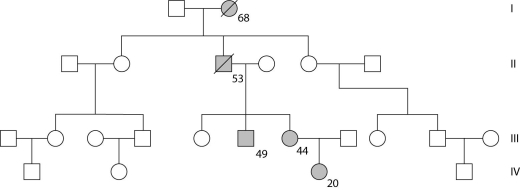 Figure 14.3
-The affected woman in generation IV is thinking about her future and asks her oncologist (cancer specialist)whether she can know whether any or all of her children will have a high risk of the same cancer. The doctor would be expected to advise which of the following?
I.genetic counseling
II.prenatal diagnosis when/if she becomes pregnant
III.testing to see whether she has the allele
IV.testing to see whether her future spouse or partner has the allele
Figure 14.3
-The affected woman in generation IV is thinking about her future and asks her oncologist (cancer specialist)whether she can know whether any or all of her children will have a high risk of the same cancer. The doctor would be expected to advise which of the following?
I.genetic counseling
II.prenatal diagnosis when/if she becomes pregnant
III.testing to see whether she has the allele
IV.testing to see whether her future spouse or partner has the allele (Multiple Choice)
4.8/5 (75)
(75) Use the following information to answer the questions below.
Labrador retrievers are black, brown, or yellow. In a cross of a black female with a brown male, results can be either all black puppies, 1/2 black to 1/2 brown puppies, or 3/4 black to 1/4 yellow puppies.
-These results indicate which of the following?
(Multiple Choice)
4.9/5 (91)
(91) Why did Mendel continue some of his experiments to the F₂ or F₃ generation?
(Multiple Choice)
4.9/5 (80)
(80) Black fur in mice (B)is dominant to brown fur (b). Short tails (T)are dominant to long tails (t). What fraction of the progeny of crosses BbTt × BBtt will be expected to have black fur and long tails?
(Multiple Choice)
4.7/5 (73)
(73) Use the following information to answer the questions below.
A woman who has blood type A positive has a daughter who is type O positive and a son who is type B negative. Rh positive is a trait that shows simple dominance over Rh negative and is designated by the alleles R and r, respectively. A third gene for the MN blood group has codominant alleles M and N.
-Which of the following is a possible partial genotype for the son?
(Multiple Choice)
5.0/5 (80)
(80) Hydrangea plants of the same genotype are planted in a large flower garden. Some of the plants produce blue flowers and others pink flowers. This can be best explained by which of the following?
(Multiple Choice)
4.9/5 (83)
(83) 
Filters
- Essay(0)
- Multiple Choice(0)
- Short Answer(0)
- True False(0)
- Matching(0)