



 Chat with AI
Exam 12: The Cell Cycle

Exam 1: Introduction: Themes in the Study of Life64 Questions
Exam 2: The Chemical Context of Life83 Questions
Exam 3: Water and Life70 Questions
Exam 4: Carbon and the Molecular Diversity of Life71 Questions
Exam 5: The Structure and Function of Large Biological Molecules109 Questions
Exam 6: A Tour of the Cell80 Questions
Exam 7: Membrane Structure and Function80 Questions
Exam 8: An Introduction to Metabolism80 Questions
Exam 9: Cellular Respiration and Fermentation107 Questions
Exam 10: Photosynthesis81 Questions
Exam 11: Cell Communication69 Questions
Exam 12: The Cell Cycle79 Questions
Exam 13: Meiosis and Sexual Life Cycles70 Questions
Exam 14: Mendel and the Gene Idea73 Questions
Exam 15: The Chromosomal Basis of Inheritance61 Questions
Exam 16: The Molecular Basis of Inheritance57 Questions
Exam 17: From Gene to Protein83 Questions
Exam 18: Regulation of Gene Expression99 Questions
Exam 19: Viruses47 Questions
Exam 20: Biotechnology72 Questions
Exam 21: Genomes and Their Evolution42 Questions
Exam 22: Descent with Modification: A Darwinian View of Life55 Questions
Exam 23: The Evolution of Populations78 Questions
Exam 24: The Origin of Species63 Questions
Exam 25: The History of Life on Earth75 Questions
Exam 26: Phylogeny and the Tree of Life73 Questions
Exam 27: Bacteria and Archaea78 Questions
Exam 28: Protists76 Questions
Exam 29: Plant Diversity I: How Plants Colonized Land74 Questions
Exam 30: Plant Diversity II: The Evolution of Seed Plants102 Questions
Exam 31: Fungi89 Questions
Exam 32: An Overview of Animal Diversity74 Questions
Exam 33: An Introduction to Invertebrates93 Questions
Exam 34: The Origin and Evolution of Vertebrates109 Questions
Exam 35: Plant Structure, Growth, and Development67 Questions
Exam 36: Resource Acquisition and Transport in Vascular Plants82 Questions
Exam 37: Soil and Plant Nutrition83 Questions
Exam 38: Angiosperm Reproduction and Biotechnology86 Questions
Exam 39: Plant Responses to Internal and External Signals108 Questions
Exam 40: Basic Principles of Animal Form and Function77 Questions
Exam 41: Animal Nutrition64 Questions
Exam 42: Circulation and Gas Exchange90 Questions
Exam 43: The Immune System100 Questions
Exam 44: Osmoregulation and Excretion69 Questions
Exam 45: Hormones and the Endocrine System72 Questions
Exam 46: Animal Reproduction94 Questions
Exam 47: Animal Development92 Questions
Exam 48: Neurons, Synapses, and Signaling73 Questions
Exam 49: Nervous Systems65 Questions
Exam 50: Sensory and Motor Mechanisms82 Questions
Exam 51: Animal Behavior69 Questions
Exam 52: An Introduction to Ecology and the Biosphere73 Questions
Exam 53: Population Ecology79 Questions
Exam 54: Community Ecology77 Questions
Exam 55: Ecosystems and Restoration Ecology81 Questions
Exam 56: Conservation Biology and Global Change67 Questions
Select questions type


Movement of the chromosomes during anaphase would be most affected by a drug that
(Multiple Choice)
4.9/5  (78)
(78) Besides the ability of some cancer cells to overproliferate, what else could logically result in a tumor?
(Multiple Choice)
4.8/5 (95)
(95) A mutation results in a cell that no longer produces a normal protein kinase for the M phase checkpoint. Which of the following would likely be the immediate result of this mutation?
(Multiple Choice)
4.8/5 (70)
(70) A group of cells is assayed for DNA content immediately following mitosis and is found to have an average of 8 picograms of DNA per nucleus. How many picograms would be found at the end of S and the end of G₂?
(Multiple Choice)
4.8/5 (83)
(83) One difference between cancer cells and normal cells is that cancer cells
(Multiple Choice)
4.9/5 (72)
(72) Use the following information to answer the questions below.
The lettered circle in Figure 12.1 shows a diploid nucleus with four chromosomes. There are two pairs of homologous chromosomes, one long and the other short. One haploid set is symbolized as black and the other haploid set is gray. The chromosomes in the unlettered circle have not yet replicated. Choose the correct chromosomal conditions for the following stages.
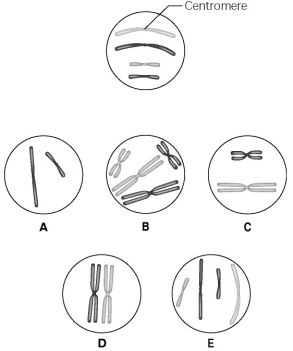 Figure 12.1
-What is the correct chromosomal condition at the prometaphase of mitosis?
Figure 12.1
-What is the correct chromosomal condition at the prometaphase of mitosis? (Multiple Choice)
4.9/5 (82)
(82) A research team began a study of a cultured cell line. Their preliminary observations showed them that the cell line did not exhibit either density-dependent inhibition or anchorage dependence. What could they conclude right away?
(Multiple Choice)
4.9/5 (67)
(67) Use the following information to answer the questions below.
The lettered circle in Figure 12.1 shows a diploid nucleus with four chromosomes. There are two pairs of homologous chromosomes, one long and the other short. One haploid set is symbolized as black and the other haploid set is gray. The chromosomes in the unlettered circle have not yet replicated. Choose the correct chromosomal conditions for the following stages.
Figure 12.1
-What is the correct chromosomal condition for one daughter nucleus at telophase of mitosis?
Figure 12.1
-What is the correct chromosomal condition for one daughter nucleus at telophase of mitosis? (Multiple Choice)
4.8/5 (82)
(82) Suppose a biologist can separate one of a dozen pieces of chromatin from a eukaryotic (animal)nucleus. It might consist of which of the following?
(Multiple Choice)
4.9/5 (84)
(84) Proteins that are involved in the regulation of the cell cycle, and that show fluctuations in concentration during the cell cycle, are called
(Multiple Choice)
4.9/5 (90)
(90) The following questions are based on Figure 12.3.
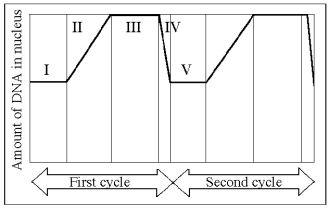 Figure 12.3
-In the figure above, mitosis is represented by which numbered part(s)of the cycle?
Figure 12.3
-In the figure above, mitosis is represented by which numbered part(s)of the cycle? (Multiple Choice)
4.9/5 (87)
(87) 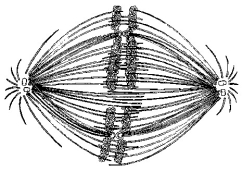 Figure 12.2
-If the cell whose nuclear material is shown in Figure 12.2 continues toward completion of mitosis, which of the following events would occur next?
Figure 12.2
-If the cell whose nuclear material is shown in Figure 12.2 continues toward completion of mitosis, which of the following events would occur next? (Multiple Choice)
4.8/5 (81)
(81) What causes the decrease in the amount of cyclin at a specific point in the cell cycle?
(Multiple Choice)
4.8/5 (89)
(89) The following information applies to the questions below.
Several organisms, primarily protists, have what are called intermediate mitotic organization.
-What is the most probable hypothesis about these intermediate forms of cell division?
(Multiple Choice)
5.0/5 (81)
(81) For a newly evolving protist, what would be the advantage of using eukaryote-like cell division rather than binary fission?
(Multiple Choice)
4.8/5 (83)
(83) For a chemotherapeutic drug to be useful for treating cancer cells, which of the following is most desirable?
(Multiple Choice)
4.8/5 (93)
(93) Use the following information to answer the questions below.
A student is looking through his light microscope (~450 X) at a squashed and stained onion root tip. Some, but not all, of the cells have clearly visible chromosome strands.
-When the cell has just completed telophase, which of the following does he see?
(Multiple Choice)
4.8/5 (88)
(88) 
Filters
- Essay(0)
- Multiple Choice(0)
- Short Answer(0)
- True False(0)
- Matching(0)