



 Chat with AI
Exam 10: Photosynthesis

Exam 1: Introduction: Themes in the Study of Life64 Questions
Exam 2: The Chemical Context of Life83 Questions
Exam 3: Water and Life70 Questions
Exam 4: Carbon and the Molecular Diversity of Life71 Questions
Exam 5: The Structure and Function of Large Biological Molecules109 Questions
Exam 6: A Tour of the Cell80 Questions
Exam 7: Membrane Structure and Function80 Questions
Exam 8: An Introduction to Metabolism80 Questions
Exam 9: Cellular Respiration and Fermentation107 Questions
Exam 10: Photosynthesis81 Questions
Exam 11: Cell Communication69 Questions
Exam 12: The Cell Cycle79 Questions
Exam 13: Meiosis and Sexual Life Cycles70 Questions
Exam 14: Mendel and the Gene Idea73 Questions
Exam 15: The Chromosomal Basis of Inheritance61 Questions
Exam 16: The Molecular Basis of Inheritance57 Questions
Exam 17: From Gene to Protein83 Questions
Exam 18: Regulation of Gene Expression99 Questions
Exam 19: Viruses47 Questions
Exam 20: Biotechnology72 Questions
Exam 21: Genomes and Their Evolution42 Questions
Exam 22: Descent with Modification: A Darwinian View of Life55 Questions
Exam 23: The Evolution of Populations78 Questions
Exam 24: The Origin of Species63 Questions
Exam 25: The History of Life on Earth75 Questions
Exam 26: Phylogeny and the Tree of Life73 Questions
Exam 27: Bacteria and Archaea78 Questions
Exam 28: Protists76 Questions
Exam 29: Plant Diversity I: How Plants Colonized Land74 Questions
Exam 30: Plant Diversity II: The Evolution of Seed Plants102 Questions
Exam 31: Fungi89 Questions
Exam 32: An Overview of Animal Diversity74 Questions
Exam 33: An Introduction to Invertebrates93 Questions
Exam 34: The Origin and Evolution of Vertebrates109 Questions
Exam 35: Plant Structure, Growth, and Development67 Questions
Exam 36: Resource Acquisition and Transport in Vascular Plants82 Questions
Exam 37: Soil and Plant Nutrition83 Questions
Exam 38: Angiosperm Reproduction and Biotechnology86 Questions
Exam 39: Plant Responses to Internal and External Signals108 Questions
Exam 40: Basic Principles of Animal Form and Function77 Questions
Exam 41: Animal Nutrition64 Questions
Exam 42: Circulation and Gas Exchange90 Questions
Exam 43: The Immune System100 Questions
Exam 44: Osmoregulation and Excretion69 Questions
Exam 45: Hormones and the Endocrine System72 Questions
Exam 46: Animal Reproduction94 Questions
Exam 47: Animal Development92 Questions
Exam 48: Neurons, Synapses, and Signaling73 Questions
Exam 49: Nervous Systems65 Questions
Exam 50: Sensory and Motor Mechanisms82 Questions
Exam 51: Animal Behavior69 Questions
Exam 52: An Introduction to Ecology and the Biosphere73 Questions
Exam 53: Population Ecology79 Questions
Exam 54: Community Ecology77 Questions
Exam 55: Ecosystems and Restoration Ecology81 Questions
Exam 56: Conservation Biology and Global Change67 Questions
Select questions type


Theodor W. Engelmann illuminated a filament of algae with light that passed through a prism, thus exposing different segments of algae to different wavelengths of light. He added aerobic bacteria and then noted in which areas the bacteria congregated. He noted that the largest groups were found in the areas illuminated by the red and blue light.
-If you ran the same experiment without passing light through a prism, what would you predict?
(Multiple Choice)
4.8/5  (70)
(70) Which of the following sequences correctly represents the flow of electrons during photosynthesis?
(Multiple Choice)
4.9/5 (78)
(78) Where are the molecules of the electron transport chain found in plant cells?
(Multiple Choice)
4.9/5 (66)
(66) Suppose the interior of the thylakoids of isolated chloroplasts were made acidic and then transferred in the dark to a pH 8 solution. What would be likely to happen?
(Multiple Choice)
4.9/5 (79)
(79) The alternative pathways of photosynthesis using the C₄ or CAM systems are said to be compromises. Why?
(Multiple Choice)
4.8/5 (68)
(68) 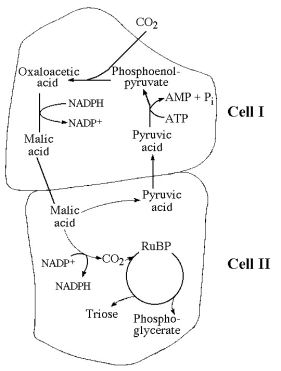 Figure 10.3
-Which of the following statements is true concerning Figure 10.3?
Figure 10.3
-Which of the following statements is true concerning Figure 10.3? (Multiple Choice)
4.9/5 (73)
(73) If photosynthesizing green algae are provided with CO₂ synthesized with heavy oxygen (¹⁸O), later analysis will show that all but one of the following compounds produced by the algae contain the ¹⁸O label. That one is
(Multiple Choice)
4.7/5 (63)
(63) If plant gene alterations cause the plants to be deficient in photorespiration, what would most probably occur?
(Multiple Choice)
4.9/5 (76)
(76) Cyclic electron flow may be photoprotective (protective to light-induced damage). Which of the following experiments could provide information on this phenomenon?
(Multiple Choice)
4.9/5 (81)
(81) Generation of proton gradients across membranes occurs during
(Multiple Choice)
4.8/5 (81)
(81) In any ecosystem, terrestrial or aquatic, what group(s)is (are)always necessary?
(Multiple Choice)
4.9/5 (82)
(82) Which of the following are directly associated with photosystem I?
(Multiple Choice)
4.8/5 (86)
(86) In autotrophic bacteria, where are the enzymes located that can carry on carbon fixation (reduction of carbon dioxide to carbohydrate)?
(Multiple Choice)
4.8/5 (77)
(77) As a research scientist, you measure the amount of ATP and NADPH consumed by the Calvin cycle in 1 hour. You find 30,000 molecules of ATP consumed, but only 20,000 molecules of NADPH. Where did the extra ATP molecules come from?
(Multiple Choice)
4.8/5 (80)
(80) In the thylakoid membranes, what is the main role of the antenna pigment molecules?
(Multiple Choice)
5.0/5 (89)
(89) Some photosynthetic bacteria (e.g., purple sulfur bacteria)have only photosystem I, whereas others (e.g., cyanobacteria)have both photosystem I and photosystem II. Which of the following might this observation imply?
(Multiple Choice)
4.8/5 (93)
(93) 
Filters
- Essay(0)
- Multiple Choice(0)
- Short Answer(0)
- True False(0)
- Matching(0)