



 Chat with AI
Exam 2: The Chemical Basis of Life

Exam 1: Introduction to the Study of Cell and Molecular Biology100 Questions
Exam 2: The Chemical Basis of Life87 Questions
Exam 3: Bioenergetics, Enzymes and Metabolism80 Questions
Exam 4: The Structure and Function of the Plasma Membrane99 Questions
Exam 5: Aerobic Respiration and the Mitochondrion99 Questions
Exam 6: Photosynthesis and the Chloroplast100 Questions
Exam 7: Interactions Between Cells and Their Environment103 Questions
Exam 8: Cytoplasmic Membrane Systems: Structure, Function, and Membrane Trafficking159 Questions
Exam 9: The Cytoskeleton and Cell Motility107 Questions
Exam 10: The Nature of the Gene and the Genome97 Questions
Exam 11: Gene Expression: From Transcription to Translation101 Questions
Exam 12: Control of Gene Expression100 Questions
Exam 13: Dna Replication and Repair98 Questions
Exam 14: Cellular Reproduction103 Questions
Exam 15: Cell Signaling and Signal Transduction: Communication Between Cells109 Questions
Exam 16: Cancer98 Questions
Exam 17: The Immune Response109 Questions
Exam 18: Techniques in Cell and Molecular Biology112 Questions
Select questions type


Carbon's suitability as the molecular framework for biochemicals stems from its:
(Multiple Choice)
4.9/5  (72)
(72) Which of these functional groups is the LEAST polar? Refer to Table 2.2 for more information if you are uncertain of the molecular structure of each one.
(Multiple Choice)
4.8/5 (78)
(78) You treat a partially purified preparation of protein with a reagent that breaks bonds between sulfur atoms. Which level(s)of protein structure are most likely to be affected? (Select all that apply)
(Multiple Choice)
4.9/5 (81)
(81) A release of hydrogen ions to a solution would most likely ____________.
(Multiple Choice)
4.9/5 (75)
(75) RNA and DNA NEVER differ in the functional groups attached to: (Select all that apply)
(Multiple Choice)
4.8/5 (90)
(90) The isotope of hydrogen which is radioactive ________________________.
(Multiple Choice)
5.0/5 (87)
(87) You discover a novel protozoan which seems able to exist in the extreme salinity of the Dead Sea. Comparative examination of its enzyme structures against those of non-halophilic protozoa are most likely to reveal that ________________.
(Multiple Choice)
5.0/5 (55)
(55) What kind of noncovalent interaction is typified by interactions between two molecules that are so close together that they can experience weak attractive forces bonding them together?
(Multiple Choice)
4.9/5 (77)
(77) Which of the groups participates exclusively in hydrophilic interactions? 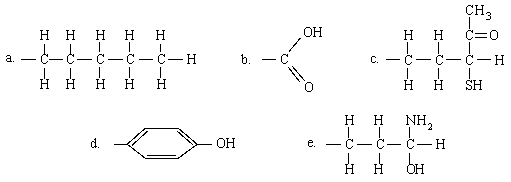
(Multiple Choice)
4.8/5 (82)
(82) Which of the following tripeptides would be most likely to be soluble in an organic (hydrophobic)solvent like benzene?
(Multiple Choice)
4.7/5 (81)
(81) How do amino acids like hydroxylysine and thyroxine, which are not among the 20 amino acids inserted into amino acid chains, get into proteins?
(Multiple Choice)
5.0/5 (82)
(82) Which organism would be a good candidate for researching genes related to nitrogen fixation?
(Multiple Choice)
4.8/5 (68)
(68) The optimal interatomic distance for strong Van der Waals interactions between atoms of two molecules is about:
(Multiple Choice)
4.8/5 (66)
(66) Which of these functional groups would make a biochemical more soluble in water? (Select all that apply)
(Multiple Choice)
4.8/5 (66)
(66) At higher proton concentrations, proteins are likely to possess:
(Multiple Choice)
4.9/5 (85)
(85) Why is silicon not suitable for making covalent bonds stable and strong enough to form the basis of living organisms, even though it is just below carbon on the periodic table?
(Multiple Choice)
4.8/5 (80)
(80) You are studying a protein. It binds to elongating polypeptide chains as they emerge from an exit channel within the ribosome's large subunit. It appears to prevent partially formed or nascent polypeptides from binding to other proteins in the cytosol, which might cause them either to aggregate or misfold. What kind of proteins is this likely to be?
(Multiple Choice)
4.9/5 (80)
(80) 
Filters
- Essay(0)
- Multiple Choice(0)
- Short Answer(0)
- True False(0)
- Matching(0)