



 Chat with AI
Exam 4: Tariffs

Exam 1: The International Economy and Globalization71 Questions
Exam 2: Foundations of Modern Trade Theory: Comparative Advantage215 Questions
Exam 3: Sources of Comparative Advantage143 Questions
Exam 4: Tariffs162 Questions
Exam 5: Nontariff Trade Barriers164 Questions
Exam 6: Trade Regulations and Industrial Policies187 Questions
Exam 7: Trade Policies for the Developing Nations305 Questions
Exam 8: Regional Trading Arrangements164 Questions
Exam 9: International Factor Movements and Multinational Enterprises123 Questions
Exam 10: The Balance-of-payments156 Questions
Exam 11: Foreign Exchange206 Questions
Exam 12: Exchange Rate Determination199 Questions
Exam 13: Mechanisms of International Adjustment107 Questions
Exam 14: Exchange Rate Adjustments and the Balance-of-payments122 Questions
Exam 15: Exchange Rate Systems and Currency Crises168 Questions
Exam 16: Macroeconomic Policy in an Open-economy72 Questions
Exam 17: International Banking: Reserves, Debt, and Risk96 Questions
Select questions type


Figure 4.3 Domestic Market for Gasoline in the United States
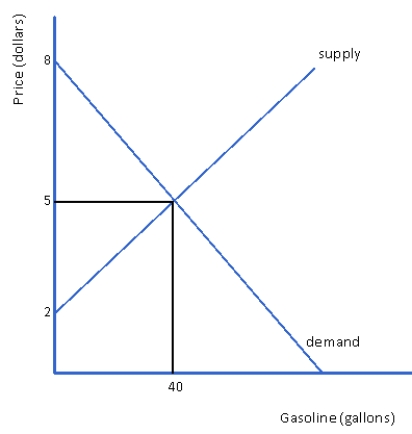 -Figure 4.3 represents the domestic market for gasoline in the United States.What is the consumer surplus in this market?
 (Multiple Choice)
4.9/5  (75)
(75) A tax of 20 cents per unit of imported cheese would be an example of:
(Multiple Choice)
4.9/5 (82)
(82) Table 4.1.Production Costs and Prices of Imported and Domestic VCRs
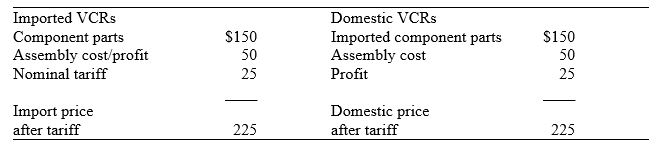 -Consider Table 4.1.After the tariff,domestic value added equals:
 (Multiple Choice)
4.8/5 (72)
(72) The deadweight losses of a tariff consist of the sum of the protective effect plus the consumption effect.
(True/False)
4.7/5 (91)
(91) If the world price of steel is $600 per ton,a specific tariff of $120 per ton is equivalent to an ad valorem tariff of 25 percent.
(True/False)
4.9/5 (81)
(81) The redistribution effect is the transfer of producer surplus to domestic consumers of the import-competing product.
(True/False)
4.9/5 (78)
(78) Unlike a specific tariff,an ad valorem tariff differentiates between commodities with different values.
(True/False)
4.7/5 (77)
(77) Suppose that Mexico is a small country and it imposes a tariff on imports.This results in
(Multiple Choice)
4.8/5 (87)
(87) According to the infant-industry argument,temporary tariff protection granted to an infant industry will help it become competitive in the world market; when international competitiveness is achieved,the tariff should be removed.
(True/False)
4.9/5 (93)
(93) Exhibit 4.2
In the absence of international trade,assume that the equilibrium price and quantity of motorcycles in Canada is $14,000 and 10 units respectively.Assuming that Canada is a small country that is unable to affect the world price of motorcycles,suppose its market is opened to international trade.As a result,the price of motorcycles falls to $12,000 and the total quantity demanded rises to 14 units; out of this total,6 units are produced in Canada while 8 units are imported.Now assume that the Canadian government levies an import tariff of $1,000 on motorcycles.
-Refer to Exhibit 4.2.The tariff's revenue effect equals $6,000.
(True/False)
4.8/5 (85)
(85) Figure 4.1 illustrates the demand and supply schedules for pocket calculators in Mexico,a "small" nation that is unable to affect the world price.
Figure 4.1.Import Tariff Levied by a "Small" Country
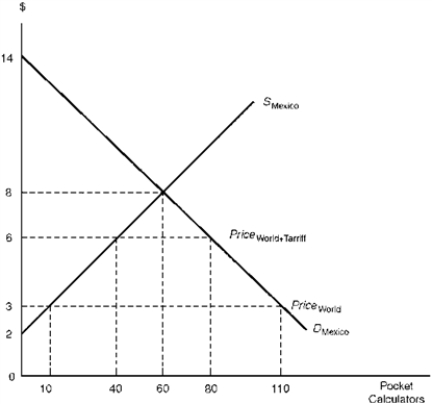 -Consider Figure 4.1.With a per-unit tariff of $3,the quantity of imports decreases to:
 (Multiple Choice)
4.9/5 (79)
(79) Exhibit 4.1
Assume that the United States imports automobiles from South Korea at a price of $20,000 per vehicle and that these vehicles are subject to an import tariff of 20 percent.Also assume that U.S.components are used in the vehicles assembled by South Korea and that these components have a value of $10,000.
-Refer to Exhibit 4.1.In the absence of the Offshore Assembly Provision of U.S.tariff policy,the price of an imported vehicle to the U.S.consumer after the tariff has been levied is:
(Multiple Choice)
4.9/5 (79)
(79) If we consider the interests of both consumers and producers,then a policy of tariff reduction in the U.S.auto industry is:
(Multiple Choice)
5.0/5 (87)
(87) A tariff quota is a combination of a specific tariff and an ad valorem tariff.
(True/False)
4.8/5 (83)
(83) Relatively low wages in Mexico make it impossible for U.S.manufacturers of labor-intensive goods to compete against Mexican manufacturers.
(True/False)
5.0/5 (89)
(89) As long as it is assumed that a nation accounts for a negligible portion of international trade,its levying an import tariff necessarily increases its overall welfare.
(True/False)
4.9/5 (76)
(76) Should the home country be "large" relative to the world,its imposition of a tariff on imports would lead to an increase in domestic welfare if the terms-of-trade effect exceeds the sum of the:
(Multiple Choice)
4.7/5 (91)
(91) 
Filters
- Essay(0)
- Multiple Choice(0)
- Short Answer(0)
- True False(0)
- Matching(0)