



 Chat with AI
Exam 4: Tariffs

Exam 1: The International Economy and Globalization71 Questions
Exam 2: Foundations of Modern Trade Theory: Comparative Advantage215 Questions
Exam 3: Sources of Comparative Advantage143 Questions
Exam 4: Tariffs162 Questions
Exam 5: Nontariff Trade Barriers164 Questions
Exam 6: Trade Regulations and Industrial Policies187 Questions
Exam 7: Trade Policies for the Developing Nations305 Questions
Exam 8: Regional Trading Arrangements164 Questions
Exam 9: International Factor Movements and Multinational Enterprises123 Questions
Exam 10: The Balance-of-payments156 Questions
Exam 11: Foreign Exchange206 Questions
Exam 12: Exchange Rate Determination199 Questions
Exam 13: Mechanisms of International Adjustment107 Questions
Exam 14: Exchange Rate Adjustments and the Balance-of-payments122 Questions
Exam 15: Exchange Rate Systems and Currency Crises168 Questions
Exam 16: Macroeconomic Policy in an Open-economy72 Questions
Exam 17: International Banking: Reserves, Debt, and Risk96 Questions
Select questions type


The imposition of tariffs on imports results in deadweight welfare losses for the home economy.These losses consist of the:
(Multiple Choice)
4.8/5  (78)
(78) Table 4.1.Production Costs and Prices of Imported and Domestic VCRs
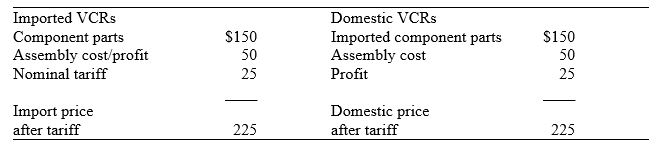 -Consider Table 4.1.The nominal tariff rate on imported VCRs equals:
 (Multiple Choice)
4.8/5 (77)
(77) If a Canadian manufacturing firm uses some imported inputs in the production process,the most accurate measure of the rate of protection is the
(Multiple Choice)
4.8/5 (86)
(86) A problem encountered when implementing an "infant industry" tariff is that:
(Multiple Choice)
4.9/5 (80)
(80) Which trade policy results in the government levying a "two-tier" tariff on imported goods?
(Multiple Choice)
4.8/5 (78)
(78) A limitation of a specific tariff is that it provides a constant level of protection for domestic commodities regardless of fluctuations in their prices over time.
(True/False)
4.9/5 (68)
(68) Which type of tariff is not used by the American government?
(Multiple Choice)
4.9/5 (71)
(71) An import tariff will worsen the terms of trade for a "small" country but improve the terms of trade for a "large" country.
(True/False)
4.9/5 (76)
(76) With a compound tariff,a domestic importer of an automobile might be required to pay a duty of $200 plus 4 percent of the value of the automobile.
(True/False)
4.8/5 (88)
(88) A worker is likely to benefit from a tariff in the short run if the worker is employed in the industry that is protected by the tariff.
(True/False)
4.8/5 (74)
(74) If Ecuador is considered to be a "small" country,a tariff will ______ increase its national welfare.
(Multiple Choice)
4.8/5 (84)
(84) A ad valorem tariff provides domestic producers a declining degree of protection against import-competing goods during periods of changing prices.
(True/False)
4.9/5 (83)
(83) To protect domestic producers from foreign competition,the U.S.government levies both import tariffs and export tariffs.
(True/False)
4.9/5 (91)
(91) Table 4.1.Production Costs and Prices of Imported and Domestic VCRs
-Consider Table 4.1.Prior to the tariff,the total price of domestically-produced VCRs is:
-Consider Table 4.1.Prior to the tariff,the total price of domestically-produced VCRs is: (Multiple Choice)
4.8/5 (71)
(71) A compound tariff permits a specified amount of goods to be imported at one tariff rate while any imports above this amount are subjected to a higher tariff rate.
(True/False)
4.8/5 (78)
(78) Tariff avoidance is the legal utilization of the tariff system to one's own advantage in order to reduce the amount of tariff that is payable by means that are within the law.
(True/False)
4.8/5 (81)
(81) A country gains from international trade when its post-trade consumption point
(Multiple Choice)
4.8/5 (86)
(86) Suppose that the United States eliminates its tariff on steel imports,permitting foreign-produced steel to enter the U.S.market.Steel prices to U.S.consumers would be expected to:
(Multiple Choice)
4.9/5 (85)
(85) 
Filters
- Essay(0)
- Multiple Choice(0)
- Short Answer(0)
- True False(0)
- Matching(0)