



 Chat with AI
Exam 2: Polynomial and Rational Functions

Exam 1: Functions and Their Graphs120 Questions
Exam 2: Polynomial and Rational Functions120 Questions
Exam 3: Exponential and Logarithmic Functions120 Questions
Exam 4: Trigonometric Functions120 Questions
Exam 5: Analytic Trigonometry120 Questions
Exam 6: Additional Topics in Trigonometry120 Questions
Exam 7: Linear Systems and Matrices120 Questions
Exam 8: Sequences, Series, and Probability118 Questions
Exam 9: Topics in Analytic Geometry120 Questions
Exam 10: Analytic Geometry in Three Dimensions120 Questions
Exam 11: Limits and an Introduction to Calculus120 Questions
Select questions type


Find the quadratic function whose graph intersects the -axis at and and the -axis at .
(Multiple Choice)
4.9/5  (69)
(69) Which of the following is the graph of the given equation?
(Multiple Choice)
4.8/5 (70)
(70) Find the quadratic function whose graph intersects the -axis at and and the -axis at .
(Multiple Choice)
4.8/5 (71)
(71) Find two positive real numbers whose product is a maximum and whose sum is 116 .
(Multiple Choice)
4.8/5 (79)
(79) Find the zeros of the function below algebraically, if any exist.
(Multiple Choice)
4.8/5 (77)
(77) Determine the vertex of the graph of the quadratic function .
(Multiple Choice)
4.8/5 (78)
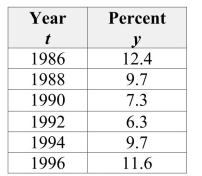
(78) The interest rates that banks charge to borrow money fluctuate with the economy. The interest rate charged by a bank in a certain country is given in the table below. Let represent the year, with corresponding to 1986 . Use the regression feature of a graphing utility to find a quadratic model of the form for the data.
(Multiple Choice)
4.8/5 (80)
(80) Write the polynomial in completely factored form. (Hint: One factor is .)
(Multiple Choice)
4.9/5 (75)
(75) Find the zeros of the function below algebraically, if any exist.
(Multiple Choice)
4.9/5 (74)
(74) 
Filters
- Essay(0)
- Multiple Choice(0)
- Short Answer(0)
- True False(0)
- Matching(0)