



 Chat with AI
Exam 2: Polynomial and Rational Functions

Exam 1: Functions and Their Graphs120 Questions
Exam 2: Polynomial and Rational Functions120 Questions
Exam 3: Exponential and Logarithmic Functions120 Questions
Exam 4: Trigonometric Functions120 Questions
Exam 5: Analytic Trigonometry120 Questions
Exam 6: Additional Topics in Trigonometry120 Questions
Exam 7: Linear Systems and Matrices120 Questions
Exam 8: Sequences, Series, and Probability118 Questions
Exam 9: Topics in Analytic Geometry120 Questions
Exam 10: Analytic Geometry in Three Dimensions120 Questions
Exam 11: Limits and an Introduction to Calculus120 Questions
Select questions type


Find a polynomial function with following characteristics.
Degree: 4
Zero: 4 , multiplicity: 2
Zero: , multiplicity: 2
Falls to the left,
Falls to the right
Absolute value of the leading coefficient is one
(Multiple Choice)
4.8/5  (81)
(81) Use the regression feature of a graphing utility to find a quadratic model for the data below.
-2 -7.3 -1 -2 0 -1 1 -4.8 2 -11.4 3 -22.8 4 -37.8
(Multiple Choice)
5.0/5 (64)
(64) Determine the vertex of the graph of the quadratic function .
(Multiple Choice)
4.8/5 (83)
(83) Write the complex conjugate of the following complex number and then multiply the number by the complex conjugate. Write the result in standard form.
(Multiple Choice)
4.8/5 (85)
(85) Identify any horizontal and vertical asymptotes of the function below.
(Multiple Choice)
4.8/5 (76)
(76) Suppose the IQ scores , rounded to the nearest for a group of people are summarized in the table below. Use the regression feature of a graphing utility to find a quadratic function of the form for the data.
IQ Score Number of People 70 50 80 76 90 89 100 93 110 74 120 53 130 16
(Multiple Choice)
4.9/5 (62)
(62) Determine the vertex of the graph of the quadratic function .
(Multiple Choice)
4.8/5 (83)
(83) Use the regression feature of a graphing utility to find a quadratic model for the data below.
-2 15.7 -1 3.5 0 -2.7 1 -2.9 2 3.7 3 15.8 4 33.6
(Multiple Choice)
4.8/5 (75)
(75) Determine the vertex of the graph of the quadratic function .
(Multiple Choice)
4.8/5 (90)
(90) If is a root of , use synthetic division to factor the polynomial completely and list all real solutions of the equation.
(Multiple Choice)
4.8/5 (73)
(73) Find a polynomial function of the lowest degree with real coefficients that has the zeros below and whose leading coefficient is one.
(Multiple Choice)
4.7/5 (75)
(75) Find all real zeros of the polynomial and determine the mutiplicity of each.
(Multiple Choice)
4.9/5 (71)
(71) Find all real zeros of the polynomial and determine the mutiplicity of each.
(Multiple Choice)
4.9/5 (68)
(68) Which of the given graphs is the graph of the polynomial function below?
Graph 1 :
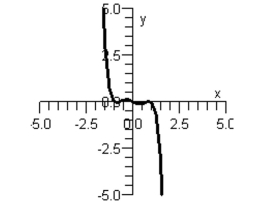 Graph 2:
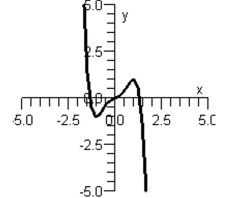 Graph 3 :
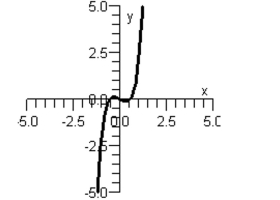 Graph 4 :
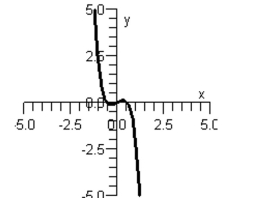 Graph 5 :
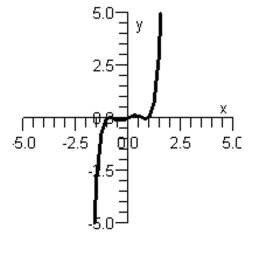
Graph 2:
Graph 3 :
Graph 4 :
Graph 5 :
(Multiple Choice)
4.9/5 (74)
(74) If is a root of , use synthetic division to factor the polynomial completely and list all real solutions of the equation.
(Multiple Choice)
4.9/5 (74)
(74) 
Filters
- Essay(0)
- Multiple Choice(0)
- Short Answer(0)
- True False(0)
- Matching(0)