



 Chat with AI
Exam 16: Electric Charge and Electric Field

Exam 1: Introduction, Measurement, Estimating29 Questions
Exam 2: Describing Motion: Kinematics in One Dimension527 Questions
Exam 3: Kinematics in Two Dimensions; Vectors183 Questions
Exam 4: Dynamics: Newtons Laws of Motion146 Questions
Exam 5: Circular Motion; Gravitation105 Questions
Exam 6: Work and Energy153 Questions
Exam 7: Linear Momentum139 Questions
Exam 8: Rotational Motion148 Questions
Exam 9: Static Equilibrium; Elasticity and Fracture83 Questions
Exam 10: Fluids98 Questions
Exam 11: Oscillations and Waves114 Questions
Exam 12: Sound21 Questions
Exam 13: Temperature and Kinetic Theory87 Questions
Exam 14: Heat88 Questions
Exam 15: The Laws of Thermodynamics78 Questions
Exam 16: Electric Charge and Electric Field99 Questions
Exam 17: Electric Potential107 Questions
Exam 18: Electric Currents96 Questions
Exam 19: Dc Circuits384 Questions
Exam 20: Magnetism164 Questions
Exam 21: Electromagnetic Induction and Faradays Law60 Questions
Exam 22: Electromagnetic Waves167 Questions
Exam 23: Light: Geometric Optics144 Questions
Exam 24: The Wave Nature of Light58 Questions
Exam 25: Optical Instruments156 Questions
Exam 26: The Special Theory of Relativity126 Questions
Exam 27: Early Quantum Theory and Models of the Atom192 Questions
Exam 28: Quantum Mechanics of Atoms74 Questions
Exam 29: Molecules and Solids26 Questions
Exam 30: Nuclear Physics and Radioactivity153 Questions
Exam 31: Nuclear Energy; Effects and Uses of Radiation36 Questions
Exam 32: Elementary Particles19 Questions
Exam 33: Astrophysics and Cosmology25 Questions
Select questions type


Two equally charged tiny spheres of mass are placed apart. When released, they begin to accelerate away from each other at . What is the magnitude of the charge on each sphere, assuming only that the electric force is present?
(Multiple Choice)
4.7/5  (80)
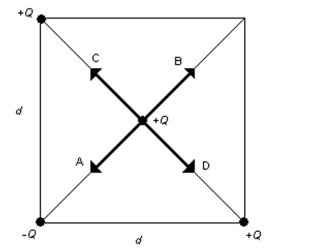
(80) Four point charges of equal magnitudes but with varying signs are arranged on three of the corners and at the center of the square of side as shown in the figure. Which one of the arrows shown represents the net force acting on the center charge?
(Multiple Choice)
4.9/5 (84)
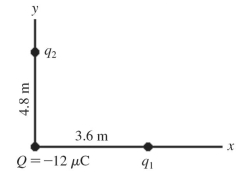
(84) A point charge , and two other charges and , are placed on axes as shown in the figure. The electric force components on charge are and
(a) How many excess electrons are there in charge ?
(b) What are the charges and q2, including their signs?
(Short Answer)
4.9/5 (85)
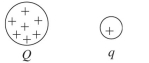
(85) In outer space, a positive charge is released near a positive fixed charge , as shown in the figure. As moves away from , what is true about the motion of ? (There may be more than one correct choice.)
(Multiple Choice)
4.9/5 (77)
(77) Two point charges of and are placed inside a cube having sides long. What is the net electric flux passing through the surface of the cube? . )
A)
B)
C)
D)
E)
(Essay)
4.9/5 (62)
(62) Three point charges are located on the -axis at the following positions: is at is at , and is at . What is the magnitude of the electric force on )
(Multiple Choice)
4.8/5 (69)
(69) Two large closely-spaced parallel metal plates are uniformly and oppositely charged and the electric field between them is .
(a) What is the charge per unit area on each plate?
(b) If the plates are now moved two times farther apart, what is the electric field between the plates?
(Short Answer)
4.9/5 (88)
(88) The force of attraction that a point charge exerts on point charge has magnitude . How far apart are these two charges?
(Multiple Choice)
4.9/5 (66)
(66) If a charge generator builds a negative static charge of , how many electrons are transferred to it during this process.
(Multiple Choice)
4.8/5 (76)
(76) Two parallel square metal plates, on each side, are apart and carry equal but opposite charge uniformly distributed over their facing surfaces. How much excess charge is there on each plate if the electric field between the plates has a magnitude of
(Short Answer)
4.8/5 (72)
(72) The zirconium nucleus contains 40 protons, and an electron is from the nucleus. What is the electric force on the electron due to the nucleus? . )
(Multiple Choice)
4.8/5 (86)
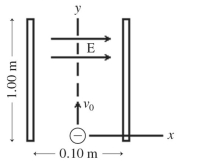
(86) An electron is projected with an initial velocity along the -axis, which is the centerline between a pair of charged plates, as shown in the figure. The plates are long and are separated by . A uniform electric field of magnitude in the -direction is present between the plates. If the magnitude of the acceleration of the electron is measured to be , what is the magnitude of the electric field between the plates? , )
(Multiple Choice)
4.8/5 (84)
(84) Two tiny particles having charges of and are placed along the -axis. The particle is at , and the other particle is at . Where must a third charged particle be placed along the -axis so that it does not experience any net electric force due to the other two particles?
(Multiple Choice)
4.9/5 (67)
(67) Consider a container of of hydrogen, (one mole). Suppose you removed all the electrons and moved them to the other side of the earth (Earth's radius is molecules
(a) How much charge is left behind after you remove the electrons?
(b) What electric force do the protons exert on the electrons after they are separated as described?
(Short Answer)
4.8/5 (93)
(93) A small insulating sphere carries a charge of and is hanging by a vertical silk thread from a fixed point in the ceiling. An external uniform vertical electric field is now applied. If the applied electric field has a magnitude of and is directed downward, what is the tension in the silk thread?
(Multiple Choice)
4.9/5 (89)
(89) How far apart should two protons be if the electrical force of repulsion on each one is equal to its weight on the earth? , )
(Short Answer)
4.8/5 (84)
(84) A thin spherical copper shell of radius carries an excess charge of . How many excess electrons are on (a) the outer surface of the shell, and (b) the inner surface? (e )
(Short Answer)
4.7/5 (62)
(62) 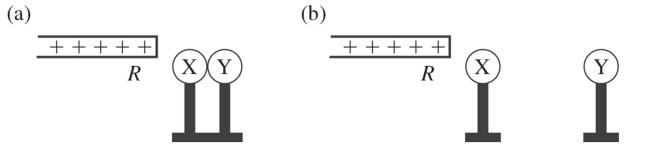 and are two initially uncharged metal spheres on insulating stands, and they are in contact with each other. A positively charged rod is brought close to as shown in part (a) of the figure. Sphere is now moved away from , as shown in part (b). What are the final charge states of and ?
 (Multiple Choice)
4.8/5 (77)
(77) Two parallel square metal plates that are apart and on each side carry equal but opposite charges uniformly spread out over their facing surfaces. How many excess electrons are on the negative surface if the electric field between the plates has a magnitude of
(Short Answer)
4.8/5 (87)
(87) 
Filters
- Essay(0)
- Multiple Choice(0)
- Short Answer(0)
- True False(0)
- Matching(0)