



 Chat with AI
Exam 16: Electric Charge and Electric Field

Exam 1: Introduction, Measurement, Estimating29 Questions
Exam 2: Describing Motion: Kinematics in One Dimension527 Questions
Exam 3: Kinematics in Two Dimensions; Vectors183 Questions
Exam 4: Dynamics: Newtons Laws of Motion146 Questions
Exam 5: Circular Motion; Gravitation105 Questions
Exam 6: Work and Energy153 Questions
Exam 7: Linear Momentum139 Questions
Exam 8: Rotational Motion148 Questions
Exam 9: Static Equilibrium; Elasticity and Fracture83 Questions
Exam 10: Fluids98 Questions
Exam 11: Oscillations and Waves114 Questions
Exam 12: Sound21 Questions
Exam 13: Temperature and Kinetic Theory87 Questions
Exam 14: Heat88 Questions
Exam 15: The Laws of Thermodynamics78 Questions
Exam 16: Electric Charge and Electric Field99 Questions
Exam 17: Electric Potential107 Questions
Exam 18: Electric Currents96 Questions
Exam 19: Dc Circuits384 Questions
Exam 20: Magnetism164 Questions
Exam 21: Electromagnetic Induction and Faradays Law60 Questions
Exam 22: Electromagnetic Waves167 Questions
Exam 23: Light: Geometric Optics144 Questions
Exam 24: The Wave Nature of Light58 Questions
Exam 25: Optical Instruments156 Questions
Exam 26: The Special Theory of Relativity126 Questions
Exam 27: Early Quantum Theory and Models of the Atom192 Questions
Exam 28: Quantum Mechanics of Atoms74 Questions
Exam 29: Molecules and Solids26 Questions
Exam 30: Nuclear Physics and Radioactivity153 Questions
Exam 31: Nuclear Energy; Effects and Uses of Radiation36 Questions
Exam 32: Elementary Particles19 Questions
Exam 33: Astrophysics and Cosmology25 Questions
Select questions type


Two coins (dimes) carrying identical charges are lying apart on a table. If each of these coins experiences an electrostatic force of magnitude due to the other coin, how large is the charge on each coin?
(Multiple Choice)
5.0/5  (77)
(77) Two tiny particles having charges of and are placed along the -axis. The particle is at , and the other particle is at . Where on the -axis must a third charged particle be placed so that it does not experience any net electrostatic force due to the other two particles?
(Multiple Choice)
5.0/5 (75)
(75) When point charge is from a second point charge, the force each one experiences a force of . What is the magnitude of the second charge?
(Multiple Choice)
4.9/5 (64)
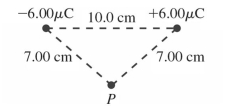
(64) An electric dipole consists of charges of that are apart, as shown in the figure. Find the magnitude and direction of the electric field this dipole produces at point , which is from each charge.
(Short Answer)
4.8/5 (62)
(62) Three equal-magnitude point charges of varying signs are placed at three of the corners of a square of side as shown in the figure. Which one of the arrows shown represents the direction of the net electric field at the vacant corner of the square?

(Multiple Choice)
4.9/5 (73)
(73) Three equal-magnitude point charges of varying signs are placed at the corners of a square of side as shown in the figure. Which one of the arrows shown represents the direction of the net electric field at the center of the square?

(Multiple Choice)
4.9/5 (85)
(85) A tiny 0.0250- oil drop containing 15 excess electrons is suspended between two horizontally closely-spaced metal plates that carry equal but opposite charges on their facing surfaces. The plates are both circular with a radius of
(a) How much excess charge must be on each plate to hold the oil drop steady?
(b) Which plate must be positive, the upper one or the lower one?
(Short Answer)
5.0/5 (71)
(71) Two point charges, and , are separated by a distance . If the magnitudes of both charges are doubled and their separation is also doubled, what happens to the electrical force that each charge exerts on the other one?
(Multiple Choice)
4.8/5 (72)
(72) Suppose you wanted to hold up an electron against the force of gravity by the attraction of a fixed proton some distance above it. How far above the electron would the proton have to be?
(Multiple Choice)
4.8/5 (91)
(91) Which one of the arrows shown in the figure best represents the direction of the electric field between the two uniformly charged metal plates?

(Multiple Choice)
4.8/5 (90)
(90) Two stationary point charges and are shown in the figure along with a sketch of some field lines representing the electric field produced by them. What can you deduce from the sketch?

(Multiple Choice)
4.9/5 (70)
(70) An electron and a proton are released simultaneously from rest and start moving toward each other due to their electrostatic attraction, with no other forces present. Which of the following statements are true just before they are about to collide? (There could be more than one correct choice.)
(Multiple Choice)
4.7/5 (86)
(86) Gaussian surfaces and B enclose the same positive charge . The area of Gaussian surface A is three times larger than that of Gaussian surface B. The electric flux through Gaussian surface is
(Multiple Choice)
4.9/5 (88)
(88) What is the magnitude of the electric field from a tiny object that carries an excess charge of
(Multiple Choice)
4.9/5 (72)
(72) A small object with a charge is accelerating horizontally on a friction-free surface at due only to an electric field. If the object has a mass of , what is the magnitude of the electric field?
(Multiple Choice)
4.9/5 (79)
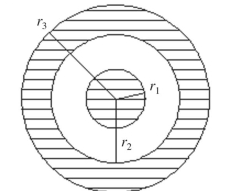
(79) In the figure, a conducting sphere of radius is placed at the center of a spherical conducting shell of inner radius and outer radius . The inner sphere carries an excess charge of . The outer spherical shell carries a net excess charge of . Calculate the magnitude of the electric field at the following distances from the center of the spheres.
(a) (in the air space between spheres),
(b) (in the metal of the spherical shell), and
(c) (outside the spherical shell).
(Short Answer)
4.8/5 (80)
(80) If a point charge of experiences an electrostatic upward force of at a certain Iocation in the laboratory, what are the magnitude and direction of the electric field at that location?
(Short Answer)
4.8/5 (73)
(73) Three equal positive point charges are placed at the corners of a square of side as shown in the figure. Which one of the arrows shown represents the direction of the net electric field at the center of the square?

(Multiple Choice)
4.9/5 (81)
(81) The electric field at a point from a small object points toward the object with a strength of . What is the object's charge ?
(Multiple Choice)
5.0/5 (80)
(80) As shown in the figure, the charge is midway between two other charges. If , what must be the charge so that charge remains stationary as and are held in place?

(Multiple Choice)
4.9/5 (85)
(85) 
Filters
- Essay(0)
- Multiple Choice(0)
- Short Answer(0)
- True False(0)
- Matching(0)