



 Chat with AI
Exam 6: Work and Energy

Exam 1: Introduction, Measurement, Estimating29 Questions
Exam 2: Describing Motion: Kinematics in One Dimension527 Questions
Exam 3: Kinematics in Two Dimensions; Vectors183 Questions
Exam 4: Dynamics: Newtons Laws of Motion146 Questions
Exam 5: Circular Motion; Gravitation105 Questions
Exam 6: Work and Energy153 Questions
Exam 7: Linear Momentum139 Questions
Exam 8: Rotational Motion148 Questions
Exam 9: Static Equilibrium; Elasticity and Fracture83 Questions
Exam 10: Fluids98 Questions
Exam 11: Oscillations and Waves114 Questions
Exam 12: Sound21 Questions
Exam 13: Temperature and Kinetic Theory87 Questions
Exam 14: Heat88 Questions
Exam 15: The Laws of Thermodynamics78 Questions
Exam 16: Electric Charge and Electric Field99 Questions
Exam 17: Electric Potential107 Questions
Exam 18: Electric Currents96 Questions
Exam 19: Dc Circuits384 Questions
Exam 20: Magnetism164 Questions
Exam 21: Electromagnetic Induction and Faradays Law60 Questions
Exam 22: Electromagnetic Waves167 Questions
Exam 23: Light: Geometric Optics144 Questions
Exam 24: The Wave Nature of Light58 Questions
Exam 25: Optical Instruments156 Questions
Exam 26: The Special Theory of Relativity126 Questions
Exam 27: Early Quantum Theory and Models of the Atom192 Questions
Exam 28: Quantum Mechanics of Atoms74 Questions
Exam 29: Molecules and Solids26 Questions
Exam 30: Nuclear Physics and Radioactivity153 Questions
Exam 31: Nuclear Energy; Effects and Uses of Radiation36 Questions
Exam 32: Elementary Particles19 Questions
Exam 33: Astrophysics and Cosmology25 Questions
Select questions type


Matthew pulls his little sister Sarah along the horizontal ground in a wagon. He exerts a force on the wagon of 60.0 N at an angle of above the horizontal. If he pulls her a distance of 12.0 m, how much work does Matthew do?
(Multiple Choice)
4.9/5  (87)
(87) Three cars (car F, car G, and car H) are moving with the same speed and slam on their brakes. The most massive car is car F , and the least massive is car H. If the tires of all three cars have identical coefficients of kinetic friciton with the road surface, which car travels the longest distance to skid to a stop?
(Multiple Choice)
4.9/5 (75)
(75) You and your friend, who weighs the same as you, want to go to the top of the Eiffel Tower. Your friend takes the elevator straight up. You decide to walk up the spiral stairway, taking longer to do
So) Compare the gravitational potential energy of you and your friend, after you both reach the
Top)
(Multiple Choice)
4.9/5 (78)
(78) If the force on an object is in the negative direction, the work it does on the object must be
(Multiple Choice)
4.8/5 (92)
(92) A 60-kg skier starts from rest from the top of a 50-m high slope. If the work done by friction is -6.0 kJ, what is the speed of the skier on reaching the bottom of the slope?
(Multiple Choice)
4.8/5 (80)
(80) An ideal spring stretches by 21.0 cm when a 135-N object is hung from it. If instead you hang a fish from this spring, what is the weight of a fish that would stretch the spring by 31.0 cm?
(Multiple Choice)
4.8/5 (87)
(87) An ideal spring has a spring constant (force constant) of 60 N/m. How much energy does it store when it is stretched by 1.0 cm?
(Multiple Choice)
4.9/5 (72)
(72) At what minimum rate is a 60.0-kg boy using energy when, in 8.00 s, he runs up a flight of stairs that is 10.0-m high?
(Multiple Choice)
4.9/5 (80)
(80) An object attached to a spring is pulled across a horizontal frictionless surface. If the force constant (spring constant) of the spring is 45 N/m and the spring is stretched by 0.88 m when the object is accelerating at
what is the mass of the object?
(Multiple Choice)
4.8/5 (72)
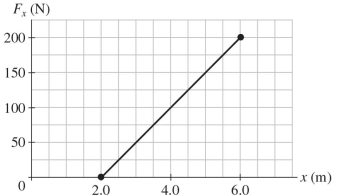
(72) The graph in the figure shows the magnitude of the net horizontal force on a 25-kg package as a function of the position x of the package. Just before the force was applied, the package was originally sliding at 6.0 m/s in the +x direction on a smooth horizontal floor. Find the x component of the velocity of the package just after the force has stopped in each of the following cases.
(a) The force is applied in the same direction as the original velocity of the box.
(b) The force is applied in the opposite direction to the original velocity of the box.
(Short Answer)
5.0/5 (72)
(72) A force acts on an object, causing it to move parallel to the force. The graph in the figure shows this force as a function of the position of the object. How much work does the force do as the object moves from 6 m to 12 m ?

(Multiple Choice)
5.0/5 (77)
(77) A tennis ball bounces on the floor three times, and each time it loses 23.0% of its energy due to heating. How high does it bounce after the third time, if we released it 4.0 m from the floor?
(Multiple Choice)
4.9/5 (91)
(91) A 3.0-kg brick rests on a perfectly smooth ramp inclined at 34° above the horizontal. The brick is kept from sliding down the plane by an ideal spring that is aligned with the surface and attached
To a wall above the brick. The spring has a spring constant (force constant) of 120 N/m. By how
Much does the spring stretch with the brick attached?
(Multiple Choice)
5.0/5 (87)
(87) A person carries a 25.0-N rock through the path shown in the figure, starting at point A and ending at point B . The total time from A to B is 1.50 min. How much work did gravity do on the rock between A and B ?

(Multiple Choice)
4.9/5 (74)
(74) Two frisky otters slide down frictionless hillsides of the same height but different slopes. The slope of the hill of otter 1 is while the slope of the hill of otter 2 is If both start from rest, which otter is moving faster when she reaches the bottom of her hill?
(Multiple Choice)
4.8/5 (80)
(80) A small but dense 2.0-kg stone is attached to one end of a very light rod that is 1.2 m long. The other end of the rod is attached to a frictionless pivot. The rod is raised until it is vertical, with the stone above the pivot. The rod is released and the stone moves in a vertical circle with no air resistance. What is the tension in the rod as the stone moves through the bottom of the circle?
(Multiple Choice)
4.8/5 (90)
(90) A sled is moving along a horizontal surface with a speed of 5.7 m/s. It then slides up a rough hill having a slope of above the horizontal. The coefficient of kinetic friction between the sled and the surface of the hill is 0.26 . How far along the surface does the block travel up the incline?
(Short Answer)
4.9/5 (73)
(73) A 1500-kg car accelerates from rest to 25 m/s in 7.0 s. What is the average power delivered by the engine? (1 hp = 746 W)
(Multiple Choice)
4.8/5 (77)
(77) If electricity costs , how much would it cost you to run a stereo system hours per day for weeks?
(Multiple Choice)
4.8/5 (82)
(82) A stone can slide down one of four different frictionless ramps, as shown in the figure. For which ramp will the speed of the ball be the greatest at the bottom?

(Multiple Choice)
4.9/5 (90)
(90) 
Filters
- Essay(0)
- Multiple Choice(0)
- Short Answer(0)
- True False(0)
- Matching(0)