



 Chat with AI
Exam 6: Work and Energy

Exam 1: Introduction, Measurement, Estimating29 Questions
Exam 2: Describing Motion: Kinematics in One Dimension527 Questions
Exam 3: Kinematics in Two Dimensions; Vectors183 Questions
Exam 4: Dynamics: Newtons Laws of Motion146 Questions
Exam 5: Circular Motion; Gravitation105 Questions
Exam 6: Work and Energy153 Questions
Exam 7: Linear Momentum139 Questions
Exam 8: Rotational Motion148 Questions
Exam 9: Static Equilibrium; Elasticity and Fracture83 Questions
Exam 10: Fluids98 Questions
Exam 11: Oscillations and Waves114 Questions
Exam 12: Sound21 Questions
Exam 13: Temperature and Kinetic Theory87 Questions
Exam 14: Heat88 Questions
Exam 15: The Laws of Thermodynamics78 Questions
Exam 16: Electric Charge and Electric Field99 Questions
Exam 17: Electric Potential107 Questions
Exam 18: Electric Currents96 Questions
Exam 19: Dc Circuits384 Questions
Exam 20: Magnetism164 Questions
Exam 21: Electromagnetic Induction and Faradays Law60 Questions
Exam 22: Electromagnetic Waves167 Questions
Exam 23: Light: Geometric Optics144 Questions
Exam 24: The Wave Nature of Light58 Questions
Exam 25: Optical Instruments156 Questions
Exam 26: The Special Theory of Relativity126 Questions
Exam 27: Early Quantum Theory and Models of the Atom192 Questions
Exam 28: Quantum Mechanics of Atoms74 Questions
Exam 29: Molecules and Solids26 Questions
Exam 30: Nuclear Physics and Radioactivity153 Questions
Exam 31: Nuclear Energy; Effects and Uses of Radiation36 Questions
Exam 32: Elementary Particles19 Questions
Exam 33: Astrophysics and Cosmology25 Questions
Select questions type


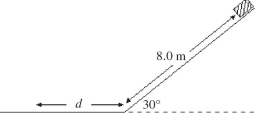
An object with a mass of 10 kg is initially at rest at the top of a frictionless inclined plane that rises at 30° above the horizontal. At the top, the object is initially 8.0 m from the bottom of the incline, as
Shown in the figure. When the object is released from this position, it eventually stops at a distance
D from the bottom of the inclined plane along a horizontal surface, as shown. The coefficient of
Kinetic friction between the horizontal surface and the object is 0.20, and air resistance is negligible.
Find the distance d.
(Multiple Choice)
4.8/5  (88)
(88) How much work would a child do while pulling a 12-kg wagon a distance of 4.3 m with a 22 N force?
(Multiple Choice)
4.9/5 (91)
(91) A 5.0-N projectile leaves the ground with a kinetic energy of 220 J. At the highest point in its trajectory, its kinetic energy is 120 J. To what vertical height, relative to its launch point, did it rise
If there was no air resistance?
(Multiple Choice)
4.9/5 (85)
(85) An object hits a wall and bounces back with half of its original speed. What is the ratio of the final kinetic energy to the initial kinetic energy of the object?
(Multiple Choice)
4.7/5 (86)
(86) A rock falls from a vertical cliff that is 4.0 m tall and experiences no significant air resistance as it falls. At what speed will its gravitational potential energy (relative to the base of the cliff) be equal
To its kinetic energy?
(Multiple Choice)
4.9/5 (64)
(64) A certain car traveling at 34.0 mph skids to a stop in 29 meters from the point where the brakes were applied. In approximately what distance would the car have stopped had it been going 105.4
Mph?
(Multiple Choice)
4.9/5 (65)
(65) The graphs shown show the magnitude F of the force exerted by a spring as a function of the distance x the spring has been stretched. For which one of the graphs does the spring obey Hooke's Law?
a)
 b)
 c)
 d)
 e)

b)
c)
d)
e)
(Multiple Choice)
4.8/5 (86)
(86) A force acts on an object, causing it to move parallel to the force. The graph in the figure shows this force as a function of the position of the object. How much work does the force do as the object moves from 4 m to 6 m?

(Multiple Choice)
4.7/5 (82)
(82) A 10-kg dog is runnng with a speed of 5.0 m/s. What is the minimum work required to stop the dog in 2.40 s?
(Multiple Choice)
4.8/5 (76)
(76) Water flows over a waterfall that is 20 m high at the rate of
If this water powers an electric generator with a 40% efficiency, how many watts of electric power can be supplied?
(Short Answer)
4.9/5 (81)
(81) If a stone is dropped with an initial gravitational potential energy of 100 J but reaches the ground
with a kinetic energy of only 75 J, this is a violation of the principle of conservation of energy.
(True/False)
4.8/5 (83)
(83) How high a hill would a 75-kg hiker have to climb to increase her gravitational potential energy by 10,000 J?
(Short Answer)
4.8/5 (73)
(73) You slam on the brakes of your car in a panic, and skid a certain distance on a straight level road. If you had been traveling twice as fast, what distance would the car have skidded, under the same
Conditions?
(Multiple Choice)
4.8/5 (77)
(77) Which requires more work, increasing a car's speed from 0 mph to 30 mph or from 50 mph to 60 mph?
(Multiple Choice)
4.9/5 (81)
(81) A 35-N bucket of water is lifted vertically 3.0 m and then returned to its original position. How much work did gravity do on the bucket during this process?
(Multiple Choice)
4.9/5 (79)
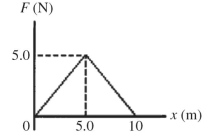
(79) The horizontal force that an animal exerts on a large fruit it has found is observed and is shown in the graph in the figure. If the fruit was initially sliding on the frictionless ground at 5.5 cm/s when The animal first grabbed it, by how much did the animal change its kinetic energy during this Encounter?
(Multiple Choice)
4.8/5 (89)
(89) A force acts on an object, causing it to move parallel to the force. The graph in the figure shows this force as a function of the position of the object. How much work does the force do as the object moves from 0 to 15 m?

(Multiple Choice)
4.9/5 (77)
(77) The resultant force on an object over a 0.50-s time interval is plotted in the graph in the figure. How much work did this force do on the object during the 0.50-s interval?

(Multiple Choice)
4.8/5 (76)
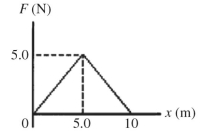
(76) The net force that an animal exerts on a large fruit it has found is observed over a 10-s interval and is shown in the graph in the figure. What was the average power delivered to the fruit by the
Animal over this time interval?
(Multiple Choice)
4.9/5 (82)
(82) Which one has larger kinetic energy: a 500-kg object moving at 40 m/s or a 1000-kg object moving at 20 m/s?
(Multiple Choice)
4.9/5 (81)
(81) 
Filters
- Essay(0)
- Multiple Choice(0)
- Short Answer(0)
- True False(0)
- Matching(0)