



 Chat with AI
Exam 7: Linear Momentum

Exam 1: Introduction, Measurement, Estimating29 Questions
Exam 2: Describing Motion: Kinematics in One Dimension527 Questions
Exam 3: Kinematics in Two Dimensions; Vectors183 Questions
Exam 4: Dynamics: Newtons Laws of Motion146 Questions
Exam 5: Circular Motion; Gravitation105 Questions
Exam 6: Work and Energy153 Questions
Exam 7: Linear Momentum139 Questions
Exam 8: Rotational Motion148 Questions
Exam 9: Static Equilibrium; Elasticity and Fracture83 Questions
Exam 10: Fluids98 Questions
Exam 11: Oscillations and Waves114 Questions
Exam 12: Sound21 Questions
Exam 13: Temperature and Kinetic Theory87 Questions
Exam 14: Heat88 Questions
Exam 15: The Laws of Thermodynamics78 Questions
Exam 16: Electric Charge and Electric Field99 Questions
Exam 17: Electric Potential107 Questions
Exam 18: Electric Currents96 Questions
Exam 19: Dc Circuits384 Questions
Exam 20: Magnetism164 Questions
Exam 21: Electromagnetic Induction and Faradays Law60 Questions
Exam 22: Electromagnetic Waves167 Questions
Exam 23: Light: Geometric Optics144 Questions
Exam 24: The Wave Nature of Light58 Questions
Exam 25: Optical Instruments156 Questions
Exam 26: The Special Theory of Relativity126 Questions
Exam 27: Early Quantum Theory and Models of the Atom192 Questions
Exam 28: Quantum Mechanics of Atoms74 Questions
Exam 29: Molecules and Solids26 Questions
Exam 30: Nuclear Physics and Radioactivity153 Questions
Exam 31: Nuclear Energy; Effects and Uses of Radiation36 Questions
Exam 32: Elementary Particles19 Questions
Exam 33: Astrophysics and Cosmology25 Questions
Select questions type


A 0.330-kg volleyball is thrown vertically downward with a speed of 0.150 m/s in a place where g = It takes it 0.0655 s to reach the ground. What is the magnitude of its momentum just before it hits the ground?
(Multiple Choice)
4.8/5  (77)
(77) A small car meshes with a large truck in a head-on collision. Which of the following statements concerning the momentum during the collision are correct? (There could be more than one correct
Choice.)
(Multiple Choice)
4.7/5 (76)
(76) A block of mass m=34 kg and speed V is behind a block of mass M=81 kg and speed of 0.50 m/s, as shown in the figure. The surface is frictionless and the blocks collide and couple. After the collision, the blocks have a common speed of 0.90 m/s. What is the magnitude of the impulse on the 34-kg block due to the collision?

(Multiple Choice)
4.9/5 (90)
(90) A 475-gram ball is traveling horizontally at 12.0 m/s to the left when it is suddenly struck horizontally by a bat, causing it to reverse direction and initially travel at 8.50 m/s to the right. If the bat produced an average force of 1275 N on the ball, for how long (in milliseconds) was it in contact with the ball?
(Short Answer)
4.7/5 (77)
(77) A 0.32-kg ball is moving horizontally at 30 m/s just before suddenly bouncing off a wall
Just after the bounce, it is moving horizontally at 25 m/s but in the opposite direction.
(a) What is the magnitude of the change in momentum of the ball during the bounce?
(b) What percentage of the ball's original kinetic energy was lost in the collision?
(Short Answer)
4.8/5 (82)
(82) An empty train car of mass kg coasts along at 10 m/s. A 3000-kg boulder is suddenly dropped vertically into the car. Find the speed of the car immediately after the boulder is dropped in.
(Short Answer)
4.8/5 (91)
(91) A batter applies an average force of 8000 N to a baseball for 1.1 ms. What is the magnitude
of the impulse delivered to the baseball by the bat?
(Short Answer)
4.8/5 (87)
(87) In a perfectly elastic collision, a 400-g ball moving toward the east at 3.7 m/s suddenly collides head-on with a 200 g ball sitting at rest.
(a) Determine the velocity of the first ball just after the collision.
(b) Determine the velocity of the second ball just after the collision.
(c) Is kinetic energy conserved in this collision? How do you know?
(Short Answer)
4.9/5 (87)
(87) Three cars, car X , car Y , and car Z , begin accelerating from rest at the same time. Car X is more massive than car Y , which is more massive than car Z . The net accelerating force exerted on each car is identical. After 10 seconds, which car has the most amount of momentum?
(Multiple Choice)
4.8/5 (84)
(84) A 60-kg swimmer suddenly dives horizontally from a 150-kg raft with a speed of 1.5 m/s . The raft is initially at rest. What is the speed of the raft immediately after the diver jumps if the water has negligible effect on the raft?
(Short Answer)
4.8/5 (85)
(85) A 1500-kg car traveling at 90 km/h toward the east suddenly collides with a 3000-kg car traveling at 60 km/h toward the south. The two cars stick together after the collision. What is the direction of motion of the cars after collision?
(Multiple Choice)
4.8/5 (85)
(85) A forklift pushes a 100-kg crate, starting from rest, with a horizontal force of magnitude F . The graph in the figure shows the x component of this force as a function of time. What is the instantaneous velocity of the crate at time t=10 s?

(Multiple Choice)
4.9/5 (78)
(78) A 1200-kg pick-up truck traveling south at 15 m/s suddenly collides with a 750-kg car that is traveling east. The two vehicles stick together and slide along the road after colliding. A highway
Patrol officer investigating the accident determines that the final position of the wreckage after the
Collision is 25 m, at an angle o ° south of east, from the point of impact. She also determines that
The coefficient of kinetic friction between the tires and the road at that location was 0.40. What was
The speed of the car just before the collision?
(Multiple Choice)
4.8/5 (85)
(85) On a frictionless horizontal surface, a 1.50-kg mass traveling at 3.50 m/s suddenly collides
with and sticks to a 3.00-kg mass that is initially at rest, as shown in the figure. This
system then runs into an ideal spring of force constant (spring constant) 50.0 N/cm.
(a) What will be the maximum compression distance of the spring?
(b) How much mechanical energy is lost during this process? During which parts of the
process (the collision and compression of the spring) is this energy lost? 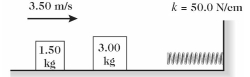
(Essay)
4.8/5 (71)
(71) Three small masses are positioned at the following coordinates: 3.0 kg at (3.0 m, 2.0 m); 4.0
kg at (0.0 m, -1.0 m); and 5.0 kg at (5.0 m, -7.0 m). What are the coordinates of the center
of mass (or center of gravity) of this system?
(Short Answer)
4.9/5 (81)
(81) Astronaut Jennifer's lifeline to her spaceship comes loose and she finds herself stranded, "floating" 100 m from the mothership. She suddenly throws her 2.00-kg wrench at 20 m/s in a direction away from the ship. If she and her spacesuit have a combined mass of 200 kg, how long does it take her to coast back to her spaceship?
(Multiple Choice)
4.9/5 (75)
(75) A batter hits a foul ball. The 0.14-kg baseball that was approaching him at 40 m/s leaves the bat at 30 m/s in a direction perpendicular to the line between the batter and the pitcher. What is the magnitude of the impulse delivered to the baseball?
(Multiple Choice)
4.9/5 (76)
(76) A very light ping-pong ball moving east at a speed of 4 m/s collides with a very heavy stationary bowling ball. The Ping-Pong ball bounces back to the west, and the bowling ball moves very
Slowly to the east. Which object experiences the greater magnitude impulse during the collision?
(Multiple Choice)
4.7/5 (76)
(76) Jennifer hits a stationary 0.20-kg ball, and it leaves her racket at 40 m/s. Time-lapse
photography shows that the ball was in contact with the racket for 40 ms.
(a) What average force did the ball exert on the racket?
(b) What is the ratio of this force to the weight of the ball?
(Short Answer)
4.8/5 (76)
(76) 
Filters
- Essay(0)
- Multiple Choice(0)
- Short Answer(0)
- True False(0)
- Matching(0)