



 Chat with AI
Exam 7: Linear Momentum

Exam 1: Introduction, Measurement, Estimating29 Questions
Exam 2: Describing Motion: Kinematics in One Dimension527 Questions
Exam 3: Kinematics in Two Dimensions; Vectors183 Questions
Exam 4: Dynamics: Newtons Laws of Motion146 Questions
Exam 5: Circular Motion; Gravitation105 Questions
Exam 6: Work and Energy153 Questions
Exam 7: Linear Momentum139 Questions
Exam 8: Rotational Motion148 Questions
Exam 9: Static Equilibrium; Elasticity and Fracture83 Questions
Exam 10: Fluids98 Questions
Exam 11: Oscillations and Waves114 Questions
Exam 12: Sound21 Questions
Exam 13: Temperature and Kinetic Theory87 Questions
Exam 14: Heat88 Questions
Exam 15: The Laws of Thermodynamics78 Questions
Exam 16: Electric Charge and Electric Field99 Questions
Exam 17: Electric Potential107 Questions
Exam 18: Electric Currents96 Questions
Exam 19: Dc Circuits384 Questions
Exam 20: Magnetism164 Questions
Exam 21: Electromagnetic Induction and Faradays Law60 Questions
Exam 22: Electromagnetic Waves167 Questions
Exam 23: Light: Geometric Optics144 Questions
Exam 24: The Wave Nature of Light58 Questions
Exam 25: Optical Instruments156 Questions
Exam 26: The Special Theory of Relativity126 Questions
Exam 27: Early Quantum Theory and Models of the Atom192 Questions
Exam 28: Quantum Mechanics of Atoms74 Questions
Exam 29: Molecules and Solids26 Questions
Exam 30: Nuclear Physics and Radioactivity153 Questions
Exam 31: Nuclear Energy; Effects and Uses of Radiation36 Questions
Exam 32: Elementary Particles19 Questions
Exam 33: Astrophysics and Cosmology25 Questions
Select questions type


A rubber ball and a lump of clay have equal mass. They are thrown with equal speed against a wall. The ball bounces back with nearly the same speed with which it hit. The clay sticks to the
Wall. Which one of these objects experiences the greater momentum change?
(Multiple Choice)
4.8/5  (72)
(72) Three masses are located in the x-y plane as follows: a mass of 6 kg is at (0 m, 0 m) , a mass of 4 kg is at (3 m, 0 m) , and a mass of 2 kg is at (0 m, 3 m) . Where is the center of mass (or center of gravity) of the system?
(Multiple Choice)
4.9/5 (84)
(84) Which of the following quantities are units of momentum? (There could be more than one correct choice.)
(Multiple Choice)
4.8/5 (70)
(70) An 80-kg man is skating northward and happens to suddenly collide with a 20-kg boy who is ice skating toward the east. Immediately after the collision, the man and boy are seen to be moving together at 2.5 m/s in a direction north of east. How fast was the boy moving just before the collision?
(Short Answer)
4.8/5 (89)
(89) A firecracker explodes in midair and breaks up into many fragments. Which of the following statements are true regarding conditions immediately before and immediately after the explosion:
I. The total momentum of the fragments is equal to the original momentum of the firecracker.
II. The total kinetic energy of the fragments is equal to the original kinetic energy of the firecracker.
(Multiple Choice)
4.8/5 (79)
(79) A 1000-kg whale swims horizontally to the right at a speed of 6.0 m/s. It suddenly collides directly with a stationary seal of mass 200 kg. The seal grabs onto the whale and holds fast. What is the
Speed of these two sea creatures just after their collision? You can neglect any drag effects of the
Water during the collision.
(Multiple Choice)
4.9/5 (80)
(80) A 0.17-kg baseball is thrown with a speed of 38 m/s and it is hit straight back toward the
pitcher with a speed of 62 m/s. What is the magnitude of the impulse exerted upon the ball
by the bat?
(Short Answer)
4.8/5 (85)
(85) A block of mass m=4.4 kg, moving on frictionless surface with a speed makes a sudden perfectly elastic collision with a second block of mass M , as shown in the figure. The second block is originally at rest. Just after the collision, the 4.4-kg block recoils with a speed of What is the mass M of the second block?
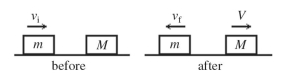
(Short Answer)
4.9/5 (71)
(71) Which of the following quantities are units of impulse? (There could be more than one correct choice.)
(Multiple Choice)
4.9/5 (87)
(87) Calculate the impulse due to a force of 4.5 N that lasts for 1.4 s.
(Multiple Choice)
4.9/5 (80)
(80) A 550-g ball traveling at 8.0 m/s undergoes a sudden head-on elastic collision with a 250-g ball traveling toward it also at 8.0 m/s. What is the speed of the 250 -g mass just after the collision?
(Multiple Choice)
4.9/5 (73)
(73) An 8.0-g bullet is suddenly shot into a 4.0-kg block, at rest on a frictionless horizontal surface, as shown in the figure. The bullet remains lodged in the block. The block then moves against a spring
And compresses it by 8.9 cm. The force constant (spring constant) of the spring is 1400 N/m. What
Is the magnitude of the impulse on the block (including the bullet inside) due to the spring during
The entire time interval during which the block compresses the spring?

(Multiple Choice)
4.7/5 (80)
(80) There must be equal amounts of mass on both sides of the center of mass (or center of gravity) of a
system.
(True/False)
4.9/5 (82)
(82) A block of mass m=5.6 kg, moving on a frictionless surface with a velocity of
right, collides with a block of mass M at rest, as shown in the figure. After the collision, the 5.6-kg
block recoils with a velocity of
the magnitude of the average force on the 5.6-kg block, while the two blocks are in contact?
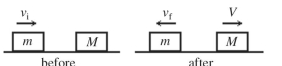
(Multiple Choice)
4.9/5 (79)
(79) In a police ballistics test, a 2.00-g bullet suddenly hits and becomes embedded in a 5.00-kg wood block which is hanging from a 1.20-m long string. This causes the block to swing through an arc of
3)50°. What was the speed of the bullet just before it hit the block?
(Multiple Choice)
4.9/5 (71)
(71) A 328-kg car moving at 19.1 m/s in the +x direction hits from behind a second car moving at 13.0 m/s in the same direction. If the second car has a mass of 790 kg and a speed of 15.1 m/s right after the collision, what is the velocity of the first car after this sudden collision?
(Multiple Choice)
4.9/5 (68)
(68) Two friends are standing on opposite ends of a canoe that is initially at rest with respect to a frictionless lake. The person in the front throws a very massive ball toward the back, and the
Person in the back catches it. After the ball is caught, the canoe is
(Multiple Choice)
4.9/5 (84)
(84) Consider two less-than-desirable options. In the first you are driving 30 mph and crash head-on into an identical car also going 30 mph. In the second option you are driving 30 mph and crash
Head-on into a stationary brick wall. In neither case does your car bounce back from the thing it
Hits, and the collision time is the same in both cases. Which of these two situations would result in
The greater impact force on your car?
(Multiple Choice)
4.8/5 (83)
(83) A 0.140-kg baseball is thrown with a velocity of 27.1 m/s.It is struck by the bat with an average force of 5000 N, which results in a velocity of 37.0 m/s in the opposite direction from the original
Velocity. How long were the bat and ball in contact?
(Multiple Choice)
4.8/5 (72)
(72) A block of mass m=3.6 kg, moving on a frictionless surface with a speed
sudden perfectly elastic collision with a stationary block of mass M , as shown in the figure. Just
after the collision, the 3.6-kg block recoils with a speed of
other block? What is the speed V of the
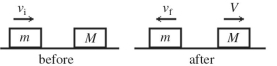
(Multiple Choice)
4.9/5 (80)
(80) 
Filters
- Essay(0)
- Multiple Choice(0)
- Short Answer(0)
- True False(0)
- Matching(0)