



 Chat with AI
Exam 7: Linear Momentum

Exam 1: Introduction, Measurement, Estimating29 Questions
Exam 2: Describing Motion: Kinematics in One Dimension527 Questions
Exam 3: Kinematics in Two Dimensions; Vectors183 Questions
Exam 4: Dynamics: Newtons Laws of Motion146 Questions
Exam 5: Circular Motion; Gravitation105 Questions
Exam 6: Work and Energy153 Questions
Exam 7: Linear Momentum139 Questions
Exam 8: Rotational Motion148 Questions
Exam 9: Static Equilibrium; Elasticity and Fracture83 Questions
Exam 10: Fluids98 Questions
Exam 11: Oscillations and Waves114 Questions
Exam 12: Sound21 Questions
Exam 13: Temperature and Kinetic Theory87 Questions
Exam 14: Heat88 Questions
Exam 15: The Laws of Thermodynamics78 Questions
Exam 16: Electric Charge and Electric Field99 Questions
Exam 17: Electric Potential107 Questions
Exam 18: Electric Currents96 Questions
Exam 19: Dc Circuits384 Questions
Exam 20: Magnetism164 Questions
Exam 21: Electromagnetic Induction and Faradays Law60 Questions
Exam 22: Electromagnetic Waves167 Questions
Exam 23: Light: Geometric Optics144 Questions
Exam 24: The Wave Nature of Light58 Questions
Exam 25: Optical Instruments156 Questions
Exam 26: The Special Theory of Relativity126 Questions
Exam 27: Early Quantum Theory and Models of the Atom192 Questions
Exam 28: Quantum Mechanics of Atoms74 Questions
Exam 29: Molecules and Solids26 Questions
Exam 30: Nuclear Physics and Radioactivity153 Questions
Exam 31: Nuclear Energy; Effects and Uses of Radiation36 Questions
Exam 32: Elementary Particles19 Questions
Exam 33: Astrophysics and Cosmology25 Questions
Select questions type


The graph in the figure shows the x component F of the net force that acts for 10 s on a 100-kg crate. What is the change in the momentum of the crate during the 10 s that this force acts?

(Multiple Choice)
4.7/5  (94)
(94) A fire hose is turned on the door of a burning building in order to knock the door down. This requires a force of 1000 N. If the hose delivers 40 kg of water per second, what is the minimum
Velocity of the stream needed to knock down the door, assuming the water doesn't bounce back?
(Multiple Choice)
4.9/5 (79)
(79) In a police ballistics test, a 10.0-g bullet moving at 300 m/s is fired into a 1.00-kg block at rest. The bullet goes through the block almost instantaneously and emerges with 50.0% of its original speed. What is the speed of the block just after the bullet emerges?
(Multiple Choice)
4.8/5 (84)
(84) The center of mass (or center of gravity) of a two-particle system is at the origin. One particle is located at (3.0 m, 0.0 m) and has a mass of 2.0 kg. The other particle has a mass of 3.0 kg. What is
The location of the 3.0-kg particle?
(Multiple Choice)
4.8/5 (90)
(90) A rubber ball bounces off of a wall with an initial speed v and reverses its direction so its speed is v right after the bounce. As a result of this bounce, which of the following quantities of the ball are
Conserved? (There could be more than one correct choice.)
(Multiple Choice)
4.8/5 (83)
(83) A 1200-kg car moving at 15.6 m/s suddenly collides with a stationary car of mass 1500 kg. If the two vehicles lock together, what is their combined velocity immediately after the collision?
(Multiple Choice)
4.9/5 (76)
(76) A 2200-kg auto moving northward at 12.0 m/s runs into a 3800-kg truck which is also
moving northward, but at 5.00 m/s. If the vehicles lock bumpers, how fast are they moving
just after the collision?
(Short Answer)
4.7/5 (87)
(87) A small car meshes with a large truck in a head-on collision. Which of the following statements concerning the magnitude of the average force during the collision is correct?
(Multiple Choice)
4.9/5 (95)
(95) A 0.140 kg baseball is thrown horizontally with a velocity of 28.9 m/s. It is struck with a constant horizontal force that lasts for 1.85 ms, which results in a velocity of 37.0 m/s in the opposite direction. What was the magnitude of the horizontal force?
(Multiple Choice)
4.8/5 (75)
(75) During World War I, Germany used a "Big Bertha" cannon to hurl shells into Paris 30 miles away. This gun also had a very long barrel. What was the reason for using a long barrel in these guns?
(Multiple Choice)
4.8/5 (73)
(73) A force of 5.3 N is needed to hold on to an umbrella in a strong wind. If the air molecules each have a mass of and each one strikes the umbrella (without rebounding) with a speed of 2.0 m/s in the same direction, how many atoms strike the umbrella each second? Assume that the wind blows horizontally so that the gravity can be neglected.
(Short Answer)
4.9/5 (77)
(77) A puck with a mass moving at 1.0 m/s approaches a stationary puck with a mass
100 g on a frictionless air table, and they undergo a sudden two-dimensional elastic collision. After
the collision, both pucks have identical speeds, but travel in different directions. What is the angle
between the original and final paths of puck with mass
(Multiple Choice)
4.7/5 (74)
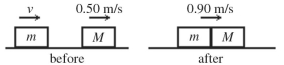
(74) A block of mass m = 9.0 kg and speed V and is behind a block of mass M = 27 kg and speed of 0.50 m/s, as shown int the figure. The surface is frictionless, and the blocks suddenly collide and
Couple. After the collision, the blocks have a common speed of 0.90 m/s. How much kinetic energy
Of the blocks is lost due to the collision?
(Multiple Choice)
4.9/5 (82)
(82) Find the magnitude and direction of the net momentum of the system shown in the figure. Express the direction by giving the angle the net momentum makes with the +x -axis.

(Short Answer)
4.9/5 (67)
(67) A proton of mass m is at rest when it is suddenly struck head-on by an alpha particle (which consists of 2 protons and 2 neutrons) moving at speed If the collision is perfectly elastic, wha speed will the alpha particle have after the collision? (Assume the neutron's mass is equal to th proton's mass.)
(Multiple Choice)
4.7/5 (86)
(86) In the figure showing an isolated system, determine the character of the collision. The masses of the blocks, and the velocities before and after, are shown. The collision is

(Multiple Choice)
4.8/5 (78)
(78) In a collision between two unequal masses, which mass receives a greater magnitude impulse?
(Multiple Choice)
4.8/5 (70)
(70) A 30-kg child stands at one end of a floating 20-kg canoe that is 5.0-m long and initially at rest in the water. The child then slowly walks to the other end of the canoe. How far does the canoe move
In the water, assuming water friction is negligible?
(Multiple Choice)
4.9/5 (71)
(71) In a police ballistics test, 2.00-g bullet traveling at 700 m/s suddenly hits and becomes embedded in a stationary 5.00-kg wood block. What is the speed of the block immediately after the bullet has stopped moving relative to the block?
(Short Answer)
4.8/5 (76)
(76) On a horizontal frictionless air table, a puck runs into an ideal horizontal spring that is fastened to the table. The puck compresses the spring by 15 cm before coming to rest. During the compression
Process, which quantities are conserved?
(Multiple Choice)
4.7/5 (83)
(83) 
Filters
- Essay(0)
- Multiple Choice(0)
- Short Answer(0)
- True False(0)
- Matching(0)