



 Chat with AI
Exam 5: Trigonometric Functions

Exam 1: Equations and Inequalities494 Questions
Exam 2: Graphs and Functions525 Questions
Exam 3: Polynomial and Rational Functions516 Questions
Exam 4: Inverse, Exponential, and Logarithmic Functions471 Questions
Exam 5: Trigonometric Functions301 Questions
Exam 6: The Circular Functions and Their Graphs289 Questions
Exam 7: Trigonometric Identities and Equations494 Questions
Exam 8: Applications of Trigonometry446 Questions
Exam 9: Systems and Matrices505 Questions
Exam 10: Analytic Geometry206 Questions
Exam 11: Further Topics in Algebra351 Questions
Exam 12: Review of Basic Concepts640 Questions
Select questions type


Use a calculator to find the function value. Give your answer rounded to seven decimal places, if necessary.
-
(Multiple Choice)
4.8/5  (100)
(100) Solve the problem.
-A ship travels on a bearing of , and then travels on a bearing of for . Find the distance from the starting point to the end of the trip, to the nearest kilometer.
(Multiple Choice)
4.8/5 (86)
(86) Solve the problem.
-The grade resistance of a car traveling up or down a hill is modeled by the equation , where is the weight of the car and is the angle of the hill's grade for uphill travel, for downhill travel). What is the grade resistance (to the nearest pound) of a car traveling downhill on a grade ?
(Multiple Choice)
4.8/5 (78)
(78) If r is a positive number and the point (x, y) is in the indicated quadrant, decide whether the given ratio is positive or
negative.
-III,
(Multiple Choice)
4.8/5 (79)
(79) Solve the problem.
-From a balloon 839 feet high, the angle of depression to the ranger headquarters is . How far is the headquarters from a point on the ground directly below the balloon (to the nearest foot)?
(Multiple Choice)
4.9/5 (91)
(91) Sketch an angle in standard position such that has the least positive measure and the given point is on the terminal
side of
-
(Multiple Choice)
4.9/5 (86)
(86) Solve the problem.
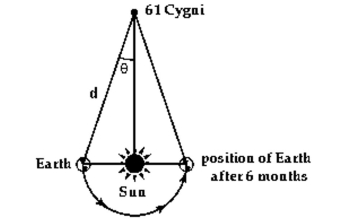
-In 1838, the German mathematician and astronomer Friedrich Wilhelm Bessel was the first person to calculate the distance to a star other than the Sun. He accomplished this by first determining the parallax of the star, 61 Cygni, at arc seconds (Parallax is the change in position of the star measured against background stars as Earth orbits the Sun. See illustration.) If the distance from Earth to the Sun is about and seconds minutes degrees, determine the distance from Earth to 61 Cygni using Bessel's figures. Express the answer in scientific notation.
(Multiple Choice)
5.0/5 (77)
(77) Solve the problem.
-The grade resistance of a car traveling up or down a hill is modeled by the equation , where is the weight of the car and is the angle of the hill's grade for uphill travel, for downhill travel). What is the grade resistance (to the nearest pound) of a 2750 -lb car on a level road ?
(Multiple Choice)
4.8/5 (77)
(77) Write the function in terms of its cofunction. Assume that any angle in which an unknown appears is an acute angle.
-
(Multiple Choice)
4.9/5 (78)
(78) Solve the right triangle.
-
Round values to one decimal place.
(Multiple Choice)
5.0/5 (95)
(95) Suppose ABC is a right triangle with sides of lengths a, b, and c and right angle at C. Find the unknown side length
using the Pythagorean theorem and then find the value of the indicated trigonometric function of the given angle.
Rationalize the denominator if applicable.
-Find when and .
(Multiple Choice)
4.9/5 (86)
(86) Find the angle of least positive measure coterminal with the given angle.
-
(Multiple Choice)
4.9/5 (77)
(77) An observer for a radar station is located at the origin of a coordinate system. For the point given, find the bearing of an
airplane located at that point. Express the bearing using both methods.
-
(Multiple Choice)
4.8/5 (70)
(70) Use the fundamental identities to find the value of the trigonometric function.
-Find , given that and is in quadrant IV.
(Multiple Choice)
4.9/5 (82)
(82) Draw the given angle in standard position. Draw an arrow representing the correct amount of rotation. Find the measure of two other angles, one positive and one negative, coterminal with the given angle.
-
(Multiple Choice)
4.7/5 (83)
(83) Sketch an angle in standard position such that has the least positive measure and the given point is on the terminal
side of
-
(Multiple Choice)
4.8/5 (79)
(79) Use the appropriate identity to find the indicated function value. Rationalize the denominator, if applicable. If the given
value is a decimal, round your answer to three decimal places.
- , given that
(Multiple Choice)
4.7/5 (86)
(86) Convert the angle to decimal degrees and round to the nearest hundredth of a degree.
-
(Multiple Choice)
4.9/5 (84)
(84) 
Filters
- Essay(0)
- Multiple Choice(0)
- Short Answer(0)
- True False(0)
- Matching(0)