



 Chat with AI
Exam 4: Exponential and Logarithmic Functions

Exam 1: Functions and Their Graphs301 Questions
Exam 2: Linear and Quadratic Functions301 Questions
Exam 3: Polynomial and Rational Functions350 Questions
Exam 4: Exponential and Logarithmic Functions518 Questions
Exam 5: Trigonometric Functions366 Questions
Exam 6: Analytic Trigonometry402 Questions
Exam 7: Applications of Trigonometric Functions103 Questions
Exam 8: Polar Coordinates; Vectors270 Questions
Exam 9: Analytic Geometry197 Questions
Exam 10: Systems of Equations and Inequalities235 Questions
Exam 11: Sequences; Induction; the Binomial Theorem238 Questions
Exam 12: Counting and Probability108 Questions
Exam 13: A Preview of Calculus: the Limit, Derivative, and Integral of a Function145 Questions
Exam 14: Review228 Questions
Select questions type


Indicate whether the function is one-to-one.
-{(5, 4), (6, 4), (7, 3), (8, -9)}
(Multiple Choice)
4.8/5  (80)
(80) The graph of a logarithmic function is shown. Select the function which matches the graph.
-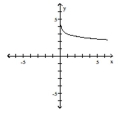 A)
B)
C)
D)
A)
B)
C)
D) (Multiple Choice)
4.8/5 (84)
(84) The graph of a logarithmic function is shown. Select the function which matches the graph.
-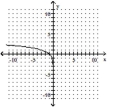 A)
B)
C)
D)
A)
B)
C)
D) (Multiple Choice)
4.8/5 (82)
(82) Use the properties of logarithms to find the exact value of the expression. Do not use a calculator.
-
(Multiple Choice)
4.9/5 (79)
(79) Choose the one alternative that best completes the statement or answers the question.
Solve the exponential equation. Use a calculator to obtain a decimal approximation, correct to two decimal places, for the
solution.
-
(Multiple Choice)
4.9/5 (77)
(77) Write the word or phrase that best completes each statement or answers the question.
Solve the problem.
-The accompanying tables represent a function f that converts seconds to hours and a function g that converts hours to days. 86,400 172,800 259,200 345,600 432,000 () 24 48 72 96 120
24 48 72 96 120 () 1 2 3 4 5
Express symbolically.
(Multiple Choice)
5.0/5 (85)
(85) Solve the problem.
-Between 7:00 AM and 8:00 AM, trains arrive at a subway station at a rate of 15 trains per hour (0.25 trains per minute). The following formula from statistics can be used to determine the probability that a train will arrive within t
Minutes of 7:00 AM. Determine how many minutes are needed for the probability to reach 20%.
(Multiple Choice)
4.9/5 (71)
(71) Solve the problem.
-The rabbit population in a forest area grows at the rate of 7% monthly. If there are 270 rabbits in September, find how many rabbits (rounded to the nearest whole number) should be expected by next September. Use
(Multiple Choice)
4.8/5 (93)
(93) Use the Change-of-Base Formula and a calculator to evaluate the logarithm. Round your answer to three decimal places.
-
(Multiple Choice)
4.9/5 (75)
(75) Use the properties of logarithms to find the exact value of the expression. Do not use a calculator.
-
(Multiple Choice)
4.9/5 (81)
(81) The graph of a logarithmic function is shown. Select the function which matches the graph.
-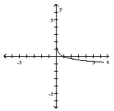 A)
B)
C)
D)
A)
B)
C)
D) (Multiple Choice)
4.7/5 (74)
(74) Use the horizontal line test to determine whether the function is one-to-one.
-
(Multiple Choice)
4.8/5 (85)
(85) Solve the problem.
-The population of a particular country was 30 million in 1984; in 1995, it was 34 million. The exponential growth function describes the population of this country t years after 1984. Use the fact that 11 years
After 1984 the population increased by 4 million to find k to three decimal places.
(Multiple Choice)
4.9/5 (68)
(68) Use the horizontal line test to determine whether the function is one-to-one.
-
(Multiple Choice)
4.8/5 (77)
(77) Express y as a function of x. The constant C is a positive number.
-
(Multiple Choice)
4.8/5 (79)
(79) Decide whether or not the functions are inverses of each other.
-
(Multiple Choice)
5.0/5 (76)
(76) Solve the problem.
-Suppose that . What is ? What point is on the graph of ?
(Multiple Choice)
4.9/5 (85)
(85) 
Filters
- Essay(0)
- Multiple Choice(0)
- Short Answer(0)
- True False(0)
- Matching(0)