



 Chat with AI
Exam 5: Trigonometric Functions

Exam 1: Functions and Their Graphs297 Questions
Exam 2: Linear and Quadratic Functions302 Questions
Exam 3: Polynomial and Rational Functions354 Questions
Exam 4: Exponential and Logarithmic Functions517 Questions
Exam 5: Trigonometric Functions354 Questions
Exam 6: Analytic Trigonometry342 Questions
Exam 7: Applications of Trigonometric Functions105 Questions
Exam 8: Polar Coordinates; Vectors253 Questions
Exam 9: Analytic Geometry200 Questions
Exam 10: Systems of Equations and Inequalities235 Questions
Exam 11: Sequences; Induction; the Binomial Theorem238 Questions
Exam 12: Counting and Probability115 Questions
Exam 13: A Preview of Calculus: the Limit, Derivative, and Integral of a Function145 Questions
Exam 14: Foundations: a Prelude to Functions234 Questions
Exam 15: Graphing Utilities29 Questions
Select questions type


Choose the one alternative that best completes the statement or answers the question.
Use the even-odd properties to find the exact value of the expression. Do not use a calculator.
-
(Multiple Choice)
5.0/5  (79)
(79) Solve the problem.
-A racetrack curve is banked so that the outside of the curve is slightly elevated or inclined above the inside of the curve. This inclination is called the elevation of the track. The maximum speed on the track in miles per
Hour is given by where r is the radius of the track in miles and θ is the elevation in degrees. Find the maximum speed for a
Racetrack with an elevation of 26° and a radius of 0.6 miles. Round to the nearest mile per hour.
(Multiple Choice)
4.9/5 (71)
(71) Write the word or phrase that best completes each statement or answers the question.
-
(Short Answer)
4.8/5 (82)
(82) If s denotes the length of the arc of a circle of radius r subtended by a central angle θ, find the missing quantity.
- centimeters, radians, ?
(Multiple Choice)
4.7/5 (72)
(72) Convert the angle in radians to degrees. Express the answer in decimal form, rounded to two decimal places.
-5
(Multiple Choice)
4.9/5 (83)
(83) 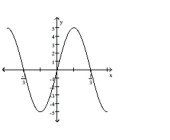
Write the word or phrase that best completes each statement or answers the question.
-Before exercising, an athlete measures her air flow and obtains
where a is measured in liters per second and t is the time in seconds. If a > 0, the athlete is inhaling; if a < 0, the athlete
is exhaling. The time to complete one complete inhalation/exhalation sequence is a respiratory cycle.
What is the amplitude? What is the period? What is the respiratory cycle?
Graph a over two periods beginning at t = 0. 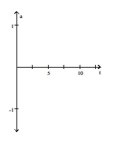
(Essay)
4.9/5 (77)
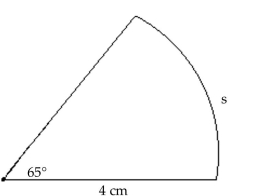
(77) Find the length s. Round the answer to three decimal places.
-
(Multiple Choice)
4.8/5 (85)
(85) Use a calculator to find the approximate value of the expression rounded to two decimal places.
-
(Multiple Choice)
4.9/5 (60)
(60) Use the properties of the trigonometric functions to find the exact value of the expression. Do not use a calculator.
-
(Multiple Choice)
4.8/5 (74)
(74) Convert the angle to a decimal in degrees. Round the answer to two decimal places.
-23°47'37"
(Multiple Choice)
4.7/5 (67)
(67) In the problem, t is a real number and P = (x, y) is the point on the unit circle that corresponds to t. Find the exact value of
the indicated trigonometric function of t.
- Find
(Multiple Choice)
4.7/5 (81)
(81) Write the word or phrase that best completes each statement or answers the question.
-The following data represents the normal monthly precipitation for a certain city in Arkansas. Month, x Normal Monthly Precipitation, inches January, 1 3.91 February, 2 4.36 March, 3 5.31 April, 4 6.21 May, 5 7.02 June, 6 7.84 July, 7 8.19 August, 8 8.06 September, 9 7.41 October, 10 6.30 November, 11 5.21 December, 12 4.28 Draw a scatter diagram of the data for one period. Find the sinusoidal function of the form y = A sin (ωx - Φ) + B that
fits the data. Draw the sinusoidal function on the scatter diagram. Use a graphing utility to find the sinusoidal
function of best fit. Draw the sinusoidal function of best fit on the scatter diagram. 
(Essay)
4.8/5 (75)
(75) Choose the one alternative that best completes the statement or answers the question.
-In a computer simulation, a satellite orbits around Earth at a distance from the Earth's surface of 2.4 x 10⁴ miles. The orbit is circular, and one revolution around Earth takes 10.1 days. Assuming the radius of the Earth is 3960
Miles, find the linear speed of the satellite. Express the answer in miles per hour to the nearest whole mile.
(Multiple Choice)
4.8/5 (79)
(79) Find the exact value of the expression if θ = 45°. Do not use a calculator.
- Find
(Multiple Choice)
4.9/5 (68)
(68) 
Filters
- Essay(0)
- Multiple Choice(0)
- Short Answer(0)
- True False(0)
- Matching(0)