



 Chat with AI
Exam 8: Polar Coordinates; Vectors

Exam 1: Functions and Their Graphs297 Questions
Exam 2: Linear and Quadratic Functions302 Questions
Exam 3: Polynomial and Rational Functions354 Questions
Exam 4: Exponential and Logarithmic Functions517 Questions
Exam 5: Trigonometric Functions354 Questions
Exam 6: Analytic Trigonometry342 Questions
Exam 7: Applications of Trigonometric Functions105 Questions
Exam 8: Polar Coordinates; Vectors253 Questions
Exam 9: Analytic Geometry200 Questions
Exam 10: Systems of Equations and Inequalities235 Questions
Exam 11: Sequences; Induction; the Binomial Theorem238 Questions
Exam 12: Counting and Probability115 Questions
Exam 13: A Preview of Calculus: the Limit, Derivative, and Integral of a Function145 Questions
Exam 14: Foundations: a Prelude to Functions234 Questions
Exam 15: Graphing Utilities29 Questions
Select questions type


The rectangular coordinates of a point are given. Find polar coordinates for the point.
- Round the polar coordinates to two decimal places, with in degrees.

Free
(Multiple Choice)
4.9/5  (83)
(83) Correct Answer: Verified
C
Solve the problem. Leave your answer in polar form.
- z=1-i w=1-i
Find .
Free
(Multiple Choice)
4.7/5 (80)
(80) Correct Answer:Verified
VerifiedC
Choose the one alternative that best completes the statement or answers the question.
Find the direction angles of the vector. Round to the nearest degree, if necessary.
-
Free
(Multiple Choice)
4.8/5 (73)
(73) Correct Answer:Verified
VerifiedA
Find the angle between v and w. Round your answer to one decimal place, if necessary.
-
(Multiple Choice)
4.8/5 (72)
(72) Choose the one alternative that best completes the statement or answers the question.
The polar coordinates of a point are given. Find the rectangular coordinates of the point.
-
(Multiple Choice)
4.9/5 (75)
(75) Solve the problem. Round your answer to the nearest tenth.
-A person is pulling a freight cart with a force of 40 pounds. How much work is done in moving the cart 30 feet if the cart's handle makes an angle of 22° with the ground?
(Multiple Choice)
5.0/5 (81)
(81) Choose the one alternative that best completes the statement or answers the question.
The polar coordinates of a point are given. Find the rectangular coordinates of the point.
-
(Multiple Choice)
4.8/5 (83)
(83) Test the equation for symmetry with respect to the given axis, line, or pole.
-
(Multiple Choice)
4.9/5 (80)
(80) Match the point in polar coordinates with either A, B, C, or D on the graph.
-
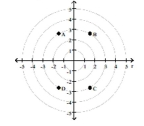
(Multiple Choice)
4.9/5 (73)
(73) Transform the polar equation to an equation in rectangular coordinates. Then identify and graph the equation.
-
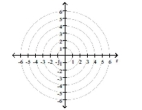
(Multiple Choice)
4.8/5 (69)
(69) 
Write the word or phrase that best completes each statement or answers the question.
Solve the problem.
-Find a unit vector normal to the plane containing
(Essay)
4.7/5 (82)
(82) Write the complex number in polar form. Express the argument in degrees, rounded to the nearest tenth, if necessary.
-
(Multiple Choice)
4.7/5 (80)
(80) 

Filters
- Essay(0)
- Multiple Choice(0)
- Short Answer(0)
- True False(0)
- Matching(0)