



 Chat with AI
Exam 5: Inverse, Exponential, and Logarithmic Functions

Exam 1: Review of Basic Concepts639 Questions
Exam 2: Equations and Inequalities496 Questions
Exam 3: Graphs and Functions522 Questions
Exam 4: Polynomial and Rational Functions508 Questions
Exam 5: Inverse, Exponential, and Logarithmic Functions472 Questions
Exam 6: Trigonometric Functions297 Questions
Exam 7: The Circular Functions and Their Graphs286 Questions
Exam 8: Trigonometric Identities and Equations492 Questions
Exam 9: Applications of Trigonometry447 Questions
Exam 10: Systems and Matrices507 Questions
Exam 11: Analytic Geometry217 Questions
Exam 12: Further Topics in Algebra348 Questions
Select questions type


An everyday activity is described. Keeping in mind that an inverse operation "undoes" what an operation does, describe
each inverse activity.
-opening a door
(Multiple Choice)
4.9/5  (84)
(84) Explain how the graph of can be obtained from the graph o
-What is the range of the function ?
(Multiple Choice)
4.7/5 (84)
(84) Graph the exponential function using transformations where appropriate.
-
(Multiple Choice)
4.8/5 (69)
(69) Choose the one alternative that best completes the statement or answers the question.
-In a town whose population is 2500 , a disease creates an epidemic. The number of people infected days after the disease has begun is given by the function . Find the number infected after 5 days.
(Multiple Choice)
4.9/5 (79)
(79) Graph the function. Give the domain and range.
- f(x)=(x+3)
(Multiple Choice)
4.9/5 (86)
(86) Find the value. Give an approximation to four decimal places.
-
(Multiple Choice)
4.9/5 (72)
(72) For the function as defined that is one-to-one, graph f and on the same axes.
-
(Multiple Choice)
4.8/5 (84)
(84) Find the value. Give an approximation to four decimal places.
-
(Multiple Choice)
4.9/5 (83)
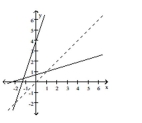
(83) Decide whether the pair of functions graphed are inverses.
-
(Multiple Choice)
4.9/5 (68)
(68) Choose the one alternative that best completes the statement or answers the question.
-The number of books in a small library increases according to the function B , where t is measured in years. How many books will the library have after 2 years?
(Multiple Choice)
4.9/5 (76)
(76) Provide an appropriate response.
-Explain how the graph of can be obtained from the graph o
(Short Answer)
4.9/5 (84)
(84) Provide an appropriate response.
-Explain how the graph of can be obtained from the graph o
(Essay)
4.8/5 (70)
(70) Solve the following graphically. If necessary, round answers to the nearest thousandth.
-
(Multiple Choice)
4.8/5 (78)
(78) Choose the one alternative that best completes the statement or answers the question.
-A lake is stocked with 557 fish of a new variety. The size of the lake, the availability of food, and the number of other fish restrict growth in the lake to a limiting value of 3481 . The population of fish in the lake after time , in months, is given by the function . After how many months will the population be 694 ?
(Multiple Choice)
5.0/5 (87)
(87) 
Filters
- Essay(0)
- Multiple Choice(0)
- Short Answer(0)
- True False(0)
- Matching(0)