



 Chat with AI
Exam 5: Inverse, Exponential, and Logarithmic Functions

Exam 1: Review of Basic Concepts639 Questions
Exam 2: Equations and Inequalities496 Questions
Exam 3: Graphs and Functions522 Questions
Exam 4: Polynomial and Rational Functions508 Questions
Exam 5: Inverse, Exponential, and Logarithmic Functions472 Questions
Exam 6: Trigonometric Functions297 Questions
Exam 7: The Circular Functions and Their Graphs286 Questions
Exam 8: Trigonometric Identities and Equations492 Questions
Exam 9: Applications of Trigonometry447 Questions
Exam 10: Systems and Matrices507 Questions
Exam 11: Analytic Geometry217 Questions
Exam 12: Further Topics in Algebra348 Questions
Select questions type


Provide an appropriate response.
-Use the properties of exponents to write the function of the form , where is a constant.
(Multiple Choice)
4.9/5  (85)
(85)
Determine whether the statement is true or false.
-If a function f has an inverse, then the graph of can be obtained by reflecting the graph of f
across the x-axis.
(True/False)
4.7/5 (89)
(89) Find the function value. If the result is irrational, round your answer to the nearest thousandth.
-Let . Find
(Multiple Choice)
4.9/5 (92)
(92) Use the definition of inverses to determine whether f and g are inverses.
-
(Multiple Choice)
4.8/5 (74)
(74) Use the properties of logarithms to rewrite the expression. Simplify the result if possible. Assume all variables represent
positive real numbers.
-
(Multiple Choice)
5.0/5 (83)
(83) If the function is one-to-one, find its inverse. If not, write "not one-to-one."
-
(Multiple Choice)
4.9/5 (75)
(75) Use a graphing calculator to estimate the solution set of the equation. Round to the nearest hundredth.
-
(Multiple Choice)
4.8/5 (75)
(75) Find the value. Give an approximation to four decimal places.
-Quail are game birds that fare poorly when their habitat is encroached upon. Wildlife biologists hav discovered that the population of quail in a region is related to the percent of the region that has paved with roads and parking lots, according to the formula
where is the percent of the region that has been paved. For a particular rural region, wher . Predict what the quail population will be in this region when it becomes paved. Round your answer to the nearest whole number.
(Multiple Choice)
4.9/5 (78)
(78) Solve the problem.
- Suppose th can be used to calculate the number of years y for x percent of a population of 298 web-footed sparrows to die. Approximate the percentage (to the nearest whole
Per cent) of web-footed sparrows that died after 3 yr.
(Multiple Choice)
4.8/5 (84)
(84) Choose the one alternative that best completes the statement or answers the question.
-An artifact is discovered at a certain site. If it has of the carbon-14 it originally contained, what is the approximate age of the artifact to the nearest year? (carbon-14 decays at the rate of annually.)
(Multiple Choice)
4.8/5 (82)
(82) Choose the one alternative that best completes the statement or answers the question.
-Suppose the government wants to impose a tax on fossil fuels to reduce carbon emissions. The cost benefit is modeled by , where represents the dollars of tax per ton of carbon emitted and represents the percent reduction in emissions of carbon. ( is in decimal form.) Determine when . Round to three decimal places.
(Multiple Choice)
4.8/5 (71)
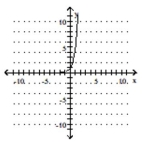
(71) Use the graph of f to sketch a graph of the inverse of f using a dashed curve.
-
(Multiple Choice)
4.9/5 (73)
(73) An everyday activity is described. Keeping in mind that an inverse operation "undoes" what an operation does, describe
each inverse activity.
-waking up
(Multiple Choice)
4.9/5 (83)
(83) Write the expression as a single logarithm with coefficient 1. Assume all variables represent positive real numbers with
-
(Multiple Choice)
4.9/5 (81)
(81) Find the function value. If the result is irrational, round your answer to the nearest thousandth.
-Let . Find
(Multiple Choice)
4.7/5 (79)
(79) 
Filters
- Essay(0)
- Multiple Choice(0)
- Short Answer(0)
- True False(0)
- Matching(0)