



 Chat with AI
Exam 4: The Accounting Cycle

Exam 1: Introduction to Accounting and Business243 Questions
Exam 2: Analyzing Transactions234 Questions
Exam 3: The Adjusting Process225 Questions
Exam 4: The Accounting Cycle211 Questions
Exam 5: Accounting for Retail Businesses273 Questions
Exam 6: Inventories236 Questions
Exam 7: Internal Control and Cash197 Questions
Exam 8: Receivables210 Questions
Exam 9: Long-Term Assets: Fixed and Intangible243 Questions
Exam 10: Liabilities: Current, Installment Notes, and Contingencies199 Questions
Exam 11: Liabilities: Bonds Payable172 Questions
Exam 12: Corporations: Organization, Stock Transactions, and Dividends221 Questions
Exam 13: Statement of Cash Flows193 Questions
Exam 14: Financial Statement Analysis206 Questions
Exam 15: Introduction to Managerial Accounting244 Questions
Exam 16: Job Order Costing212 Questions
Exam 17: Process Cost Systems196 Questions
Exam 18: Activity-Based Costing109 Questions
Exam 19: Support Department and Joint Cost Allocation172 Questions
Exam 20: Cost-Volume-Profit Analysis247 Questions
Exam 21: Variable Costing for Management Analysis136 Questions
Exam 22: Budgeting197 Questions
Exam 23: Evaluating Variances From Standard Costs172 Questions
Exam 24: Evaluating Decentralized Operations210 Questions
Exam 25: Differential Analysis and Product Pricing157 Questions
Exam 26: Capital Investment Analysis191 Questions
Exam 27: Lean Manufacturing and Activity Analysis134 Questions
Exam 28: The Balanced Scorecard and Corporate Social Responsibility170 Questions
Exam 29: Investments137 Questions
Select questions type


Match each journal entry that follows with one of the types of journal entries (a-c) below.
-Dividends 215
Cash 215
A)Journal entries
B)Adjusting journal entries
C)Closing journal entries
(Short Answer)
4.9/5  (85)
(85) During the end-of-period processing, which of the following best describes the logical order of steps?
(Multiple Choice)
4.8/5 (76)
(76) The usual presentation of the retained earnings statement is (1) Beginning balance, (2) Net income or loss, (3) Dividends, (4) Stockholders' investments, (5) Ending balance.
(True/False)
4.7/5 (84)
(84) The following is the adjusted trial balance for Miller Company. 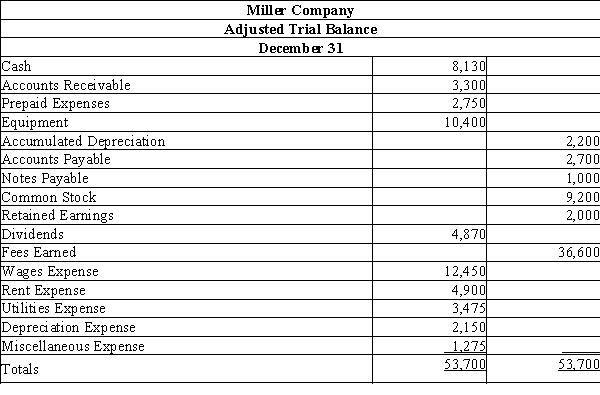 Prepare closing entries and the post-closing trial balance.
 (Essay)
4.9/5 (74)
(74) An end-of-period spreadsheet heading is dated for a period of time.
(True/False)
4.8/5 (82)
(82) Which of the following accounts ordinarily appears in the post-closing trial balance?
(Multiple Choice)
4.9/5 (86)
(86) Beachside Realty rents condominiums and furnishings. Below is the adjusted trial balance at December 31. 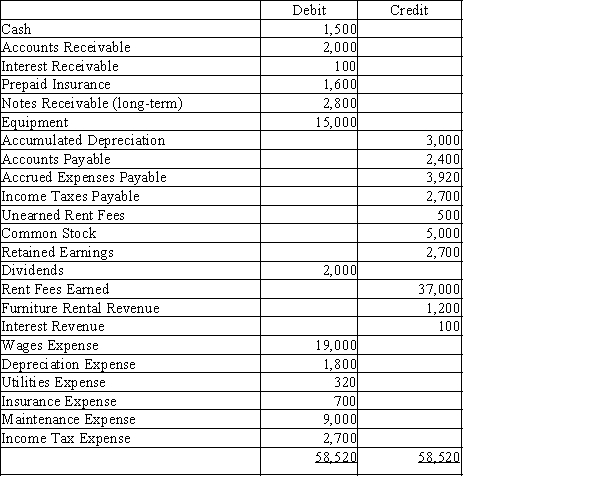 Prepare the closing entry required to transfer the income or loss at the end of the period.
 (Essay)
4.9/5 (84)
(84) Shores Sports rents canoes and kayaks. Below is the adjusted trial balance at December 31. 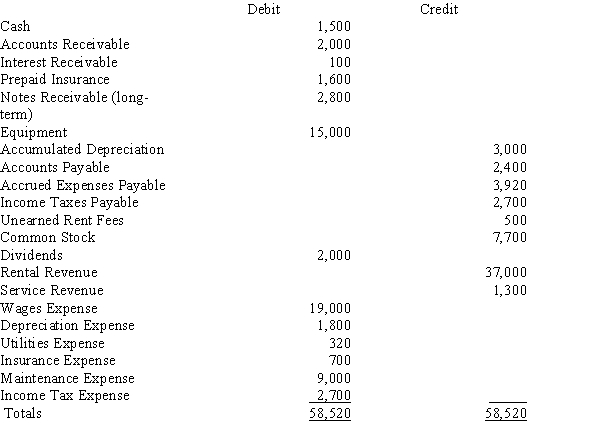 The entry required to close the revenue and expense accounts at the end of the period includes a:
 (Multiple Choice)
5.0/5 (93)
(93) On the end-of-period spreadsheet, the common stock and dividends account balances are extended to the Balance Sheet columns.
(True/False)
4.8/5 (83)
(83) Accrued revenues are ordinarily listed on the balance sheet as current liabilities.
(True/False)
5.0/5 (68)
(68) Indicate whether each of the following would be reported in the financial statements as a (a) current asset, (b) current liability, (c) revenue, or (d) expense: 
(Essay)
4.8/5 (79)
(79) Diane's Designs purchased a one-year liability insurance policy on March 1 of a year for $8,400 and recorded it as a prepaid expense. Which of the following amounts would be recorded as insurance expense during the adjusting process at the end of Diane's first month of operations on March 31?
(Multiple Choice)
4.8/5 (74)
(74) Of the following steps of the accounting cycle, which step should be completed first?
(Multiple Choice)
4.8/5 (80)
(80) The end-of-period spreadsheet is not considered a part of the formal accounting records.
(True/False)
4.9/5 (66)
(66) The following accounts were taken from the Adjusted Trial Balance columns of the end-of-period spreadsheet: 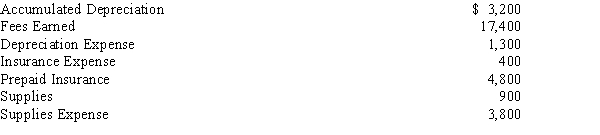 Net income for the period is
 (Multiple Choice)
4.9/5 (86)
(86) The first item appearing on the statement of stockholders' equity is
(Multiple Choice)
4.7/5 (75)
(75) Liabilities that will be due within one year or less and that are to be paid out of current assets are called current liabilities.
(True/False)
4.8/5 (76)
(76) 
Filters
- Essay(0)
- Multiple Choice(0)
- Short Answer(0)
- True False(0)
- Matching(0)