



 Chat with AI
Exam 14: Financial Statement Analysis

Exam 1: Introduction to Accounting and Business243 Questions
Exam 2: Analyzing Transactions234 Questions
Exam 3: The Adjusting Process225 Questions
Exam 4: The Accounting Cycle211 Questions
Exam 5: Accounting for Retail Businesses273 Questions
Exam 6: Inventories236 Questions
Exam 7: Internal Control and Cash197 Questions
Exam 8: Receivables210 Questions
Exam 9: Long-Term Assets: Fixed and Intangible243 Questions
Exam 10: Liabilities: Current, Installment Notes, and Contingencies199 Questions
Exam 11: Liabilities: Bonds Payable172 Questions
Exam 12: Corporations: Organization, Stock Transactions, and Dividends221 Questions
Exam 13: Statement of Cash Flows193 Questions
Exam 14: Financial Statement Analysis206 Questions
Exam 15: Introduction to Managerial Accounting244 Questions
Exam 16: Job Order Costing212 Questions
Exam 17: Process Cost Systems196 Questions
Exam 18: Activity-Based Costing109 Questions
Exam 19: Support Department and Joint Cost Allocation172 Questions
Exam 20: Cost-Volume-Profit Analysis247 Questions
Exam 21: Variable Costing for Management Analysis136 Questions
Exam 22: Budgeting197 Questions
Exam 23: Evaluating Variances From Standard Costs172 Questions
Exam 24: Evaluating Decentralized Operations210 Questions
Exam 25: Differential Analysis and Product Pricing157 Questions
Exam 26: Capital Investment Analysis191 Questions
Exam 27: Lean Manufacturing and Activity Analysis134 Questions
Exam 28: The Balanced Scorecard and Corporate Social Responsibility170 Questions
Exam 29: Investments137 Questions
Select questions type


Based on the following data, what is the accounts receivable turnover? 
(Multiple Choice)
4.9/5  (78)
(78) When you are interpreting financial ratios, it is useful to compare a company's ratios to the same ratios from a prior period or to the ratios of another company in the same industry.
(True/False)
4.8/5 (69)
(69) The following data are taken from or calculated from the financial statements:  (a)Assuming that credit terms on all sales are n/45, determine for each year (1) the accounts receivable turnover and (2) the number of days' sales in receivables.Round intermediate calculations to whole numbers and final answers to two decimal places.(b)Comment on any significant trends revealed by the data.
 (Essay)
5.0/5 (81)
(81) Match each definition that follows with the term (a-h) it defines.
-the percentage analysis of the relationship of each component in a financial statement to a total within the statement
(Multiple Choice)
4.9/5 (75)
(75) In the vertical analysis of a balance sheet, the base for current liabilities is total liabilities.
(True/False)
4.9/5 (81)
(81) CorpCo gathered the following information at the end of the current fiscal year: 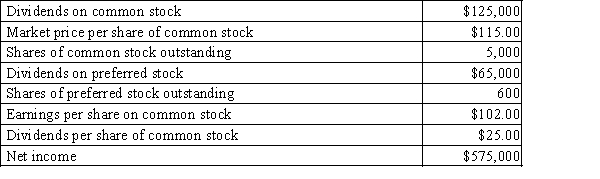 What is CorpCo's price-earnings ratio? Round your answer to one decimal place.
 (Essay)
4.8/5 (84)
(84) A decrease in the ratio of liabilities to stockholders' equity indicates an improvement in the margin of safety for creditors.
(True/False)
4.9/5 (73)
(73) The following information pertains to Diane Company. Assume that all balance sheet amounts represent both average and ending balance figures and that all sales were on credit.Assets  Liabilities and Stockholders' Equity
 Income Statement

 -What is the return on common stockholders' equity for Diane Company?
Liabilities and Stockholders' Equity Income Statement
-What is the return on common stockholders' equity for Diane Company? (Multiple Choice)
4.8/5 (98)
(98) Unusual items affecting the prior period's income statement consist of changes in or errors in applying accounting principles.
(True/False)
4.8/5 (81)
(81) The denominator of the return on total assets ratio is the average total assets.
(True/False)
4.8/5 (70)
(70) Which of the following ratios provides a solvency measure that shows the margin of safety of bondholders and also gives an indication of the potential ability of the business to borrow additional funds on a long-term basis?
(Multiple Choice)
5.0/5 (81)
(81) Earnings per share amounts are only required to be presented for income from continuing operations and net income on the face of the statement.
(True/False)
4.7/5 (81)
(81) A financial statement showing each item on the statement as a percentage of one key item on the statement is called a common-sized financial statement.
(True/False)
4.8/5 (73)
(73) Using measures to assess a business's ability to pay its current liabilities is called current position analysis.
(True/False)
4.7/5 (75)
(75)  -Based on the data for Harding Company, what is the amount of quick assets?
 (Multiple Choice)
5.0/5 (85)
(85) The following information pertains to Diane Company. Assume that all balance sheet amounts represent both average and ending balance figures and that all sales were on credit.Assets Liabilities and Stockholders' Equity Income Statement
-The following information pertains to Dallas Company. Assume that all balance sheet amounts represent both average and ending balance figures and that all sales were on credit. 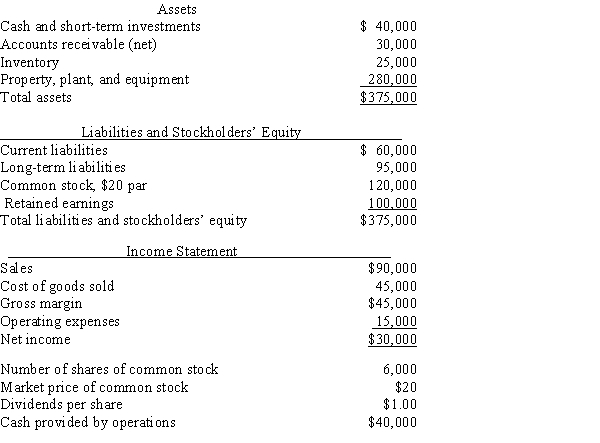 What is the return on stockholders' equity?
Liabilities and Stockholders' Equity Income Statement
-The following information pertains to Dallas Company. Assume that all balance sheet amounts represent both average and ending balance figures and that all sales were on credit. What is the return on stockholders' equity? (Multiple Choice)
4.8/5 (80)
(80) The following information pertains to Diane Company. Assume that all balance sheet amounts represent both average and ending balance figures and that all sales were on credit.Assets Liabilities and Stockholders' Equity Income Statement
-What is the price-earnings ratio for Diane Company?
Liabilities and Stockholders' Equity Income Statement
-What is the price-earnings ratio for Diane Company? (Multiple Choice)
4.7/5 (72)
(72) The excess of current assets over current liabilities is referred to as working capital.
(True/False)
4.7/5 (71)
(71) 
Filters
- Essay(0)
- Multiple Choice(0)
- Short Answer(0)
- True False(0)
- Matching(0)