



 Chat with AI
Exam 16: Job Order Costing

Exam 1: Introduction to Accounting and Business243 Questions
Exam 2: Analyzing Transactions234 Questions
Exam 3: The Adjusting Process225 Questions
Exam 4: The Accounting Cycle211 Questions
Exam 5: Accounting for Retail Businesses273 Questions
Exam 6: Inventories236 Questions
Exam 7: Internal Control and Cash197 Questions
Exam 8: Receivables210 Questions
Exam 9: Long-Term Assets: Fixed and Intangible243 Questions
Exam 10: Liabilities: Current, Installment Notes, and Contingencies199 Questions
Exam 11: Liabilities: Bonds Payable172 Questions
Exam 12: Corporations: Organization, Stock Transactions, and Dividends221 Questions
Exam 13: Statement of Cash Flows193 Questions
Exam 14: Financial Statement Analysis206 Questions
Exam 15: Introduction to Managerial Accounting244 Questions
Exam 16: Job Order Costing212 Questions
Exam 17: Process Cost Systems196 Questions
Exam 18: Activity-Based Costing109 Questions
Exam 19: Support Department and Joint Cost Allocation172 Questions
Exam 20: Cost-Volume-Profit Analysis247 Questions
Exam 21: Variable Costing for Management Analysis136 Questions
Exam 22: Budgeting197 Questions
Exam 23: Evaluating Variances From Standard Costs172 Questions
Exam 24: Evaluating Decentralized Operations210 Questions
Exam 25: Differential Analysis and Product Pricing157 Questions
Exam 26: Capital Investment Analysis191 Questions
Exam 27: Lean Manufacturing and Activity Analysis134 Questions
Exam 28: The Balanced Scorecard and Corporate Social Responsibility170 Questions
Exam 29: Investments137 Questions
Select questions type


Match each of the following costs with the appropriate classification (a-e).
-Insurance on factory building
A)Product cost - direct materials
B)Product cost - direct labor
C)Product cost - factory overhead
D)Period cost - selling expense
E)Period cost - administrative expense
(Short Answer)
4.8/5  (74)
(74) Journalizing the entry to record the application of factory overhead costs to jobs would include a credit to
(Multiple Choice)
4.8/5 (82)
(82) Winston Company estimates that the factory overhead for the following year will be $1,250,000. The company has decided that the basis for applying factory overhead should be machine hours, which is estimated to be 50,000 hours. The total machine hours for the year were 54,300. The actual factory overhead for the year was $1,375,000. Determine the over- or underapplied amount for the year.
(Multiple Choice)
5.0/5 (84)
(84) Journalizing the entry to record the indirect labor costs incurred for general factory use would include a debit to
(Multiple Choice)
4.8/5 (80)
(80) The following budget data are available for Sharp Company:  If factory overhead is to be applied based on direct labor dollars, the predetermined overhead rate is
 (Multiple Choice)
4.7/5 (79)
(79) Which of the following types of inventories does a manufacturing business report on the balance sheet?
(Multiple Choice)
4.8/5 (77)
(77) For which of the following businesses would the process cost system be appropriate?
(Multiple Choice)
4.8/5 (80)
(80) During the period, labor costs incurred on account amounted to $175,000, including $150,000 for production orders and $25,000 for general factory use (indirect labor). In addition, factory overhead charged to production was $32,000. The journal entry to record the direct labor costs is 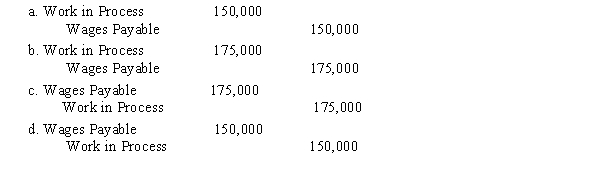
(Short Answer)
4.8/5 (71)
(71) Cranston Company estimates the following overhead costs for the coming year:  Cranston is also budgeting $600,000 in direct labor costs and 15,000 machine hours for the coming year.
a. Compute the predetermined overhead rate using direct labor costs as the allocation base.
b. Compute the predetermined overhead rate using machine hours as the allocation base.
Cranston is also budgeting $600,000 in direct labor costs and 15,000 machine hours for the coming year.
a. Compute the predetermined overhead rate using direct labor costs as the allocation base.
b. Compute the predetermined overhead rate using machine hours as the allocation base. (Essay)
4.8/5 (80)
(80) Sanders Inc. has applied $567,988 of overhead to jobs. Actual overhead at the end of the year is $575,000. The adjustment for over- or underapplied overhead is
(Multiple Choice)
4.9/5 (88)
(88) Nonmanufacturing costs are generally classified into two categories: selling and administrative.
(True/False)
4.9/5 (74)
(74) Selected accounts with some amounts omitted are as follows: 
 If the balance of Work in Process on October 31 is $21,000, what was the amount of factory overhead applied in October?
 (Multiple Choice)
4.9/5 (83)
(83) Which of the following are the two main types of cost accounting systems for manufacturing operations?
(Multiple Choice)
4.9/5 (77)
(77) Selected accounts with some amounts omitted are as follows: 
 If the balance of Work in Process on August 31 is $220,000, what was the amount debited to Work in Process for factory overhead in August, assuming a factory overhead rate of 30% of direct labor costs?
 (Multiple Choice)
4.9/5 (78)
(78) Journalizing the entry to record jobs shipped and customers billed would include a credit to
(Multiple Choice)
4.8/5 (72)
(72) If the underapplied factory overhead amount is immaterial, it is transferred to Cost of Goods Sold at the end of the fiscal year.
(True/False)
4.8/5 (86)
(86) Match each of the following costs with the appropriate classification (a-e).
-Salary of the director of internal auditing
A)Product cost - direct materials
B)Product cost - direct labor
C)Product cost - factory overhead
D)Period cost - selling expense
E)Period cost - administrative expense
(Short Answer)
4.9/5 (82)
(82) Adams Company is a manufacturing company that has worked on several production jobs during the first quarter of the year. Below is a list of all the jobs for the quarter: 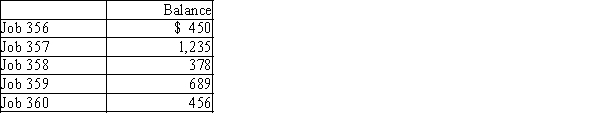 Jobs 356, 357, 358, and 359 were completed. Jobs 356 and 357 were sold at a profit of $500 on each job.
-What is the balance of Sales for Adams Company at the end of the first quarter?
Jobs 356, 357, 358, and 359 were completed. Jobs 356 and 357 were sold at a profit of $500 on each job.
-What is the balance of Sales for Adams Company at the end of the first quarter? (Multiple Choice)
4.9/5 (73)
(73) Match each of the following costs with the appropriate classification (a-e).
-Cotton for a textile manufacturer of blue jeans
A)Product cost - direct materials
B)Product cost - direct labor
C)Product cost - factory overhead
D)Period cost - selling expense
E)Period cost - administrative expense
(Short Answer)
4.8/5 (88)
(88) 
Filters
- Essay(0)
- Multiple Choice(0)
- Short Answer(0)
- True False(0)
- Matching(0)