



 Chat with AI
Exam 24: Evaluating Decentralized Operations

Exam 1: Introduction to Accounting and Business243 Questions
Exam 2: Analyzing Transactions234 Questions
Exam 3: The Adjusting Process225 Questions
Exam 4: The Accounting Cycle211 Questions
Exam 5: Accounting for Retail Businesses273 Questions
Exam 6: Inventories236 Questions
Exam 7: Internal Control and Cash197 Questions
Exam 8: Receivables210 Questions
Exam 9: Long-Term Assets: Fixed and Intangible243 Questions
Exam 10: Liabilities: Current, Installment Notes, and Contingencies199 Questions
Exam 11: Liabilities: Bonds Payable172 Questions
Exam 12: Corporations: Organization, Stock Transactions, and Dividends221 Questions
Exam 13: Statement of Cash Flows193 Questions
Exam 14: Financial Statement Analysis206 Questions
Exam 15: Introduction to Managerial Accounting244 Questions
Exam 16: Job Order Costing212 Questions
Exam 17: Process Cost Systems196 Questions
Exam 18: Activity-Based Costing109 Questions
Exam 19: Support Department and Joint Cost Allocation172 Questions
Exam 20: Cost-Volume-Profit Analysis247 Questions
Exam 21: Variable Costing for Management Analysis136 Questions
Exam 22: Budgeting197 Questions
Exam 23: Evaluating Variances From Standard Costs172 Questions
Exam 24: Evaluating Decentralized Operations210 Questions
Exam 25: Differential Analysis and Product Pricing157 Questions
Exam 26: Capital Investment Analysis191 Questions
Exam 27: Lean Manufacturing and Activity Analysis134 Questions
Exam 28: The Balanced Scorecard and Corporate Social Responsibility170 Questions
Exam 29: Investments137 Questions
Select questions type


Division A of Chacha Company has sales of $140,000, cost of goods sold of $83,000, operating expenses of $43,000, and invested assets of $150,000.
-The profit margin for Division A is
(Multiple Choice)
4.7/5  (77)
(77) Miller's Quarter Horse Company has sales of $4,500,000. It also has invested assets of $2,500,000 and operating expenses of $3,800,000. The company has established a minimum return of 7%. Round percentages and investment turnover to one decimal place.
a. What is Miller's profit margin?
b. What is the investment turnover?
c. What is the rate of return on investment?
d. What is Miller's residual income?
(Essay)
4.8/5 (65)
(65) Which of the following formulas is the investment turnover factor as used in the DuPont formula for determining the return on investment (ROI)?
(Multiple Choice)
4.8/5 (75)
(75) Match each definition that follows with the term (a-e) it defines.
-Ratio of operating income to sales
A)Controllable revenues
B)Profit margin
C)Investment turnover
D)Return on investments (ROI)e.Residual income
(Short Answer)
4.8/5 (69)
(69) The amount of detail presented in a budget performance report for a cost center depends upon the level of management to which the report is directed.
(True/False)
4.9/5 (98)
(98) The support department cost that will be allocated to the Super Division is
(Multiple Choice)
4.9/5 (87)
(87) Match each of the following phrases as describing (a) an advantage, (b) a disadvantage, or (c) neither of decentralization.
-Separate office staff
A)Advantage of decentralization
B)Disadvantage of decentralization
C)Neither an advantage nor a disadvantage
(Short Answer)
4.9/5 (72)
(72) The excess of divisional operating income over a minimum acceptable operating income is termed the residual income.
(True/False)
4.8/5 (88)
(88) Investment centers differ from profit centers in that they
(Multiple Choice)
4.9/5 (77)
(77) Which of the following is not a disadvantage of decentralized operations?
(Multiple Choice)
4.9/5 (93)
(93) Controllable expenses are those that can be influenced by the decisions of the profit center manager.
(True/False)
4.8/5 (72)
(72) Match each definition that follows with the term (a-e) it defines.
-Operating income divided by invested assets
A)Controllable revenues
B)Profit margin
C)Investment turnover
D)Return on investments (ROI)e.Residual income
(Short Answer)
4.9/5 (78)
(78) The profit margin for the Central Division is 20%, and the investment turnover is 2.8. The return on investment (ROI) for the Central Division is
(Multiple Choice)
4.8/5 (82)
(82) The materials used by Hibiscus Company's Division A are currently purchased from an outside supplier at $55 per unit. Division B is able to supply Division A with 20,000 units at a variable cost of $42 per unit. The two divisions have recently negotiated a transfer price of $48 per unit for the 20,000 units.
a. By how much will each division's income increase as a result of this transfer?
b. What is the total increase in income for Hibiscus Company?
(Essay)
4.8/5 (88)
(88) Using the data from Terrace Industries, determine the divisional operating income for Districts 1 and 2. 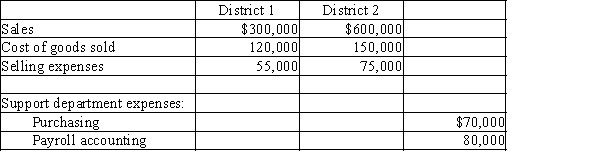 Allocate support department expenses proportional to the sales of each district.
 (Essay)
4.7/5 (80)
(80) To compute operating income, total support department allocations are
(Multiple Choice)
4.8/5 (81)
(81) A cost driver is used to allocate support department expenses. Match each of the following cost drivers with the appropriate department (a-h).
-Allocated equally among divisions
A)Purchasing
B)Payroll Accounting
C)Human Resources
D)Maintenance
E)Information Systems
F)Marketing
G)President's Office
H)Transportation
(Short Answer)
4.9/5 (100)
(100) Support department allocations are similar to the expenses of a profit center that purchases services from a source outside the company.
(True/False)
4.9/5 (93)
(93) Peppy Portraits specializes in pet photography and has both franchised and company-operated studios. Profit margin and investment turnover for both segments are as follows:  Peppy Portraits is expanding. Based on the return on investment (ROI), would you advise a new location to be a company-operated or franchised studio?
 (Essay)
4.9/5 (82)
(82) The negotiated price approach allows the managers of decentralized units to agree on the transfer price.
(True/False)
4.8/5 (84)
(84) 
Filters
- Essay(0)
- Multiple Choice(0)
- Short Answer(0)
- True False(0)
- Matching(0)