



 Chat with AI
Exam 25: Differential Analysis and Product Pricing

Exam 1: Introduction to Accounting and Business243 Questions
Exam 2: Analyzing Transactions234 Questions
Exam 3: The Adjusting Process225 Questions
Exam 4: The Accounting Cycle211 Questions
Exam 5: Accounting for Retail Businesses273 Questions
Exam 6: Inventories236 Questions
Exam 7: Internal Control and Cash197 Questions
Exam 8: Receivables210 Questions
Exam 9: Long-Term Assets: Fixed and Intangible243 Questions
Exam 10: Liabilities: Current, Installment Notes, and Contingencies199 Questions
Exam 11: Liabilities: Bonds Payable172 Questions
Exam 12: Corporations: Organization, Stock Transactions, and Dividends221 Questions
Exam 13: Statement of Cash Flows193 Questions
Exam 14: Financial Statement Analysis206 Questions
Exam 15: Introduction to Managerial Accounting244 Questions
Exam 16: Job Order Costing212 Questions
Exam 17: Process Cost Systems196 Questions
Exam 18: Activity-Based Costing109 Questions
Exam 19: Support Department and Joint Cost Allocation172 Questions
Exam 20: Cost-Volume-Profit Analysis247 Questions
Exam 21: Variable Costing for Management Analysis136 Questions
Exam 22: Budgeting197 Questions
Exam 23: Evaluating Variances From Standard Costs172 Questions
Exam 24: Evaluating Decentralized Operations210 Questions
Exam 25: Differential Analysis and Product Pricing157 Questions
Exam 26: Capital Investment Analysis191 Questions
Exam 27: Lean Manufacturing and Activity Analysis134 Questions
Exam 28: The Balanced Scorecard and Corporate Social Responsibility170 Questions
Exam 29: Investments137 Questions
Select questions type


The condensed income statement for Hayden Corp. for the past year is as follows: 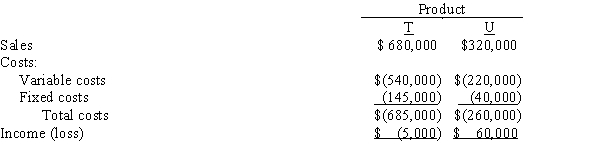 Management is considering the discontinuance of the manufacture and sale of Product T at the beginning of the current year. The discontinuance would have no effect on the total fixed costs and expenses or on the sales of Product U. The amount of change in profit for the current year that will result from the discontinuance of Product T is a
 (Multiple Choice)
4.9/5  (83)
(83) Cost-plus methods determine the normal selling price by estimating a cost amount per unit and adding a markup.
(True/False)
4.9/5 (83)
(83) Using the variable cost method of applying the cost-plus approach to product pricing, determine the selling price for 30,000 units using the following data: variable cost per unit, $15.00; total fixed costs, $90,000; and desired profit, $150,000.
(Essay)
4.9/5 (75)
(75) Match each phrase that follows with the term (a-e) it describes.
-Strategy that focuses on reducing the influence of bottlenecks
A)Opportunity cost
B)Sunk cost
C)Theory of constraints
D)Differential analysis
E)Product cost distortion
(Short Answer)
4.9/5 (86)
(86) An employee of Morgan Corporation found some partially completed units of Model X in a dusty corner of the warehouse. A job ticket attached to the units indicates that a total of $750 in manufacturing costs have been used to bring the materials to this point in the manufacturing process. The units can be sold in their current condition for $275 to a scrap metal dealer. If Morgan spends $250 to complete the units, they could be sold for $600.
a. What should Morgan do? Why?
b. Identify the sunk cost, if any.
(Essay)
4.9/5 (93)
(93) Match each word or phrase that follows with the term (a-e) it describes.
-Only includes the costs of manufacturing in product cost per unit
A)Demand-based method
B)Competition-based method
C)Product cost method
D)Target costing method
E)Production bottleneck
(Short Answer)
4.7/5 (76)
(76) Discontinuing a product or segment is a huge decision that must be carefully analyzed. Which of the following would be a valid reason not to discontinue an operation?
(Multiple Choice)
4.9/5 (85)
(85) If the total unit cost of manufacturing Product Y is currently $36 and the total unit cost after modifying the style is estimated to be $48, the differential cost for this situation is $12.
(True/False)
4.8/5 (92)
(92) Match each phrase that follows with the term (a-e) it describes. Some terms may not be used and other terms may be used more than once.
-= Cost Amount per Unit + Markup
A)Total cost method
B)Variable cost method
C)Normal selling price
D)Product cost method
E)Yield pricing
(Short Answer)
4.8/5 (84)
(84) When a segment of a company is showing a net loss, it is always best to discontinue the segment in order not to continue with losses.
(True/False)
4.8/5 (92)
(92) When a bottleneck occurs in a process used in the production of multiple products, the company must determine the contribution margin for each product and give priority to the product that has the lowest contribution margin per bottleneck hour.
(True/False)
4.9/5 (77)
(77) Falcon Inc. manufactures Product B, incurring variable costs of $15.00 per unit and fixed costs of $70,000. Falcon desires a profit equal to a 12% return on invested assets, $785,000 of assets are devoted to producing Product B, and 100,000 units are expected to be produced and sold.
a.Compute the markup percentage, using the total cost method of applying the cost-plus approach to product pricing.
b.Compute the selling price of Product B.Round your intermediate computations and final answer to two decimal places.
(Essay)
4.9/5 (83)
(83) The costs of initially producing an intermediate product should be considered in deciding whether to further process a product, even though the costs will not change, regardless of the decision.
(True/False)
4.7/5 (82)
(82) Dotterel Corporation uses the variable cost method of product pricing. Below is cost information for the production and sale of 35,000 units of its sole product. Dotterel desires a profit equal to an 11.2% return on invested assets of $350,000. 
-The unit selling price for Dotterel's product is
-The unit selling price for Dotterel's product is (Multiple Choice)
4.8/5 (64)
(64) The total cost method includes all manufacturing costs plus selling and administrative expenses in the cost amount to which the markup is added to determine product price.
(True/False)
4.9/5 (69)
(69) Which of the following is not a method commonly used in applying the cost-plus approach to product pricing?
(Multiple Choice)
4.8/5 (70)
(70) The revenue that is forgone from an alternative use of an asset, such as cash, is called
(Multiple Choice)
4.8/5 (77)
(77) Which of the following methods of applying the cost-plus approach to product pricing includes only total manufacturing costs in the cost amount to which the markup is added?
(Multiple Choice)
4.7/5 (87)
(87) In using the total cost method of applying the cost-plus approach to product pricing, selling expenses, administrative expenses, and profit are covered in the markup.
(True/False)
4.7/5 (75)
(75) 
Filters
- Essay(0)
- Multiple Choice(0)
- Short Answer(0)
- True False(0)
- Matching(0)