



 Chat with AI
Exam 26: Capital Investment Analysis

Exam 1: Introduction to Accounting and Business243 Questions
Exam 2: Analyzing Transactions234 Questions
Exam 3: The Adjusting Process225 Questions
Exam 4: The Accounting Cycle211 Questions
Exam 5: Accounting for Retail Businesses273 Questions
Exam 6: Inventories236 Questions
Exam 7: Internal Control and Cash197 Questions
Exam 8: Receivables210 Questions
Exam 9: Long-Term Assets: Fixed and Intangible243 Questions
Exam 10: Liabilities: Current, Installment Notes, and Contingencies199 Questions
Exam 11: Liabilities: Bonds Payable172 Questions
Exam 12: Corporations: Organization, Stock Transactions, and Dividends221 Questions
Exam 13: Statement of Cash Flows193 Questions
Exam 14: Financial Statement Analysis206 Questions
Exam 15: Introduction to Managerial Accounting244 Questions
Exam 16: Job Order Costing212 Questions
Exam 17: Process Cost Systems196 Questions
Exam 18: Activity-Based Costing109 Questions
Exam 19: Support Department and Joint Cost Allocation172 Questions
Exam 20: Cost-Volume-Profit Analysis247 Questions
Exam 21: Variable Costing for Management Analysis136 Questions
Exam 22: Budgeting197 Questions
Exam 23: Evaluating Variances From Standard Costs172 Questions
Exam 24: Evaluating Decentralized Operations210 Questions
Exam 25: Differential Analysis and Product Pricing157 Questions
Exam 26: Capital Investment Analysis191 Questions
Exam 27: Lean Manufacturing and Activity Analysis134 Questions
Exam 28: The Balanced Scorecard and Corporate Social Responsibility170 Questions
Exam 29: Investments137 Questions
Select questions type


The expected average rate of return for a proposed investment of $800,000 in a fixed asset with a useful life of 4 years, straight-line depreciation, no residual value, and an expected total income of $360,000 for the 4 years is
(Multiple Choice)
4.8/5  (77)
(77) In computing the net present value of an investment in equipment, the required investment and its residual value should be subtracted from the present value of all future cash inflows.
(True/False)
4.9/5 (81)
(81) The anticipated purchase of a fixed asset for $400,000, with a useful life of 5 years and no residual value, is expected to yield total net income of $300,000 over the 5 years. The expected average rate of return is 37.5%.
(True/False)
4.7/5 (79)
(79) The internal rate of return method of analyzing capital investment proposals uses present value concepts to compute a rate of return expected from the proposals.
(True/False)
4.7/5 (76)
(76) The computations involved in the net present value method of analyzing capital investment proposals are more involved than those for the average rate of return method.
(True/False)
4.7/5 (83)
(83) A company is considering the purchase of a new machine for $48,000. Management expects that the machine can produce sales of $16,000 each year for the next 10 years. Expenses are expected to include direct materials, direct labor, and factory overhead totaling $8,000 per year plus depreciation of $4,000 per year. All revenues and expenses except depreciation are on a cash basis. The payback period for the machine is 12 years.
(True/False)
5.0/5 (77)
(77) With expected value analysis, incorporating the probabilities of various outcomes allows uncertainty to be completely eliminated.
(True/False)
4.8/5 (83)
(83) Which of the following methods for evaluating capital investment proposals reduces the expected future net cash flows originating from the proposals to their present values and computes a net present value?
(Multiple Choice)
4.8/5 (90)
(90) The management of Wyoming Corporation is considering the purchase of a new machine costing $375,000. The company's desired rate of return is 6%. The present value factor for an annuity of $1 at interest of 6% for 5 years is 4.212. In addition to the foregoing information, use the following data in determining the acceptability of this investment: 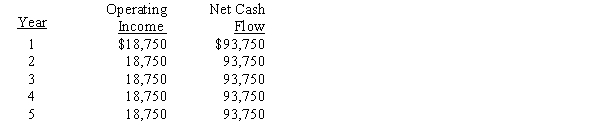
-Motel Corporation is analyzing a capital expenditure that will involve a cash outlay of $208,240. Estimated cash flows are expected to be $40,000 annually for 7 years. The present value factors for an annuity of $1 for 7 years at interest of 6%, 8%, 10%, and 12% are 5.582, 5.206, 4.868, and 4.564, respectively. The internal rate of return for this investment is
-Motel Corporation is analyzing a capital expenditure that will involve a cash outlay of $208,240. Estimated cash flows are expected to be $40,000 annually for 7 years. The present value factors for an annuity of $1 for 7 years at interest of 6%, 8%, 10%, and 12% are 5.582, 5.206, 4.868, and 4.564, respectively. The internal rate of return for this investment is (Multiple Choice)
4.8/5 (69)
(69) The management of River Corporation is considering the purchase of a new machine costing $380,000. The company's desired rate of return is 6%. The present value factor for an annuity of $1 at interest of 6% for 5 years is 4.212. In addition to the foregoing information, use the following data in determining the acceptability of this investment: 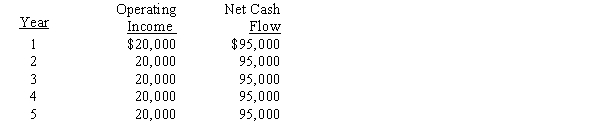
-The average rate of return for this investment is
-The average rate of return for this investment is (Multiple Choice)
4.7/5 (82)
(82) Which of the following is not an advantage of the average rate of return method?
(Multiple Choice)
4.9/5 (81)
(81) An anticipated purchase of equipment for $490,000 with a useful life of 8 years and no residual value is expected to yield the following annual incomes and net cash flows:  The cash payback period for the equipment is
 (Multiple Choice)
4.9/5 (82)
(82) Match each phrase that follows with the term (a-f) it describes.
-A stream of equal cash flow amounts
A)Capital rationing
B)Annuity
C)Capital investment analysis
D)Internal rate of return method
E)Payback period
F)Accounting rate of return
(Short Answer)
4.7/5 (83)
(83) The production department is proposing the purchase of an automatic insertion machine. It has identified 3 machines, each with an estimated life of 10 years. Which machine offers the best internal rate of return? 
(Multiple Choice)
4.9/5 (85)
(85) With sensitivity analysis, at least one input must be a known (not estimated) value.
(True/False)
4.9/5 (67)
(67) T-Bone Company is contemplating investing in a new piece of manufacturing machinery. The amount to be invested is $150,000. The present value of the future cash flows is $141,000. Should the company invest in this project?
(Multiple Choice)
5.0/5 (85)
(85) The method of analyzing capital investment proposals in which the estimated average annual income is divided by the average investment is the average rate of return method.
(True/False)
4.8/5 (79)
(79) For Years 1-5, a proposed expenditure of $500,000 for a fixed asset with a 5-year life is expected to generate operating income of $40,000, $35,000, $25,000, $25,000, and $25,000, respectively, and net cash inflows of $90,000, $85,000, $75,000, $75,000, and $75,000, respectively. The cash payback period is 5 years.
(True/False)
4.8/5 (68)
(68) Project A requires an original investment of $65,000. The project will yield cash flows of $15,000 per year for 7 years. Project B has a computed net present value of $5,500 over a 5-year life. Project A could be sold at the end of 5 years for a price of $30,000. (a) Using the present value tables that follow, determine the net present value of Project A over a 5-year life with salvage value assuming a minimum rate of return of 12%. (b) Which project provides the greatest net present value?
Following is a table for the present value of $1 at compound interest:  Following is a table for the present value of an annuity of $1 at compound interest:

Following is a table for the present value of an annuity of $1 at compound interest: (Essay)
5.0/5 (79)
(79) Which of the following is a method of analyzing capital investment proposals that ignores present value?
(Multiple Choice)
4.8/5 (66)
(66) 
Filters
- Essay(0)
- Multiple Choice(0)
- Short Answer(0)
- True False(0)
- Matching(0)