



 Chat with AI
Exam 17: Understanding Corporate Annual Reports: Basic Financial Statements

Exam 1: Managerial Accounting and the Business Organization173 Questions
Exam 2: Introduction to Cost Behavior and Cost Volume Relationships194 Questions
Exam 3: Measurement of Cost Behavior173 Questions
Exam 4: Cost Management Systems and Activity-Based Costing196 Questions
Exam 5: Relevant Information and Decision-Making: Marketing Decisions194 Questions
Exam 6: Relevant Information and Decision-Making: Product Decisions141 Questions
Exam 7: The Master Budget151 Questions
Exam 8: Flexible Budget and Variance Analysis166 Questions
Exam 9: Management Control Systems and Responsibility Accounting184 Questions
Exam 10: Management Control in Decentralized Organizations201 Questions
Exam 11: Capital Budgeting165 Questions
Exam 12: Cost Allocation158 Questions
Exam 13: Job-Costing176 Questions
Exam 14: Process-Costing Systems166 Questions
Exam 15: Overhead Application: Variable and Absorbtion Costing186 Questions
Exam 16: Basic Accounting Concepts, Techniques, and Conventions187 Questions
Exam 17: Understanding Corporate Annual Reports: Basic Financial Statements167 Questions
Select questions type


Presented below are the balance sheets of Monty Company and Hall Company at January 1, 20X6: 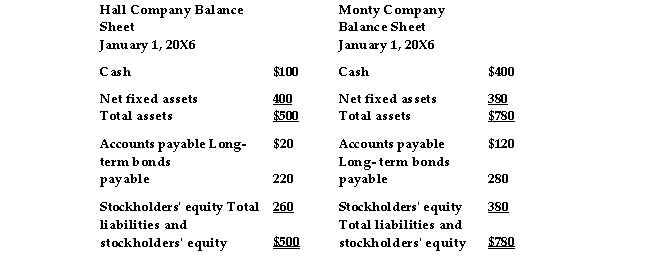 On January 1, 20X6, Monty Company acquired 100% of the outstanding common stock of Hall Company for $260 in cash. _ is the balance of the Investment in Hall Stock on the consolidated balance sheet immediately after the acquisition of Hall's stock.
 (Multiple Choice)
4.8/5  (77)
(77) Company B has 40,000 shares of its common stock outstanding. Company A owns 15,000 shares of Company B stock. Company A should use to account for its investment in Company B.
(Multiple Choice)
4.9/5 (78)
(78) All other things being equal, a higher current ratio indicates that:
(Multiple Choice)
4.8/5 (83)
(83) A subsidiary is a company that owns more than 50% of another business's stock.
(True/False)
4.7/5 (77)
(77) Trading securities are investments where there is no intention to sell in the near future.
(True/False)
4.9/5 (76)
(76) The following information pertains to Barnum Company: Balance Sheet
At D ecember
Current assets \ 18,700 Current liabilities \ 7,600 Long-term assets Long- term liabilities 13,250 Stockholders' eauity 27,550 Total assets \ 8400 Total liabilities and s.e. \ 48,400
Barnum Company Income Statement
For the Year Ended December 31, 20X2
Sales \ 106,950 Less: Cost of goods sold (61,800) Gross profit \ 45,150 Less: Operating expenses Operatingincome \ 13,450 Less other expenses: interest (1,300) Income before taxes \ 12,150 Less: Income tax expense Net income \ 7,300 There were 1,000 shares of common stock outstanding with a market value of $75 as of December 31, 20X2. Dividends declared and paid was $5 per share. The current ratio for 20X2 is:
(Multiple Choice)
4.9/5 (92)
(92) Hawkeye Company began the current year with 1,000 units in ending inventory valued at $6.00 per unit. During the year, no inventory was purchased. The company sold for cash 920 units at $7.80 per unit. The replacement cost of the inventory was $6.80 per unit. At the beginning of the year, the general price level index was 100. At the end of the year, the general price level index was 110.
Required: Compute the ending inventory and any holding gains on the unsold units using:
1. historical cost/nominal dollars
2. current cost/nominal dollars
3. historical cost/current dollars
4. current cost/constant dollars
(Essay)
4.9/5 (79)
(79) If a company uses the equity method to account for long- term equity investments, the company recognizes income from the investee when the investee pays a dividend.
(True/False)
4.8/5 (80)
(80) The Investments in Affiliates account appears on the consolidated balance sheet of the subsidiary company.
(True/False)
4.9/5 (77)
(77) Company B has 40,000 shares of its common stock outstanding. Company A owns 5,000 shares of Company B stock. Company A should use to account for its investment in Company B.
(Multiple Choice)
5.0/5 (70)
(70) Net income less dividends in preferred stock (if any) / average common shares outstanding
(Short Answer)
4.8/5 (80)
(80) Fisher Company acquired 80% of the outstanding shares of Gibbs Company for $152 in cash. The net income was $100 and $20 for Fisher Company and Gibbs Company, respectively. None of the income resulted from intercompany sales. The net income on the consolidated income statement is:
(Multiple Choice)
4.9/5 (80)
(80) Under the equity method, the investor recognizes as income:
(Multiple Choice)
4.8/5 (76)
(76) The investor's method of accounting for long- term equity securities depends on the ability of the investor to influence the operations of the investee.
(True/False)
4.8/5 (86)
(86) The method of accounting for investments in equity securities that shows the investment on the balance sheet at market value
(Short Answer)
4.8/5 (84)
(84) 
Filters
- Essay(0)
- Multiple Choice(0)
- Short Answer(0)
- True False(0)
- Matching(0)