



 Chat with AI
Exam 5: Elasticity and Its Application

Exam 1: Ten Principles of Economics220 Questions
Exam 2: Thinking Like an Economist284 Questions
Exam 3: Interdependence and the Gains From Trade192 Questions
Exam 4: The Market Forces of Supply and Demand277 Questions
Exam 5: Elasticity and Its Application222 Questions
Exam 6: Supply, Demand, and Government Policies321 Questions
Exam 7: Consumers, Producers, and the Efficiency of Markets218 Questions
Exam 8: Applications: The Costs of Taxation203 Questions
Exam 9: Application: International Trade214 Questions
Exam 10: Externalities204 Questions
Exam 11: Public Goods and Common Resources182 Questions
Exam 12: The Design of the Tax System225 Questions
Exam 13: The Costs of Production261 Questions
Exam 14: Firms in Competitive Markets243 Questions
Exam 15: Monopoly231 Questions
Exam 16: Monopolistic Competition246 Questions
Exam 17: Oligopoly204 Questions
Exam 18: The Markets for the Factors of Production232 Questions
Exam 19: Earnings and Discrimination230 Questions
Exam 20: Income Inequality and Poverty194 Questions
Exam 21: The Theory of Consumer Choice209 Questions
Exam 22: Frontiers in Microeconomics185 Questions
Exam 23: Measuring a Nations Income231 Questions
Exam 24: Measuring the Cost of Living214 Questions
Exam 25: Production and Growth187 Questions
Exam 26: Saving, Investment, and the Financial System225 Questions
Exam 27: Tools of Finance198 Questions
Exam 28: Unemployment and Its Natural Rate361 Questions
Exam 29: The Monetary System210 Questions
Exam 30: Money Growth and Inflation201 Questions
Exam 31: Open-Economy Macroeconomics: Basic Concepts194 Questions
Exam 32: A Macroeconomic Theory of the Open Economy188 Questions
Exam 33: Aggregate Demand and Aggregate Supply189 Questions
Exam 34: The Influence of Monetary and Fiscal Policy on Aggregate Demand207 Questions
Exam 35: The Short-Run Tradeoff Between Inflation and Unemployment223 Questions
Exam 36: Six Debates Over Macroeconomic Policy154 Questions
Select questions type


Figure 5-4
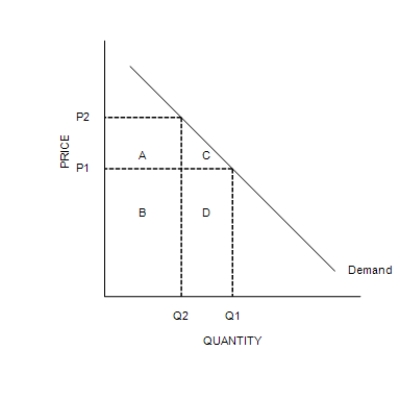 -Refer to Figure 5-4. Total revenue when the price is P1 is represented by
 (Multiple Choice)
4.9/5  (72)
(72) Figure 5-2

-Refer to Figure 5-2. If the price decreases in the region of the demand curve between points B to A, we can expect total revenue to
-Refer to Figure 5-2. If the price decreases in the region of the demand curve between points B to A, we can expect total revenue to (Multiple Choice)
4.9/5 (77)
(77) If marijuana were legalized, it is likely that there would be an increase in the demand for marijuana. If demand for marijuana is inelastic and the supply of marijuana is perfectly elastic, this will result in
(Multiple Choice)
4.8/5 (85)
(85) OPEC failed to maintain a high price of oil in the long run, partly because both the supply of oil and the demand for oil are more elastic in the long run than in the short run.
(True/False)
4.9/5 (74)
(74) Figure 5-3

-Refer to Figure 5-3. At a price of $60 per unit, sellers' total revenue equals
-Refer to Figure 5-3. At a price of $60 per unit, sellers' total revenue equals (Multiple Choice)
5.0/5 (86)
(86) Figure 5-8

-Refer to Figure 5-21. Using the midpoint method, what is the price elasticity of supply between $15 and $25?
-Refer to Figure 5-21. Using the midpoint method, what is the price elasticity of supply between $15 and $25? (Short Answer)
4.9/5 (82)
(82) The flatter the demand curve that passes through a given point, the more inelastic the demand.
(True/False)
4.8/5 (80)
(80) Last year, Damaris bought 8 burgers when her income was $43,000. This year, her income is $54,000, and she purchased 9 burgers. Holding other factors constant and using the midpoint method, it follows that Damaris's income elasticity of demand is about
(Multiple Choice)
4.9/5 (89)
(89) Studies indicate that the price elasticity of demand for cigarettes is about 0.4. A government policy aimed at reducing smoking changed the price of a pack of cigarettes from $2 to $6. According to the midpoint method, the government policy should have reduced smoking by
(Multiple Choice)
4.9/5 (80)
(80) Scenario 5-2
Milk has an inelastic demand, and steak has an elastic demand. Suppose that a mysterious increase in bovine infertility decreases both the population of dairy cows and the population of beef cattle by 50 percent.
-Refer to Scenario 5-2. The equilibrium price will
(Multiple Choice)
4.8/5 (85)
(85) For a particular good, a 12 percent increase in price causes a 3 percent decrease in quantity demanded. Which of the following statements is most likely applicable to this good?
(Multiple Choice)
4.8/5 (89)
(89) Figure 5-4
-Refer to Figure 5-4. If rectangle D is larger than rectangle A, then which of the following is not correct?
-Refer to Figure 5-4. If rectangle D is larger than rectangle A, then which of the following is not correct? (Multiple Choice)
5.0/5 (87)
(87) Suppose the price of gas increases by 20%. Will demand be more elastic if consumers have 3 weeks or 3 years to adjust to this price change?
(Short Answer)
4.9/5 (75)
(75) When the price of good A is $50, the quantity demanded of good A is 500 units. When the price of good A rises to $70, the quantity demanded of good A falls to 400 units. Using the midpoint method, the price elasticity of demand for good A is
(Multiple Choice)
4.9/5 (82)
(82) If a supply curve is perfectly horizontal, what is the value of the price elasticity of supply?
(Short Answer)
4.9/5 (78)
(78) Which of the following is likely to have the most price inelastic demand?
(Multiple Choice)
4.8/5 (83)
(83) Scenario 5-2
Milk has an inelastic demand, and steak has an elastic demand. Suppose that a mysterious increase in bovine infertility decreases both the population of dairy cows and the population of beef cattle by 50 percent.
-Refer to Scenario 5-2. Total consumer spending on milk will
(Multiple Choice)
4.8/5 (67)
(67) Which of the following could be the price elasticity of demand for a good for which a decrease in price would increase total revenue?
(Multiple Choice)
4.8/5 (80)
(80) Demand is elastic if the price elasticity of demand is greater than 1.
(True/False)
4.8/5 (70)
(70) 
Filters
- Essay(0)
- Multiple Choice(0)
- Short Answer(0)
- True False(0)
- Matching(0)