



 Chat with AI
Exam 30: Money Growth and Inflation

Exam 1: Ten Principles of Economics220 Questions
Exam 2: Thinking Like an Economist284 Questions
Exam 3: Interdependence and the Gains From Trade192 Questions
Exam 4: The Market Forces of Supply and Demand277 Questions
Exam 5: Elasticity and Its Application222 Questions
Exam 6: Supply, Demand, and Government Policies321 Questions
Exam 7: Consumers, Producers, and the Efficiency of Markets218 Questions
Exam 8: Applications: The Costs of Taxation203 Questions
Exam 9: Application: International Trade214 Questions
Exam 10: Externalities204 Questions
Exam 11: Public Goods and Common Resources182 Questions
Exam 12: The Design of the Tax System225 Questions
Exam 13: The Costs of Production261 Questions
Exam 14: Firms in Competitive Markets243 Questions
Exam 15: Monopoly231 Questions
Exam 16: Monopolistic Competition246 Questions
Exam 17: Oligopoly204 Questions
Exam 18: The Markets for the Factors of Production232 Questions
Exam 19: Earnings and Discrimination230 Questions
Exam 20: Income Inequality and Poverty194 Questions
Exam 21: The Theory of Consumer Choice209 Questions
Exam 22: Frontiers in Microeconomics185 Questions
Exam 23: Measuring a Nations Income231 Questions
Exam 24: Measuring the Cost of Living214 Questions
Exam 25: Production and Growth187 Questions
Exam 26: Saving, Investment, and the Financial System225 Questions
Exam 27: Tools of Finance198 Questions
Exam 28: Unemployment and Its Natural Rate361 Questions
Exam 29: The Monetary System210 Questions
Exam 30: Money Growth and Inflation201 Questions
Exam 31: Open-Economy Macroeconomics: Basic Concepts194 Questions
Exam 32: A Macroeconomic Theory of the Open Economy188 Questions
Exam 33: Aggregate Demand and Aggregate Supply189 Questions
Exam 34: The Influence of Monetary and Fiscal Policy on Aggregate Demand207 Questions
Exam 35: The Short-Run Tradeoff Between Inflation and Unemployment223 Questions
Exam 36: Six Debates Over Macroeconomic Policy154 Questions
Select questions type


If the government were to run a budget deficit and wanted to finance it by printing money, would it have the central bank conduct open market purchases or open market sales?
(Short Answer)
4.9/5  (69)
(69) If velocity is 6, real output is 10,000, and M is 20,000 what would the price level be? If M increases to 25,000 but V and Y do not change, what happens to the price level? Are the change in the money supply and the change in the price level proportional?
(Essay)
4.7/5 (76)
(76) The idea that firms incur actual costs when they change prices is known as _____. Firms in countries with lower inflation rates will change price _____ frequently compared to those countries where inflation is higher.
(Short Answer)
4.9/5 (66)
(66) The quantity theory of money implies that if output and velocity are constant, then a 50 percent increase in the money supply would lead to less than a 50 percent increase in the price level.
(True/False)
4.8/5 (101)
(101) Changes in nominal variables are determined mostly by the quantity of money and the monetary system according to
(Multiple Choice)
4.7/5 (73)
(73) An increase in money demand would create a surplus of money at the original value of money.
(True/False)
4.9/5 (78)
(78) Which of the following helps to explain why the "inflation fallacy" is a fallacy?
(Multiple Choice)
4.9/5 (90)
(90) Jackie saves $100 and receives $106 the next year. During the same year, the price of the basket of goods that she purchases increases from $100 to $104. What is nominal interest rate on Jackie's saving? What is the real interest rate on Jackie's saving? What was the inflation rate?
(Essay)
4.9/5 (73)
(73) When the market for money is drawn with the value of money on the vertical axis and the quantity of money on the horizontal axis, long-run equilibrium is obtained when the quantity demanded and quantity supplied of money are equal due to adjustments in
(Multiple Choice)
4.9/5 (62)
(62) Figure 30-2
In the graph, MS represents the money supply and MD represents money demand. The vertical axis is the value of money measured as 1/P and the horizontal axis is the quantity of money. 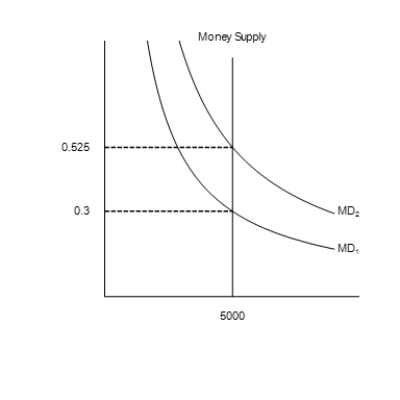 -Refer to Figure 30-2. What quantity is measured along the vertical axis?
 (Multiple Choice)
4.9/5 (78)
(78) In the long run inflation is explained by __________. For countries that had hyperinflation this source of inflation arose primarily because the government __________.
(Essay)
4.8/5 (80)
(80) If inflation is less than expected, who is wealth redistributed to?
(Short Answer)
4.9/5 (85)
(85) According to the classical dichotomy, what changes nominal variables? What changes real variables?
(Essay)
4.8/5 (92)
(92) On a given morning, Franco sold 40 pairs of shoes for a total of $800 at his shoe store.
(Multiple Choice)
4.8/5 (86)
(86) Inflation distorts relative prices. What does this mean and why does it impose a cost on society?
(Essay)
4.9/5 (91)
(91) 
Filters
- Essay(0)
- Multiple Choice(0)
- Short Answer(0)
- True False(0)
- Matching(0)