



 Chat with AI
Exam 18: International Trade and Public Policy

Exam 1: Introduction: What Is Economics?118 Questions
Exam 2: The Key Principles of Economics144 Questions
Exam 3: Exchange and Markets111 Questions
Exam 4: Demand, Supply, and Market Equilibrium172 Questions
Exam 5: Measuring a Nation's Production and Income152 Questions
Exam 6:Unemployment and Inflation155 Questions
Exam 7:The Economy at Full Employment148 Questions
Exam 8: Why Do Economies Grow?167 Questions
Exam 9: Aggregate Demand and Aggregate Supply160 Questions
Exam 10: Fiscal Policy133 Questions
Exam 11: The Income-Expenditure Model193 Questions
Exam 12: Investment and Financial Markets150 Questions
Exam 13: Money and the Banking System170 Questions
Exam 14: The Federal Reserve and Monetary Policy149 Questions
Exam 15: Modern Macroeconomics: From the Short Run to the Long Run152 Questions
Exam 16: The Dynamics of Inflation and Unemployment149 Questions
Exam 17: Macroeconomic Policy Debates147 Questions
Exam 18: International Trade and Public Policy155 Questions
Exam 19: The World of International Finance150 Questions
Select questions type


The relative amounts of the goods that will be exchanged for each other in trade refers to the nations'
(Multiple Choice)
4.7/5  (75)
(75) Which of the following situations will arise in the domestic market following the imposition of an import quota?
(Multiple Choice)
4.9/5 (64)
(64) Explain the concept of "learning by doing" with respect to infant industry protection.
(Essay)
4.8/5 (90)
(90) If the tariffs on the textiles, apparel items and footwear mentioned in the Application were replaced by equivalent voluntary export restraints (VERs), low-income consumers would probably
(Multiple Choice)
4.8/5 (94)
(94) The first major international trade agreement following World War II was the North American Free Trade Agreement (NAFTA).
(True/False)
4.9/5 (82)
(82) The case of Airbus, an airplane manufacturing consortium in Europe, which receives large subsidies from several European countries, best exemplifies which rationale for protectionist policies?
(Multiple Choice)
4.9/5 (88)
(88) Figure 18.2
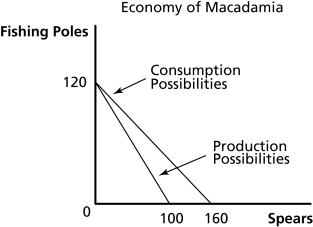 -Refer to Figure 18.2. Macadamia has a comparative advantage in the production of
 (Multiple Choice)
4.9/5 (70)
(70) What is the difference between price discrimination and predatory pricing?
(Essay)
4.9/5 (78)
(78) What is the difference between a production possibilities curve and a consumption possibilities curve?
(Essay)
4.9/5 (74)
(74) The equilibrium price under an import quota is below the price that occurs with an import ban.
(True/False)
4.8/5 (87)
(87) A(n)________ is a trade policy by which a nation agrees to limit its exports of a good in order to avoid more restrictive trade policies.
(Multiple Choice)
4.7/5 (82)
(82) If a country bans the importation of a particular good, the market equilibrium is shown by the intersection of the foreign demand curve and the domestic supply curve.
(True/False)
4.8/5 (70)
(70) Recall the Application about why international trade may reduce measured inequality in the United States to answer the following question(s). While it is conventional wisdom now that inequality in the United States has increased in the last several decades, until recently no one has taken a careful look at the actual living standards of different income groups, taking into account the goods they purchase. Two economists from the University of Chicago, Christian Broda and John Romalis, investigated the living standards of low-income groups and high-income groups based on the goods these groups purchase.
-According to this Application, the poor consume ________ ratio of nondurable goods to services ________.
(Multiple Choice)
4.9/5 (79)
(79) 
Filters
- Essay(0)
- Multiple Choice(0)
- Short Answer(0)
- True False(0)
- Matching(0)