



 Chat with AI
Exam 18: International Trade and Public Policy

Exam 1: Introduction: What Is Economics?118 Questions
Exam 2: The Key Principles of Economics144 Questions
Exam 3: Exchange and Markets111 Questions
Exam 4: Demand, Supply, and Market Equilibrium172 Questions
Exam 5: Measuring a Nation's Production and Income152 Questions
Exam 6:Unemployment and Inflation155 Questions
Exam 7:The Economy at Full Employment148 Questions
Exam 8: Why Do Economies Grow?167 Questions
Exam 9: Aggregate Demand and Aggregate Supply160 Questions
Exam 10: Fiscal Policy133 Questions
Exam 11: The Income-Expenditure Model193 Questions
Exam 12: Investment and Financial Markets150 Questions
Exam 13: Money and the Banking System170 Questions
Exam 14: The Federal Reserve and Monetary Policy149 Questions
Exam 15: Modern Macroeconomics: From the Short Run to the Long Run152 Questions
Exam 16: The Dynamics of Inflation and Unemployment149 Questions
Exam 17: Macroeconomic Policy Debates147 Questions
Exam 18: International Trade and Public Policy155 Questions
Exam 19: The World of International Finance150 Questions
Select questions type


Consider the following weekly production possibilities of gloves and hats in Panama and Russia:
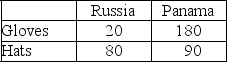 What is the possible range of terms of trade between Panama and Russia?
 (Essay)
4.8/5  (74)
(74) The argument that calls for the trade protection of only newly developing industries is known as the ________ argument.
(Multiple Choice)
5.0/5 (77)
(77) For a nation to have ________ in producing a good it must have a lower opportunity cost of producing that good than the other country.
(Multiple Choice)
4.8/5 (77)
(77) If the tariffs on the textiles, apparel items and footwear mentioned in the Application were replaced by equivalent voluntary export restraints (VERs), who would benefit the most?
(Multiple Choice)
4.7/5 (90)
(90) Today, the average U.S. tariff is 4.6 percent of the value of imported goods, which is very low by historical standards.
(True/False)
4.7/5 (80)
(80) Which of the following groups of countries are members of NAFTA?
(Multiple Choice)
4.8/5 (78)
(78) Figure 18.1
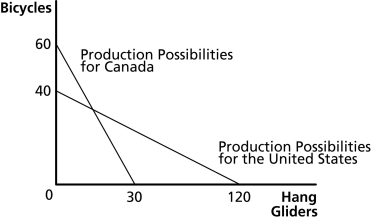 -Refer to Figure 18.1. The United States has a comparative advantage in the production of
 (Multiple Choice)
4.9/5 (66)
(66) Which of the following situations will arise in the domestic market following the imposition of a voluntary export restraint?
(Multiple Choice)
4.9/5 (71)
(71) Which of the following situations will arise in the domestic market following the imposition of an import ban?
(Multiple Choice)
4.7/5 (74)
(74) Import bans, import quotas, voluntary export restraints, and tariffs on goods all
(Multiple Choice)
4.7/5 (76)
(76) A possible reason to impose a protectionist policy such as a tariff is to
(Multiple Choice)
4.8/5 (87)
(87) Suppose the nation of Arcadia produces only two goods, teapots and surfboards. If Arcadia produces only teapots, it can make 80 per day. If Arcadia produces only surfboards, it can make 30 per day. What is the opportunity cost of 1 teapot in Arcadia?
(Multiple Choice)
4.8/5 (81)
(81) A possible reason a nation might impose a protectionist policy such as a tariff is to
(Multiple Choice)
4.8/5 (71)
(71) Figure 18.3
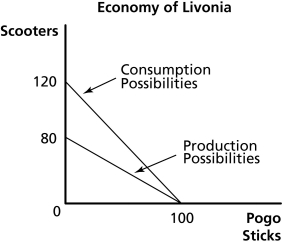 -Refer to Figure 18.3. Livonia has a comparative advantage in the production of
 (Multiple Choice)
4.9/5 (97)
(97) Figure 18.2
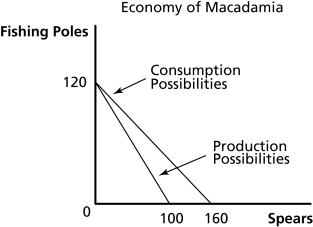 -Refer to Figure 18.2. The opportunity cost of producing fishing poles in Macadamia is
 (Multiple Choice)
4.8/5 (79)
(79) Recall the Application about the method used by the Commerce Department to determine if imported products are being sold at lower prices in the United States than in their countries of origin to answer the following question(s).
-Recall the Application. Firms that sell products at a lower price in foreign countries than they do in their domestic markets are said to be engaging in
(Multiple Choice)
4.9/5 (79)
(79) Which of the following situations will arise in the domestic market following the removal of an import quota?
(Multiple Choice)
4.9/5 (84)
(84) Suppose Belgium produces only two goods, chocolate and lace. If Belgium has a comparative advantage in lace, a move toward free trade will
(Multiple Choice)
4.9/5 (71)
(71) Using a graph, illustrate what the market effects of a quota, a tariff, or a complete ban on imports would be.
(Essay)
4.8/5 (83)
(83) Which of the following situations will arise in the domestic market following the imposition of a tariff?
(Multiple Choice)
4.8/5 (71)
(71) 
Filters
- Essay(0)
- Multiple Choice(0)
- Short Answer(0)
- True False(0)
- Matching(0)