



 Chat with AI
Exam 18: International Trade and Public Policy

Exam 1: Introduction: What Is Economics?118 Questions
Exam 2: The Key Principles of Economics144 Questions
Exam 3: Exchange and Markets111 Questions
Exam 4: Demand, Supply, and Market Equilibrium172 Questions
Exam 5: Measuring a Nation's Production and Income152 Questions
Exam 6:Unemployment and Inflation155 Questions
Exam 7:The Economy at Full Employment148 Questions
Exam 8: Why Do Economies Grow?167 Questions
Exam 9: Aggregate Demand and Aggregate Supply160 Questions
Exam 10: Fiscal Policy133 Questions
Exam 11: The Income-Expenditure Model193 Questions
Exam 12: Investment and Financial Markets150 Questions
Exam 13: Money and the Banking System170 Questions
Exam 14: The Federal Reserve and Monetary Policy149 Questions
Exam 15: Modern Macroeconomics: From the Short Run to the Long Run152 Questions
Exam 16: The Dynamics of Inflation and Unemployment149 Questions
Exam 17: Macroeconomic Policy Debates147 Questions
Exam 18: International Trade and Public Policy155 Questions
Exam 19: The World of International Finance150 Questions
Select questions type


Consider a nation that has a comparative advantage in the production of goods using unskilled labor. What types of workers will benefit from increased trade, and what type will lose?
(Essay)
4.7/5  (75)
(75) If the tradeoff between the two goods is constant, the production possibilities curve is
(Multiple Choice)
4.8/5 (92)
(92) Figure 18.3
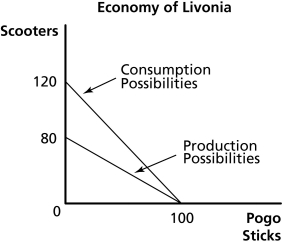 -Refer to Figure 18.3. In autarky, the maximum amount of scooters that Livonia can produce is
 (Multiple Choice)
4.9/5 (76)
(76) Recall the Application about the impact Chinese imports have on U.S. labor markets to answer the following question(s).
-This Application addresses the idea that
(Multiple Choice)
4.9/5 (83)
(83) Figure 18.1
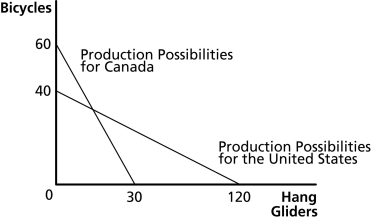 -Refer to Figure 18.1. The opportunity cost of bicycles in the United States is
 (Multiple Choice)
4.8/5 (83)
(83) 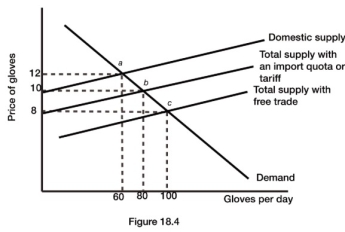 -Refer to Figure 18.4. With an import ban, how many gloves are produced domestically in Duckland?
 (Multiple Choice)
4.9/5 (81)
(81) A possible reason a nation might impose a protectionist policy such as a tariff is to
(Multiple Choice)
4.7/5 (88)
(88) In 1995, the United States threatened to impose 100 percent tariffs on ________ from ________ if it didn't loosen its protectionist policies.
(Multiple Choice)
4.9/5 (83)
(83) Table 18.1
Daily Output of Russia and Panama
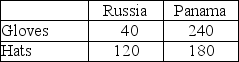 -Refer to Table 18.1. Russia has a comparative advantage in
 (Multiple Choice)
4.8/5 (75)
(75) Since 1973 in the United States, wages of skilled workers have
(Multiple Choice)
4.9/5 (84)
(84) Import bans, import quotas, voluntary export restraints, and tariffs on goods all
(Multiple Choice)
4.8/5 (74)
(74) Figure 18.2
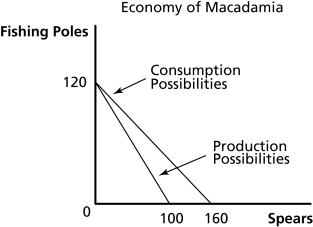 -Refer to Figure 18.2. In autarky, the maximum amount of spears that Macadamia can produce is
 (Multiple Choice)
4.9/5 (69)
(69) If the opportunity cost of 1 wristwatch is 4 wall clocks in Japan and 2 wall clocks in Germany, it makes sense for Japan to produce wristwatches.
(True/False)
4.8/5 (89)
(89) Figure 18.3
-Refer to Figure 18.3. The opportunity cost of producing pogo sticks in Livonia is
-Refer to Figure 18.3. The opportunity cost of producing pogo sticks in Livonia is (Multiple Choice)
4.9/5 (86)
(86) Figure 18.3
-Refer to Figure 18.3. The opportunity cost of producing scooters in Livonia is
-Refer to Figure 18.3. The opportunity cost of producing scooters in Livonia is (Multiple Choice)
4.8/5 (93)
(93) Figure 18.1
-Refer to Figure 18.1. After trade begins, ________ will specialize in the production of bicycles and ________ will specialize in the production of hang gliders.
-Refer to Figure 18.1. After trade begins, ________ will specialize in the production of bicycles and ________ will specialize in the production of hang gliders. (Multiple Choice)
4.8/5 (78)
(78) Recall the Application about the method used by the Commerce Department to determine if imported products are being sold at lower prices in the United States than in their countries of origin to answer the following question(s).
-According to this Application, because of the method used to determine if foreign companies are selling products at lower prices in the United States than in their own domestic markets, the Commerce Department
(Multiple Choice)
4.8/5 (79)
(79) A consumption possibilities curve shows the combinations of two goods that can be consumed when a nation specializes in producing a particular good and trades with another nation.
(True/False)
4.8/5 (74)
(74) In the last few decades there has been little progress in lowering the barriers to international trade.
(True/False)
4.7/5 (77)
(77) 
Filters
- Essay(0)
- Multiple Choice(0)
- Short Answer(0)
- True False(0)
- Matching(0)