



 Chat with AI
Exam 17: Corporations: Introduction and Operating Rules

Exam 1: Understanding and Working With the Federal Tax Law208 Questions
Exam 2: Working With the Tax Law102 Questions
Exam 3: Computing the Tax166 Questions
Exam 4: Gross Income: Concepts and Inclusions122 Questions
Exam 5: Gross Income: Exclusions111 Questions
Exam 6: Deductions and Losses: in General148 Questions
Exam 7: Deductions and Losses: Certain Business Expenses and Losses116 Questions
Exam 8: Depreciation, Cost Recovery, Amortization, and Depletion113 Questions
Exam 9: Deductions: Employee and Self-Employed-Related Expenses126 Questions
Exam 10: Deductions and Losses: Certain Itemized Deductions103 Questions
Exam 11: Investor Losses130 Questions
Exam 12: Tax Credits and Payments103 Questions
Exam 13: Property Transactions: Determination of Gain or Loss, Basis Considerations, and Nontaxable Exchanges250 Questions
Exam 14: Property Transactions: Capital Gains and Losses, Section 1231, and Recapture Provisions156 Questions
Exam 15: Taxing Business Income65 Questions
Exam 16: Accounting Periods and Methods86 Questions
Exam 17: Corporations: Introduction and Operating Rules137 Questions
Exam 18: Corporations: Organization and Capital Structure107 Questions
Exam 19: Corporations: Distributions Not in Complete Liquidation183 Questions
Exam 20: Corporations: Distributions in Complete Liquidation and an Overview of Reorganizations67 Questions
Exam 21: Partnerships231 Questions
Exam 22: S Corporations121 Questions
Exam 23: Exempt Entities129 Questions
Exam 24: Multistate Corporate Taxation184 Questions
Exam 25: Taxation of International Transactions128 Questions
Exam 26: Tax Practice and Ethics174 Questions
Exam 27: The Federal Gift and Estate Taxes145 Questions
Exam 28: Income Taxation of Trusts and Estates154 Questions
Select questions type


Permanent differences include items that appear in the Federal income tax return as income or deduction and in the
GAAP financial statements as revenue or expense but in different reporting periods.
(True/False)
5.0/5  (75)
(75) For tax years beginning before 2018, the corporate marginal income tax rates ranged from 15% to 39%.
(True/False)
4.8/5 (72)
(72) Orange Corporation, a calendar year C corporation, owns stock in White Corporation and has net operating income of $400,000 for the current year. White Corporation pays Orange a dividend of $60,000. What amount of dividends received deduction may Orange claim if it owns 45% of White stock (assuming Orange's dividends received deduction is not limited by its taxable income)?
(Multiple Choice)
4.7/5 (71)
(71) Which of the following statements is incorrect regarding the dividends received deduction?
(Multiple Choice)
4.8/5 (74)
(74) Schedule M-1 of Form 1120 is used to reconcile financial net income with taxable income reported on the corporation's income tax return as follows: net income per books + additions - subtractions = taxable income. Which of the following items is a subtraction on Schedule M-1?
(Multiple Choice)
4.9/5 (77)
(77) Create, Inc., a domestic corporation, owns 100% of Vinyl, Ltd., a foreign corporation and Digital, Inc., a domestic corporation. Create also owns 12% of Record, Inc., a domestic corporation. Create receives no distributions from any of these corporations. Which of these entities' net income is included in Create's income statement for current- year financial reporting purposes?
(Multiple Choice)
4.7/5 (73)
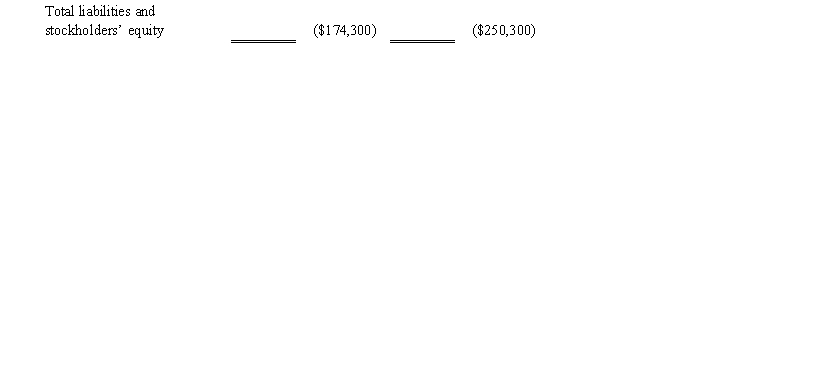
(73) Black, Inc., is a domestic corporation with the following balance sheet for book and tax purposes at the end of the year. Assume a 21% corporate tax rate and no valuation allowance. Tax Debit/(Credit) Book Debit/(Credit) Assets Cash \3 00 \3 00 Accounts receivable 5,000 5,000 Buildings 300,000 300,000 Accumulated depreciation (150,000) (80,000) Furniture \& fixtures 40,000 40,000 Accumulated depreciation (21,000) (15,000) Total assets \ 174,300 \ 250,300 Liabilities Accrued litigation expense \- 0- (\ 27,000) Note payable (116,000) Total liabilities Stockholders' Equity Paid-in canital (\ 1000) (\ 1000) Retained earnings (57,300) (106,300)
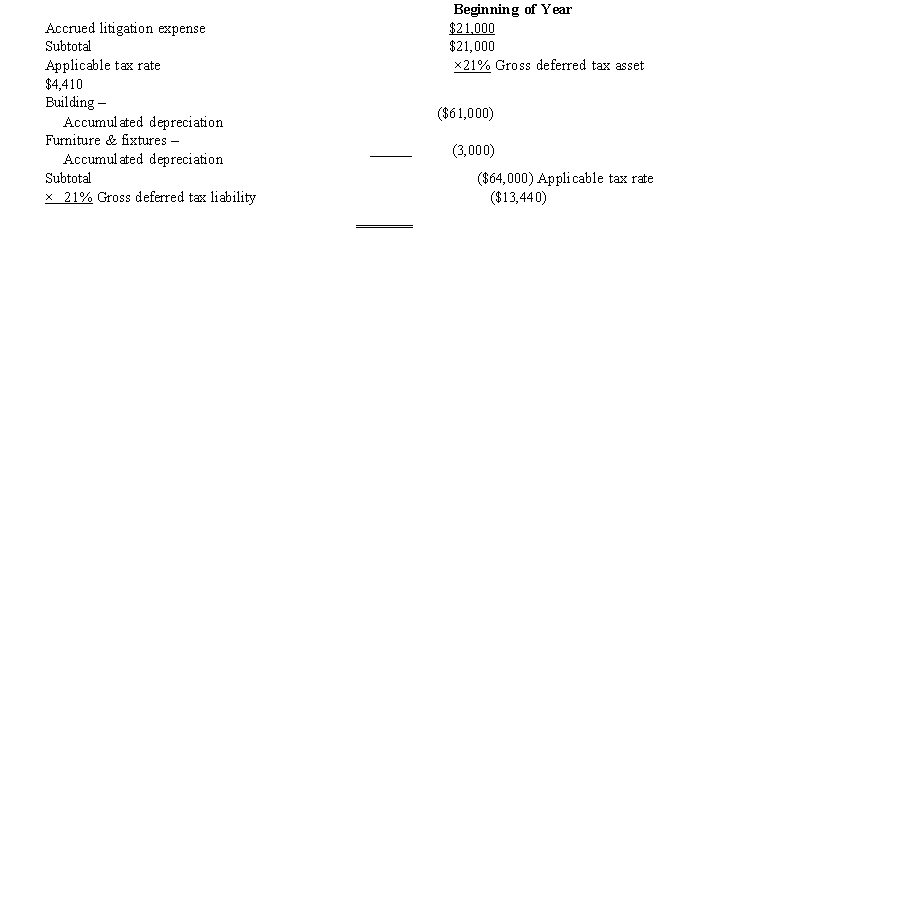
 Black, Inc.'s, gross deferred tax assets and liabilities at the beginning of Black's year are as follows:
 Black, Inc.'s, book income before tax is $6,000. Black records two permanent book-tax differences.
It earned $250 in tax-exempt municipal bond interest and incurred $500 in nondeductible business meals expense. Provide the income tax footnote rate reconciliation for Black, using either
dollars or percentages.
Black, Inc.'s, gross deferred tax assets and liabilities at the beginning of Black's year are as follows: Black, Inc.'s, book income before tax is $6,000. Black records two permanent book-tax differences.
It earned $250 in tax-exempt municipal bond interest and incurred $500 in nondeductible business meals expense. Provide the income tax footnote rate reconciliation for Black, using either
dollars or percentages. (Essay)
4.9/5 (79)
(79) Income that is included in net income per books but not included in taxable income is a subtraction item on Schedule
M-1.
(True/False)
4.7/5 (90)
(90) Schedule M-3 is similar to Schedule M-1 in that the form is designed to reconcile net income per books with taxable income. However, an objective of Schedule M-3 is more transparency between financial statements and tax returns than that provided by Schedule M-1.
(True/False)
4.9/5 (75)
(75) Schedule M-2 is used to reconcile unappropriated retained earnings at the beginning of the year with unappropriated retained earnings at the end of the year.
(True/False)
4.8/5 (81)
(81) In the current year, Red Corporation (a calendar year C corporation), which owns stock in Blue Corporation, had net operating income of $200,000 for the year. Blue pays Red a dividend of $40,000. Red takes a dividends received deduction of $20,000. Which of the following statements is correct?
(Multiple Choice)
4.9/5 (75)
(75) On December 20, 2019, the directors of Quail Corporation (an accrual basis, calendar year C corporation) authorized a cash donation of $5,000 to the American Cancer Society, a qualified charity. The payment, which is made on April
6, 2020, may be claimed as a deduction for tax year 2019.
(True/False)
5.0/5 (71)
(71) Saleh, an accountant, is the sole shareholder of Turquoise Corporation, a C corporation. Turquoise is a personal service corporation with a fiscal year ending September 30 (pursuant to a § 444 election). The corporation paid Saleh a salary of $330,000 during its fiscal year ending September 30, 2019. How much salary must Turquoise pay Saleh during the period October 1 through December 31, 2019, if the corporation is to continue to use its fiscal year without negative tax effects?
(Multiple Choice)
4.8/5 (77)
(77) A deferred tax liability represents a current tax liability associated with income or expense to be reported in future year GAAP financial statements.
(True/False)
4.8/5 (78)
(78) Albatross, a C corporation, had $140,000 net income from operations and a $25,000 short-term capital loss in the current year. Albatross Corporation's taxable income is $140,000.
(True/False)
5.0/5 (71)
(71) Because of the taxable income limitation, no dividends received deduction is allowed if a corporation has an NOL for the current taxable year.
(True/False)
4.8/5 (73)
(73) Purple, Inc., a domestic corporation, owns 80% of Blue, Ltd., a foreign corporation and Yellow, Inc., a domestic corporation. Purple also owns 50% of Green, Inc., a domestic corporation. Purple receives no distributions from any of these corporations. Which of these entities' net income is included in Purple's Federal income tax return for the current year, assuming that Purple elects to include all eligible entities in its consolidated Federal income tax return?
(Multiple Choice)
4.9/5 (65)
(65) The current tax expense reported on the GAAP financial statements generally represents the taxes actually payable to domestic or foreign governmental authorities.
(True/False)
4.9/5 (84)
(84) Rodney, the sole shareholder of Orange Corporation, an accrual method, calendar year corporation, loaned the corporation a substantial amount of money on January 1, 2019. Orange Corporation accrued $45,000 of interest expense on the loan on December 31, 2019. Orange pays the interest to Rodney, a cash basis taxpayer, on January 1, 2020. Based on these facts:
(Multiple Choice)
4.9/5 (72)
(72) During the current year, Coyote Corporation (a calendar year C corporation) has the following transactions: Income from operations \ 260,000 Expenses from operations 305,000 Dividends received from Roadrunner Corporation 115,000
a. Coyote owns 5% of Roadrunner Corporation's stock. How much is Coyote Corporation's taxable income (loss) for the year?
b. Would your answer change if Coyote owned 25% of Roadrunner Corporation's stock?
(Essay)
4.9/5 (67)
(67) 
Filters
- Essay(0)
- Multiple Choice(0)
- Short Answer(0)
- True False(0)
- Matching(0)