



 Chat with AI
Exam 19: Solid-State Switching Circuits

Exam 1: Fundamental Solid-State Principles35 Questions
Exam 2: Diodes32 Questions
Exam 3: Common Diode Applications: Basic Power Supply Circuits30 Questions
Exam 4: Common Diode Applications: Clippers, Clampers, Voltage Multipliers, and Displays33 Questions
Exam 5: Special Applications Diodes30 Questions
Exam 6: Bipolar Junction Transistors32 Questions
Exam 7: DC Biasing Circuits30 Questions
Exam 8: Introduction to Amplifiers30 Questions
Exam 9: Common-Emitter Amplifiers31 Questions
Exam 10: Other BJT Amplifiers29 Questions
Exam 11: Power Amplifiers31 Questions
Exam 12: Field-Effect Transistors32 Questions
Exam 13: Mosfets33 Questions
Exam 14: Amplifier Frequency Response32 Questions
Exam 15: Operational Amplifiers32 Questions
Exam 16: Additional Op-Amp Applications27 Questions
Exam 17: Tuned Amplifiers34 Questions
Exam 18: Oscillators31 Questions
Exam 19: Solid-State Switching Circuits34 Questions
Exam 20: Thyristors and Optoelectronics Devices30 Questions
Exam 21: Discrete and Integrated Voltage Regulators25 Questions
Select questions type


In most practical BJT buffers, the value of Vin that is used to drive the transistor into cutoff is approximately equal to
(Multiple Choice)
4.9/5  (77)
(77) The time required for IC to increase from 10% of its maximum value to 90% of its maximum value is called
(Multiple Choice)
4.9/5 (70)
(70) 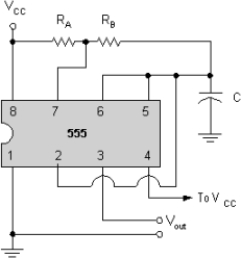 -The circuit in Figure has the following values: RA=RB=10 kΩ and C=0.01 μF. What is the operating frequency of the circuit?
 (Multiple Choice)
5.0/5 (83)
(83) A BJT has the following values: td = 20 nS, tr = 20 nS, ts = 150 nS, and tf = 60 nS. What is a practical limit on the operating frequency of the device in any switching application?
(Multiple Choice)
4.8/5 (72)
(72) A BJT has the following values: td = 20 nS, tr = 20 nS, ts = 150 nS, and tf = 60 nS. What is the upper cutoff frequency for the device in any switching application?
(Multiple Choice)
4.8/5 (85)
(85) 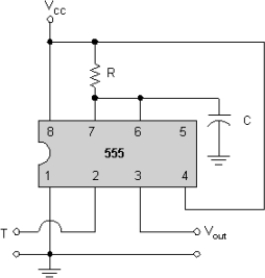 -A 555 timer is connected as shown in Figure If the cap on pin #6 is being held at 0 V by pin 7, pin #2 must go below for the output from the timer to go high.
 (Multiple Choice)
4.8/5 (88)
(88)
-Which of the following switching circuits would have the lowest power dissipation?
-Which of the following switching circuits would have the lowest power dissipation? (Multiple Choice)
4.8/5 (100)
(100) 
Filters
- Essay(0)
- Multiple Choice(0)
- Short Answer(0)
- True False(0)
- Matching(0)