



 Chat with AI
Exam 3: Common Diode Applications: Basic Power Supply Circuits

Exam 1: Fundamental Solid-State Principles35 Questions
Exam 2: Diodes32 Questions
Exam 3: Common Diode Applications: Basic Power Supply Circuits30 Questions
Exam 4: Common Diode Applications: Clippers, Clampers, Voltage Multipliers, and Displays33 Questions
Exam 5: Special Applications Diodes30 Questions
Exam 6: Bipolar Junction Transistors32 Questions
Exam 7: DC Biasing Circuits30 Questions
Exam 8: Introduction to Amplifiers30 Questions
Exam 9: Common-Emitter Amplifiers31 Questions
Exam 10: Other BJT Amplifiers29 Questions
Exam 11: Power Amplifiers31 Questions
Exam 12: Field-Effect Transistors32 Questions
Exam 13: Mosfets33 Questions
Exam 14: Amplifier Frequency Response32 Questions
Exam 15: Operational Amplifiers32 Questions
Exam 16: Additional Op-Amp Applications27 Questions
Exam 17: Tuned Amplifiers34 Questions
Exam 18: Oscillators31 Questions
Exam 19: Solid-State Switching Circuits34 Questions
Exam 20: Thyristors and Optoelectronics Devices30 Questions
Exam 21: Discrete and Integrated Voltage Regulators25 Questions
Select questions type


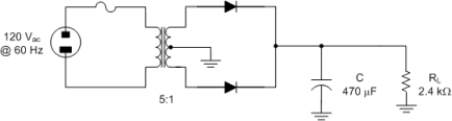 -What is the ripple voltage across the load?
Free
(Multiple Choice)
4.8/5  (97)
(97) Correct Answer: Verified
C
When troubleshooting a rectifier, it is important to check every diode in the rectifier.

Free
(True/False)
4.9/5 (80)
(80) Correct Answer:Verified
VerifiedTrue
. For the transformer shown, which current and voltage have the greatest values?
. For the transformer shown, which current and voltage have the greatest values?Free
(Multiple Choice)
4.8/5 (85)
(85) Correct Answer:Verified
VerifiedC
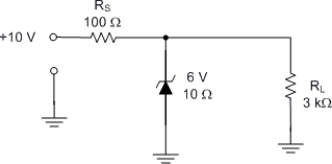 -What is the value of IZ for the circuit?
A positive full-wave rectifier has a secondary voltage of 20 Vpk. The peak load voltage for the circuit is
(Multiple Choice)
4.9/5 (71)
(71) 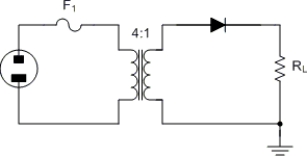 -A transformer with a 10:1 turns ratio has a 120 Vac line input. The transformer secondary is connected to a half-wave rectifier circuit using a capacitor filter. Ignoring any ripple, what is the dc output voltage from the circuit?
 (Multiple Choice)
4.9/5 (77)
(77)  -Identify the power supply circuits represented in Figure .
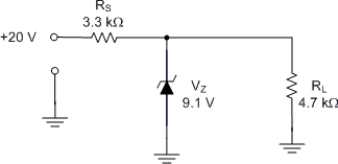 -When testing a basic power supply, you see that the primary fuse is blown. This typically indicates that
 (Multiple Choice)
4.7/5 (75)
(75) A full-wave rectifier has a 9.3 Vpk output and a 4.7 kΩ load resistance. What is the dc load current for the circuit?
(Multiple Choice)
4.8/5 (91)
(91) A negative half-wave rectifier eliminates the alternations of the transformer output.
(Multiple Choice)
4.9/5 (84)
(84) Why is the bridge rectifier used more commonly than the full-wave rectifier?
(Multiple Choice)
4.9/5 (87)
(87) In the schematic for a half-wave rectifier , the diode points toward the ungrounded side of the load. The output from the rectifier is
(Multiple Choice)
4.9/5 (81)
(81) A 22 μF filter capacitor is connected to a half-wave rectifier. If the value of the capacitor is increased to 100 μF, the ripple in the circuit output will
(Multiple Choice)
4.9/5 (95)
(95) A bridge rectifier has values of V1 = 120 Vac, turns ratio = 5:1, and RL = 500 Ω. What is the dc output voltage?
(Multiple Choice)
4.9/5 (86)
(86) A half-wave rectifier is connected to a transformer with a secondary voltage of 20 Vpk. The average output voltage is
(Multiple Choice)
4.9/5 (76)
(76) A filtered half-wave rectifier has a peak secondary voltage of 20 Vpk. The PIV rating for any diode in the circuit must be at least
(Multiple Choice)
4.8/5 (78)
(78) 
Filters
- Essay(0)
- Multiple Choice(0)
- Short Answer(0)
- True False(0)
- Matching(0)